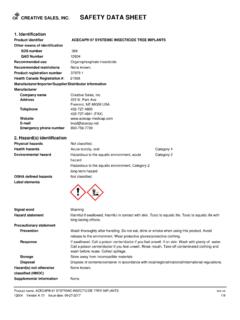
Transcription of SYSTEMIC INSECTICIDE IMPLANTS - acecap-medicap.com
1 acecap 97 SYSTEMIC INSECTICIDE IMPLANTS Material Safety Data SheetCONTAINS TECHNICAL ACEPHATEPage 1 of 8 Please read the entire document. This Material Safety Data Sheet contains importantenvironmental, health, and toxicology information for your employees, and anyone who will use,transport, store, dispose of or handle this product. Please make sure this information is given to also contains information to help you meet community right-to-know/emergency response reportingrequirements under SARA Title III and many other laws. If you resell this product, this MSDS must begiven to the buyer or the information contained herein must be incorporated in your MSDS. Changeshave been made throughout this Material Safety Data 1: CHEMICAL PRODUCT AND COMPANY IDENTIFICATIONPRODUCT NAME: acecap 97 SYSTEMIC INSECTICIDE ImplantsPRODUCT NUMBER(S):NAEPA REGISTRATION NUMBER:37979-1 HEALTH CANADA REG.
2 NO.:21568 SECTION 2: COMPOSITION/INFORMATION ON INGREDIENTSPRODUCT NAME/CAS#EXPOSURE LIMITSCONC(%)ORTHENE Technical / No Data Available NA Not ApplicableMSDS Number: 0007 Revision Number: 2 Revision Date: 06/15/2004 MANUFACTURERC reative Sales, Box 501222 No. Park AvenueFremont, 68025-0501 EMERGENCY TELEPHONE NUMBERSHEALTH EMERGENCY OR SPILL(800) 759-7739(402) 727-4800 PRODUCT INFORMATION: (402) 727-4800 acecap 97 SYSTEMIC INSECTICIDE ImplantsPage 2 of 8 CONTAININGINGREDIENT NAME/CAS #EXPOSURE LIMITSCONC(%)ACEPHATE: O,S-DIMETHYL > CAS305601911mg/m3 Chevron TLVMANUFACTURING IMPURITIESNA< of these manufacturing impurities are present at less than 1% and are not known humancarcinogens, or are not known to be Threshold Limit ValueTWA- Time Weighted AverageSTEL- Short-term Exposure LimitCAS- Chemical Abstract Service NumberSECTION 3: HAZARDS IDENTIFICATIONPOTENTIAL HEALTH EFFECTSA cute ToxicityEye:This substance is not expected to cause prolonged or significant eye.
3 This substance is not expected to cause prolonged or significant skin absorbed through the skin, this substance is considered practically non-toxic to : This substance is slightly toxic to internal organs if swallowed. The degree ofinjury will depend on the amount absorbed from the gut. Signs and symptoms which maybe seen usually within 12 hours following overexposure, may include, but not be limited to,headache, dizziness, weakness, constriction of the pupil of the eye, blurred or dark vision,excessive salivation or nasal discharge, profuse sweating, abdominal cramps, nausea,and vomiting. Incontinence, unconsciousness, and convulsions indicate severe untreated severe poisoning, respiratory depression or cardia arrest may be : If inhaled, this substance is considered practically non-toxic to internal substance may be irritating if inhaled.
4 Signs and symptoms of respiratory tractEMERGENCY TELEPHONE #: (800) 759-7739 NDA No Data Available NA Not ApplicableMSDS Number: 0007 Revision Number: 2 Revision Date: 06/15/2004 EMERGENCY OVERVIEWCAUTION:- HARMFUL IF SWALLOWED- AVOID CONTACT WITH EYES, SKIN, OR CLOTHING- AVOID BREATHING DUST OR SPRAY MIST- AVOID BREATHING VAPOR- KEEP OUT OF REACH OF CHILDRENACECAP 97 SYSTEMIC INSECTICIDE ImplantsPage 3 of 8irritations may include, but may not be limited to, one or more of the following: nasaldischarge, sore throat, coughing, bronchitis, pulmonary edema and difficulting Toxicity (Including Cancer): High doses of Acephate have produced cancer in mice butthere is no evidence that Acephate causes cancer in (Birth Defects) Information: There is no evidence that Acephate causes birth Information: There is no evidence that Acephate causes reproductive effects complete discussion of the toxicology data from which this evaluation was made, refer to 4: FIRST AID MEASURESEMERGENCY NUMBER (800) 892-0099 EYES: Flush eyes immediately with fresh water for at least 15 minutes while holding the eyelids contact lenses if worn.
5 No additional first aid should be necessary. However, if irritationpersists, see a : If on skin, remove contaminated clothing, wash skin with plenty of soap and water. Washcontaminated clothing before : If swallowed, drink 1 or 2 glasses of water (or milk) and induce vomiting by touching theback of the throat with finger. If possible, contact a physician, Poison Control Center, or emergencycenter before inducing vomiting. Do not induce vomiting or give anything by mouth to an unconsciousperson. Take person and product container to the nearest emergency treatment : If inhaled: Move victim to fresh air. If not breathing, give artificial respiration, preferablymouth to mouth. Get medical TO PHYSICIAN: This material contains a cholinesterase inhibitor. Measurement of bloodcholinesterase activity may be useful in monitoring exposure but decisions regarding treatment willusually need to be made before test results are available.
6 If signs of cholinesterase inhibition appear,atropine sulfate is antidotal. 2-PAM (PROTOPAM) is also antidotal and may be used in conjunctionwith atropine but should not be used 5: FIRE FIGHTING MEASURESFLASH POINT:NAMETHOD: NAAUTOIGNITION:NDAEXTINGUISHING MEDIA: CO2, dry chemical, foam, water LIMITS (% by volume in air): Lower: NDAU pper: NDANFPA RATINGS: Health 1; Flammability 1; Reactivity NDA; Special NDA(Least-0, Slight-1, Moderate-2, High-3, Extreme-4). These values are obtained using the guidelines orpublished evaluations prepared by the National Fire Protection Association, NFPAEMERGENCY TELEPHONE #: (800) 759-7739 NDA No Data Available NA Not ApplicableMSDS Number: 0007 Revision Number: 2 Revision Date: 06/15/2004 acecap 97 SYSTEMIC INSECTICIDE ImplantsPage 4 of 8 FIRE FIGHTING INSTRUCTIONS: Products of combustion from fires involving this material may betoxic.
7 Avoid breathing smoke and mists. Avoid personnel and equipment contact with fallout and the amount of water used for fire fighting. Do not enter any enclosed area without fullprotective equipment, including self-contained breathing equipment. Contain and isolate runoff anddebris for proper disposal. Decontaminate personal protective equipment and fire fighting equipmentbefore reuse. Read the entire COMBUSTION PRODUCTS: Normal combustion forms carbon dioxide, water vaporand may product oxides of sulfur, nitrogen and phosphorous. Incomplete combustion can producecarbon monoxide. SECTION 6: ACCIDENTAL RELEASE MEASURESSPILL OR LEAK PRECAUTIONS: Do not discharge into lakes, streams, ponds or public waters unlessin accordance with an NPDES permit. Do not apply directly to water or wetlands. Do not contaminatewater by cleaning of equipment or disposal of up spills immediately, observing precautions in Personal Protection Section 8.
8 Vacuum withmachines equipped with high efficiency filters or sweep up material and place in a disposablecontainer. Scrub contaminated area with detergent and water using a stiff broom. Pick up liquid with OilDry, cat litter, clay, rags or other absorbent and place in a disposable METHODS: Refer to Section 13, Disposal 7: HANDLING AND STORAGEREAD AND OBSERVE ALL PRECAUTIONS ON PRODUCT pesticide in original in a cool, dry place. Protect from excessive not contaminate food or not store or transport near feed or 8: EXPOSURE CONTROLS; PERSONAL PROTECTIONEYE PROTECTION:User:Do not get this material in your eyes. Eye contact can be avoided by wearing chemicalgogglesEmergencyResponder: NDARESPIRATORY/VENTILATION REQUIREMENTS:User:No special respiratory protection is normally required.
9 However, if operating conditionscreate airborne concentrations which exceed the recommended exposure standards, theuse of an approved respirator is adequate ventilation to keep the airborne concentrations of this material below therecommended exposure :NDAEMERGENCY TELEPHONE #: (800) 759-7739 NDA No Data Available NA Not ApplicableMSDS Number: 0007 Revision Number: 2 Revision Date: 06/15/2004 acecap 97 SYSTEMIC INSECTICIDE ImplantsPage 5 of 8 SKIN PROTECTION:User:No special skin protection is usually necessary. Avoid prolonged or frequently repeatedskin contact with this material. Skin contact can be minimized by wearing :NDAEXPOSURE LIMITS: See Section 9: PHYSICAL AND CHEMICAL PROPERTIESAPPEARANCE:White powder with a strong cabbage-like C (Decomposes)BOILING POINT:NADENSITY/BULK DENSITY/SPECIFIC :Soluble in water; moderately soluble in alcohol andacetone; slight-moderate solubility in aromatic 6 mm Hg @ 24 CDISSOCIATION CONSTANT:NDAOCTANOL/WATER PARTITIONCOEFFICIENT:NDApH:NDAVISCOSITY: NDAMISCIBILITY:NDACORROSION CHARACTERISTICS:NDASECTION 10: STABILITY AND REACTIVITYCHEMICAL STABILITY: Stable at temperatures below 122 F (50 C).
10 INCOMPATIBILITY: Avoid contact with alkaline DECOMPOSITION PRODUCTS: Contact with alkaline materials including hypochloriteoxidants, may product noxious POLYMERIZATION: Polymerization will not EXPLODABILITY: NDAOXIDATION/REDUCTION PROPERTIES: NDASECTION 11: TOXICOLOGY INFORMATIONACUTE (Product Specific Information)Eye Irritation: Minimal effects clearing within 24 Irritation: No irritation was present 72 hours after Toxicity: The dermal LD50 in rabbits is > 10 TELEPHONE #: (800) 759-7739 NDA No Data Available NA Not ApplicableMSDS Number: 0007 Revision Number: 2 Revision Date: 06/15/2004 acecap 97 SYSTEMIC INSECTICIDE ImplantsPage 6 of 8 Oral Toxicity: The oral LD50 in male rates is 1447 mg/kg. The oral LD50 in female rates is 1030mg/kgInhalation Toxicity: The 4-hour LC50 in rates is > Sensitization: Acephate did not induce a positive skin sensitization reaction in the guineapig using the Modified Buehler or the Maximization : The most significant treatment related effect of Acephate is a decrease incholinesterase activity of plasma, RBC, and : When mice were fed diets containing Acephate throughout theirentire lifetime, a compound-related increase in liver weight, together with liver carcinome (a commonlyoccurring cancer in mice) occurred in high-dose females.