Transcription of Emerald Ash Borer: Insecticide Options for Protecting Ash ...
1 Emerald Ash Borer: Insecticide Options for Protecting Ash Trees and Their Effectiveness R. Chris Williamson, Associate Professor, Department of Entomology, University of Wisconsin-Madison Now that the Emerald ash borer (EAB) has been officially confirmed in Wisconsin, many questions have been asked by homeowners and Green industry professionals regarding the capability and need of insecticides for Protecting ash trees from EAB. There has been much confusion surrounding the question of whether insecticides are an effective management option for EAB. Research and experience has shown that insecticides can protect ash trees from being killed by EAB.
2 However, success in not guaranteed! In some university trials, Insecticide treatments were effective, but in other trials the same treatments failed. Some studies conducted over multiple years revealed that EAB infestations continued to increase despite ongoing treatment programs. Insecticides are not effective in eradicating EAB infestations, which is why they have not been used as an eradication tool by the Cooperative EAB program in other states. Research suggests that best control can be achieved when Insecticide treatments are started in the earliest stages of infestation before visible symptoms are present or possibly the year before trees are infested.
3 It is important to understand that Insecticide treatments must be repeated each year. Consequently, it may be more cost-effective to remove and replace the ash tree with an alternative tree to increase species diversity. There are several Insecticide Options available for those people who want to treat their trees. It is important to understand that controlling wood-boring insects with insecticides has always been a difficult proposition. This is especially true with EAB because our native North American ash trees have no known natural resistance to this pest. Insecticide research programs are showing promise, but research on chemical control of EAB is still in early stages.
4 Scientists from universities, government agencies, and companies are conducting intensive studies to understand the circumstances under which Insecticide treatments will be most effective. Insecticide Options for Controlling EAB Insecticides used for control of EAB fall into three categories: 1) systemic insecticides that are applied as soil injections or drenches; 2) systemic insecticides applied as trunk injections or trunk implants ; and 3) protective cover sprays that are applied to the trunk, main branches, and (depending on the label) foliage. Insecticide formulations and application methods that have been evaluated for control of EAB are listed in Table 1.
5 Some products can be purchased and applied by homeowners while other can only be applied by professional applicators. Strategies for their effective use are described below. It is important to note that pesticide labels and registrations may change. It is the pesticide applicator s legal responsibility to read, clearly understand, and follow all current label directions for the specific pesticide product being used. Table 1. Insecticide Options for professionals and homeowners for control of EAB. Insecticide FORMULATION ACTIVE INGREDIENT APPLICATION METHOD TIMING Professional Use Products Merit (75WP, 75 WSP, 2F)
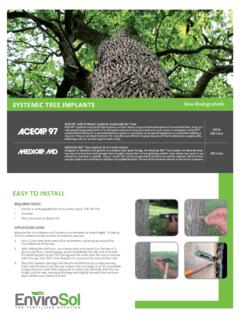
6 Imidacloprid Soil injection or drench Mid-April to mid-May IMA-jet Imidaclorprid Trunk injection, Arborjet Mid-May to mid-June Imicide Imidacloprid Trunk injection, Mauget Mid-May to mid-June Pointer Imidacloprid Trunk injection, Wedgle Mid-May to mid-June Inject-A-Cide B Bidrin Trunk injection, Mauget Mid-May to mid-June Safari + PentraBark Dinotefuran Trunk Spray Late-April to late-May Astro Permethrin Onyx Bifenthrin Sevin SL Carbaryl Tempo Cyfluthrin Preventative Bark and Foliage Cover Sprays 2 applications at 4 week intervals with the first application when black locust is blooming Homeowner Products Bayer Advanced Tree & Shrub Insect Control Imidacloprid Soil drench Mid-April to mid-May acecap 97 systemic Insecticide Tree implants Acephate Trunk implant Mid-May to mid-June Bonide Bullets Acephate Trunk implant Mid-May to mid-June Using Insecticides to Control EAB Soil-Injection/Drench systemic
7 Insecticides systemic insecticides applied to the soil are taken up by the roots and translocated (moved) throughout the tree. The most widely tested systemic Insecticide for control of EAB is imidacloprid. It is available for use by homeowners and professional applicators. The homeowner formulation of imidacloprid is Bayer Advanced Tree & Shrub Insect control. Professional use formulations of soil-applied imidacloprid include Merit 75WP, Merit 75 WSP, and Merit 2F. Additional formulations of imidacloprid with different brand names are also becoming available. All imidacloprid formulations can be applied as a drench by mixing it with water and pouring it directly on the soil at the base of the trunk.
8 The application rates for both the homeowner and professional formulations of imidacloprid are quite similar ( and grams of active ingredient per inch of trunk diameter, respectively). Soil drenches offer the advantage of requiring no special equipment to apply (other than a bucket or watering can). However, surface layers of organic matter, such as mulch or leaf litter, can bind the Insecticide and reduce uptake. Prior to applying soil drenches, it is important to remove or pull back any mulch or dead leaves so the Insecticide solution in poured directly on mineral soil. Imidacloprid formulations can also be applied as soil injections, which require special equipment, but offer the advantage of placing the Insecticide directly into the root zone.
9 Soil injections should be made only deep enough (2-3 inches) to place the Insecticide under the turf or mulch layer. Soil injections can be made either at the base of the trunk or on a grid pattern extending to the edge of the tree canopy. Recent research studies have revealed that soil injections made immediately adjacent to the trunk (within 6-18 inches) are more effective than those made on a grid pattern under the tree canopy. Density of fine root hairs is very high at the base of the trunk and declines quickly as you move away from the tree. This pattern of root distribution can be clearly observed on trees that have been recently uprooted in a storm or when taking soil cores under the tree canopy.
10 Optimal timing for imidacloprid soil drenches or injections is mid-April to mid-May (treat on the early side in southern Wisconsin and on the later side in northern Wisconsin), which allows the 4-6 weeks necessary for uptake and distribution of the Insecticide before EAB larvae begin to establish in mid- to late June. EAB larvae damage the vascular system ( tree plumbing) as they feed, which interferes with the translocation of systemic insecticides. Soil drench or injections are aimed primarily at preventative treatment applications, however; in some cases, this approach may provide corrective control of low populations of EAB infested ash trees.