Transcription of Talk, Read and Sing Together Every Day! - Home | U.S ...
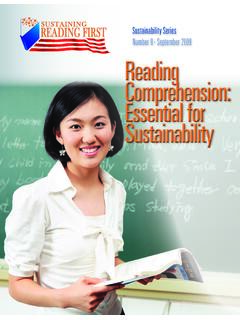
1 Talk, read and Sing Together Every Day!Tips For Preschool Teachers & Other Early Childhood Education Program ProvidersA language rich environment is one in which children are surrounded by talking , singing, and reading and have many opportunities throughout their day, across all activities, to communicate with others and engage in back-and-forth conversations. A rich language environment is important to children s early learning, and can have strong effects on early language, vocabulary, reading, and math skills, as well as on children s social-emotional development.
2 Research shows that some young children are exposed to more language in their homes, early learning programs, and school settings, than other children . This difference in the number of words and back-and-forth conversations to which children are exposed is called the word gap . Below are some tips that you can use to help bridge the word gap by enriching the language environment of all young children in your care, including children who do not speak yet, children with disabilities or delays, and children who are learning more than one language.
3 Partner with families and encourage them to try these strategies at home, in their home language. For children with disabilities or delays, communicate with their other service providers and keep each other informed about the strategies you are using to enhance their language children IN CONVERSATIONST eachers and families play a critical role in developing language-rich learning environments. Try these strategies to engage all children in rich conversations in English or in their home language. Get down on the child s level. Tune in and listen to what the child says.
4 If the child does not speak yet, tune into what they are doing or pointing to and use these moments to talk with them. Take turns talking . If the child doesn t have language yet, that may mean you are talking and the child is communicating in nonverbal ways, such as through gestures, looks, smiles, babbles, and word approximations ( children s attempts at words). Talk about what the child is doing, what the child is looking at, or what the child is interested in. Ask questions that relate to the child s experiences or interests. Add words or questions to what the child says or does and model new language.
5 Give the child enough time to respond. For children who do not have language yet, this may be a nonverbal response, like a gesture or a look. Stay tuned in to the child s facial and body expressions to make sure they are engaged. FACILITATING THICK CONVERSATIONSC hildren benefit from thick conversations. Thick conversations are characterized by giving children many chances to speak and communicate, asking open-ended questions, encouraging them to think and imagine, and having many back-and-forth exchanges. Here are four key strategies to engage children in thick conversations in English or in their home language: 1.
6 Encourage back-and-forth exchanges. Tune into children s interests and experiences and talk about them. Take turns communicating. Show that you are interested in what they are doing and listening to what they say. Provide time for children to Extend children s language. Expand on children s words or their attempts at words by adding a little more. For example, if the child says ball , you can say the blue ball is bouncing! Add new vocabulary words to the ones children are already using when talking to them. Restate children s language using correct grammar.
7 3. Invite children to talk about what they are doing. Comment on what children are doing. Ask children questions about what they are doing, what they did before, and what they plan to do next. Encourage children to make comparisons and consider other Encourage higher-level thinking. Help children make connections between what is happening in the classroom and what is happening in their home or community. Explain your thinking process. Introduce new concepts or s one way to turn a thin : Do you want to play with the boat?
8 Child: : What color is it? Child: : Who will ride in the boat? Child: The a thick : Which toy do you like to play with the most?Child: The : Oh, the boat is your favorite. What will you do with the boat?Child: The man is going to ride on : Where is the man traveling?Child: Into the : The bubbles are dense. Watch out!Child: Help! The man is falling out!Adult: Oh no! Who will rescue the man?Child: I ll get the whale!Adult: The whale is the hero!Expand on children s words to scaffold language and give them more QUESTIONSA sking stimulating and developmentally appropriate questions can help boost the language environment.
9 Below are four strategies for extending conversations with questions. Ask children about what they are doing. What are you working on today? You are working very hard, tell me about your project. What are your plans for those materials?Ask children to provide explanations. Why do you think that happened? How can I help you solve this problem? How did you do that?Ask children to make predictions. What do you think will happen next? What else could we use this container for? What would you do if that were you?Ask children to connect learning to their own lives.
10 What does this remind you of? These blocks are blue what blue objects do you have in your home? The boy in the story loved his pet hamster. Do you have any pets? Tell me about them. For children with limited language, giving them a choice can help them respond more easily to questions. For example, did you use crayons or markers to draw that picture? Keep high expectations for all children and gradually increase the complexity of your questions as children progress in their development. EXPAND ON children S WORDSE xpanding on children s language, nonverbally, in English or in their home language, is a meaningful way to extend conversations with children .