Transcription of Gender equality in sport - eige.europa.eu
1 sport implies two di erent perspectives that are in-creasingly considered at EU level: professional sport and sport as a leisure activity. In both cases, sport represents a large and fast-growing sector of the economy and makes an important contribution to growth and jobs. sport encourages social interaction, which is impor-tant for both young and old, women and men, and promotes physical and mental health. It can also foster education, communication, negotiation skills and leadership, vital for women s the playing eldEquality between women and men is a fundamen-tal principle of the European Union. The European Commission expressed its commitment, in both the Women s Charter and the Strategy for equality between Women and Men 2010 2015, to address and eliminate the Gender gap in decision-making.
2 Following the EU Conference on Gender equality in sport in 2013, the proposal for Strategic Actions on Gender equality in sport 2014 2020 was ap-proved. Recognising that there is still a lot to do, the actions and recommendations contained in the proposal encourage sports governing bodies and non-governmental organisations to develop and implement national and international strate-gies for action on Gender equality in sport , support-ed by coherent and concrete measures at EU level. The Council conclusions on Gender equality in sport encourage sports organisations to increase Gender balance on executive boards and commit-tees, and in management and coaching. They also support the removal of non-legislative obstacles which prevent women from taking up such func-tions (20 May 2014).
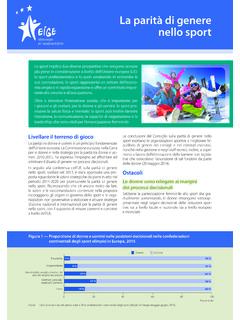
3 Hurdles Women side lined from decision-makingDespite the gradually increasing participation of women in sport , women remain underrepresented in the decision-making bodies of sporting institu-tions at local, national, European and global levels. Data from the report on women in power and decision-making, prepared by the European Insti-tute for Gender equality (EIGE) for the Luxembour- Gender equality in sportFigure 1 Proportion of women and men in decision-making positions in continental confederations of Olympic sports in Europe, 2015 Source: Data were collected from all 28 continental confederations of Olympic sports in Europe (May June 2015).Women MenPercentage 0 20 40 60 80 100 TotalPresident/ChairpersonVice-President /Vice-ChairpersonBoard members for the highest decision-making bodyGeneral Director/General Secretary4 %9 %15 %22 %14 %96 %91 %85 %78 %86 % gish Presidency of the Council of the EU, shows that at European level, on average, women make up 14 % of decision-making positions in the continental confederations of Olympic sports in Europe.
4 From the 28 confederations surveyed,there was only one woman president or chair-person and eight vice-presidents out of a total of 91. These fi gures refl ect trends found in other areas of decision-making, where the more senior the position, the wider the Gender gap. Across Member States, the representation of wom-en among the top decision-making positions in sports organisations remains very low. On aver-age in 2015, only 14 % of all positions were occu-pied by women, ranging from 3 % in Poland to 43 % in is considered a men s arenaSport is traditionally a male-dominated sector and progress in Gender equality in this area is hindered by the social constructions of femininity and mas-culinity, which often associate sport with mascu-line characteristics, such as physical strength and resilience, speed, and a highly competitive, some-times confrontational spirit.
5 Women who engage in sports may be perceived as masculine , while men who are not interested in sports could be consid-ered unmanly . Prevailing Gender stereotypes aff ect not only women s participation in decision-making within sporting organisations, but also their partici-pation in sporting activities. Traditional Gender roles may dictate how many hours women spend on caring responsibilities, which can have a ripple eff ect on how much time is left over for sporting activities. EIGE s Gender equality Index clearly shows that while women spend more time on caring activities, compared with men, they participate less in other social ac-tivities, such as sporting, cultural or leisure activities.
6 Men dominate the coaching professionCoaching is another area of sports where women are largely underrepresented. Based on fi gures in seven EU Member States, it is estimated that only 20 % to 30 % of all sports coaches in Europe are women1. Women coaches are more likely to be found in sports that have a high proportion of women participants ( dancing, gymnastics, fi gure skating and equestrian sports ) and they predominantly work with women, adolescents or children who compete at local and regional levels. There are also more men than women employed in sports , and data from EIGE s Gender Statistics Database shows that at European level, from 2012 to 2014, women s employment in sports actually decreased, whereas men s European Commission (2014), Gender equality in sport : Proposal for Strategic Actions 2014 2020, 2 Proportion of women among all decision-making positions in national sport federations in the EU-28, 2015PL CY SI CZ HR IT EL MT HU SK LT EE RO BE ES PT LV EU-28 AT DE IE LU DK BG UK FR FI NL SEGender balance zonePercentage of women10080604020014 %Source.
7 Data were collected from the 10 most popular national sport federations in each of the 28 Member States (280 in total), between May and June : The following positions are included: president/chairperson, vice-president/vice-chairperson, general director/general secretary and other board members. To avoid double counting, each person is counted only once, even if (s)he occupies several positions. Stereotypes in the media keep women o sideThe media can play a signifi cant role in either reinforcing or challenging Gender stereotypes in sports . In reality, Gender stereotyping of women and men athletes by the media is well document-ed and women athletes are often sexualised. They are frequently depicted in a way that contributes to the marginalisation of women s achievements in sport , due to the emphasis placed on femininity and sexual attraction instead of strength and skills.
8 There are also signifi cant diff erences in the media coverage given to women s and men s sports , with the latter receiving far more attention2. The absence of women in sports journalism is another challenge. At the 2012 London Olympics, only 15 % of the jour-nalists and photographers were women. The gen-der gap in sports journalism further extends into media organisations, where women hold less than a third of senior management is being done about it?Several international and continental federations in Europe, responsible for the promotion and development of sports , have already shown a commitment to Gender equality by introducing Gender 2015, nine of the 28 European confederations had a Gender quota for the highest decision-making body (executive committee, presidium or board of directors) and only one failed to meet this quota, had no women in top decision-making posts.
9 In four of the remaining 19 European con-federations without a Gender quota, women were absent from the highest decision-making , women s commissions or commit-tees are present in fi ve organisations: European Boxing Confederation (EUBC) European Taekwondo Union (ETU) European Union of Gymnastics (UEG) FIBA Europe Union of European Football Associations (UEFA)At the national level, voluntary targets for Gender balance in the governance structures of sports federations have been proposed or are already introduced in fi ve Member States (DE, FR, FI, SE, UK (England)).However, further measures are required if gen-der equality in sports and decision-making is to be Ibid, p. Data from the presentation by Anthony Edgar, IOC head of media operations, The Olympic Games: Meeting New Global Challenges , Oxford University Club, Oxford, The Future of Reporting at the Olympic Games , 13 14 August quotas in European sports confederations, 2015 Gender quota for the highest decision-making bodyAt least one woman & one manGender quota for councils, committees and commissionsSource: Data derived from the statutes of federations.
10 Note: The highest decision-making body includes the executive committee, presidium, and board of World Wrestling Europe (UWW-Europe)European Fencing Confederation (EFC)European Handball Federation (EHF)European Shooting Confederation (ESC)European Weightlifting Federation (EWF)Union of European Football Associations (UEFA)European Handball Federation (EHF)European Shooting Confederation (ESC)European Table Tennis Union (ETTU)European Taekwondo Union (ETU)European Triathlon Union (ETU)At least 2 women & 2 menAt least 3 women & 3 menEuropean Hockey Federation (EHF)FIBA EuropeEuropean Triathlon Union (ETU)European Institute for Gender EqualityThe European Institute for Gender equality (EIGE) is the EU knowledge centre on Gender equality .