Transcription of UNDERSTANDING THE FEDERAL AND STATE COURTS
1 UNDERSTANDING THE FEDERAL AND STATE COURTS Grade Levels: 9 - 12 Academic Standards: Civics and Government , , , , and This lesson is a supplement to The Role of COURTS in Balancing Liberties and Safety lesson from the Law Day 2005 K-12 Lesson Plan Guide. See the original lesson from the lesson plan guide before working through this supplement. It was shared with the Pennsylvania Bar Association by the Administrative Office of the COURTS . Introduction The United states judicial system is unique insofar as it is actually made up of two different court systems the FEDERAL court system and the court systems of each of the 50 states .
2 While each court system is responsible for hearing certain types of cases, neither is completely independent of the other, and both systems often interact with each other. Solving legal disputes and vindicating legal rights is a primary goal of both court systems. This lesson is designed to examine the differences, similarities and interactions between the FEDERAL and STATE court systems so as to make the public aware of how each system goes about achieving this goal. Objectives After completing this lesson, a student should be able to: Understand that the American judicial system is actually made up of two separate court systems: 1) the FEDERAL court system; and 2) the court systems of each of the 50 states .
3 Know the structure of: 1) the FEDERAL court system; 2) a typical STATE court system; and 3) be able to discuss the similarities and differences between the two. Distinguish between the types of cases that are heard in the FEDERAL COURTS and those that are heard in the STATE COURTS . Comprehend how the 14th Amendment to the Constitution allows the FEDERAL COURTS to become involved in cases arising in STATE COURTS and how, subsequently, this allows the two systems to interact. Overview of Key Concepts Student Handout Why are there two separate court systems in the United states ? The Constitution created a governmental structure for the United states known as federalism.
4 Federalism refers to a sharing of powers between the central ( FEDERAL ), or United states government, and the governments of each of the individual 50 states . The Constitution gives certain powers to the FEDERAL government and reserves the rest for the states . Therefore, while the Constitution declares that the FEDERAL government is supreme with regard to the powers expressly or implicitly delegated to it, the states remain supreme in matters reserved to them. This supremacy of each government in its own sphere is known as separate sovereignty, or each government being sovereign in its own right. Likewise, both the FEDERAL and STATE governments need their own court systems in order to apply and interpret their laws.
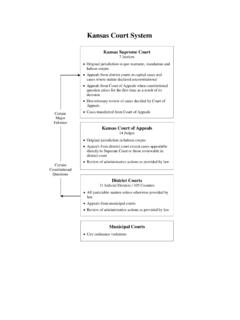
5 Both the FEDERAL and STATE constitutions attempt to do this by specifically spelling out the jurisdiction of their respective court systems. For example, since the Constitution gives congress the sole authority to make uniform laws concerning bankruptcies, a STATE court would lack jurisdiction in this matter. Likewise, since the Constitution does not give the FEDERAL government authority in most matters concerning the regulation of the family, a FEDERAL court would lack jurisdiction in a divorce case. This is why there are two separate court systems in America. The FEDERAL court system deals with issues of law relating to the powers expressly or implicitly granted to it by the Constitution while the STATE court systems deal with issues of law relating to the matters that the Constitution did not give to the FEDERAL government nor explicitly deny to the states .
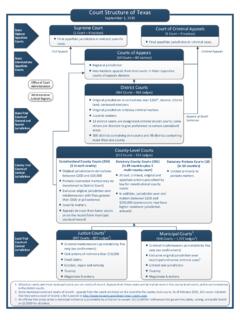
6 Description of the difference in the structure of the FEDERAL and STATE court systems. FEDERAL court System The term FEDERAL court can actually refer to one of two types of COURTS . The first type of court is what is known as an Article III court . These COURTS get their name from the fact that they derive their power from Article III of the Constitution. These COURTS include the District COURTS , the Circuit COURTS of Appeal and the Supreme court . They also include two special COURTS : the court of Claims and the court of International Trade. These COURTS are referred to as specialized because, unlike the other COURTS , they are not COURTS of general jurisdiction.
7 COURTS of general jurisdiction can hear almost any case. All judges of Article III COURTS are appointed by the President of the United states with the advice and consent of the Senate and hold office during good behavior. The second type of court also is established by Congress. These COURTS are magistrate COURTS , bankruptcy COURTS , the court of Military Appeals, the Tax court and the court of Veterans Appeals. The judges of these COURTS are appointed by the president with the advice and consent of the Senate. They hold office for a set number of years, usually about 15. magistrate and bankruptcy COURTS are attached to each District court .
8 The court of Military Appeals, Tax court and court of Veterans Appeals are called Article I or Legislative COURTS . District COURTS There are 94 District COURTS in the United states . Every STATE has at least one district court and some large states , such as California, have as many as four. Each district court has between two and 28 judges. The District COURTS are trial COURTS , or COURTS of original jurisdiction. This means that the vast majority of FEDERAL cases begin there. They hear both civil and criminal cases. In many cases, the judge determines issues of law while the jury (or judge sitting without a jury) determines findings of fact.
9 US. Circuit COURTS of Appeal There are 13 Circuit COURTS of Appeal in the United states . These COURTS are divided into 12 regional circuits and sit in various cities throughout the country. The court of Appeals for the FEDERAL Circuit (the Thirteenth court ) sits in Washington. With the exception of criminal cases in which a defendant is found not guilty, any party who is dissatisfied with the judgment of a District court (or the findings of certain administrative agencies) may appeal to the Circuit court of Appeal in his/her geographical district. These COURTS only will examine the trial record for mistakes of law the facts of the case already were determined by the District court .
10 As such, the court usually will neither review the facts of the case nor take any additional evidence. When hearing cases, these COURTS usually sit in panels of three judges. Supreme court of the United states The Supreme court of the United states sits at the apex of the FEDERAL court system. It is composed of nine judges, known as justices, and is presided over by the chief justice. It sits in Washington Parties who are not satisfied with the decision of a Circuit court of Appeal (or, in rare cases, of a District court ), or a STATE supreme court can petition the Supreme court to hear their case. This is mainly done by a legal procedure known as a Petition for a Writ of Certiorari (cert.)