Transcription of Things Your Next Firewall Must Do - …
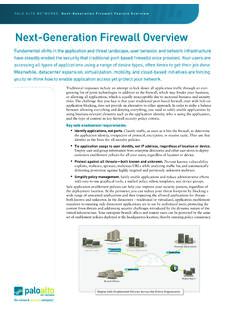
1 Things your next Firewall Must Do10 Palo Alto Networks . 10 Things your next Firewall Must Do Page 2 Introduction: 10 Things your next Firewall Must DoMuch has been made about bringing application visibility and control into network security. The reason is obvious: applications can easily slip by traditional port-based firewalls. And the value is obvious: employees use any application they need to get their job done often indifferent to the risk that use poses to the business. Nearly every network security vendor has acknowledged that application control is an increasingly critical part of network security. While the next -generation Firewall (NGFW) is well defined by Gartner as something new, enterprise-focused, and distinct, many network security vendors are claiming NGFW is a subset of other functions ( , UTM or IPS).
2 Most traditional network security vendors are attempting to provide application visibility and control by using a limited number of application signatures supported in their IPS or other external database. But underneath, these capabilities are poorly integrated and their products are still based on legacy port-blocking technology, not NGFW technology. Perhaps most importantly, these folks are missing the point it s not about blocking applications, but safely enabling them. Unfortunately, the products proffered by traditional network security vendors ignore much of what enterprises do with applications today they use them to enable their business and as such, need to make sure that those applications run securely.
3 It is obvious that a next -generation Firewall is a different and revolutionary class of product, but the interest from enterprise customers is so strong that vendors of traditional products are trying to subvert the interest of enterprise network security team by attempting to look like an enterprises looking at NGFWs, the most important consideration is: Will this new technology empower security teams to securely enable applications to the benefit of the organization? Key questions to ask include:n Will it increase visibility and understanding of application traffic? n Will it expand traffic control options beyond blunt allow/deny? n Will it help prevent threats? n Will it eliminate the need to compromise between performance and security?
4 N Will it reduce costs for my organization? n Will it make the job of risk management easier or simpler? If the answers to the above questions are yes, then transition is easy to : next -generation Firewall . 5 Requirements:1. Identify applications regardless of port, protocol, evasive tactic or SSL 2. Identify users regardless of IP address3. Protect in real-time against threats embedded across applications4. Fine-grained visibility and policy control over application access / functionality5. Multi-gigabit, in-line deployment with no performance degradationPalo Alto Networks . 10 Things your next Firewall Must Do Page 3 There are substantial differences between NGFWs and UTM-style devices in terms of the kinds of organization each targets, and in terms of architecture and security model.
5 These differences have dramatic impacts on real-world functions/features, operations, and performance as we ve attempted to capture in the ten Things section and Security Model: Traffic is Best Classified in the FirewallIn building next -generation firewalls, security vendors have taken one of two architectural approaches:1. Build application identification into the Firewall as the primary classification engine2. Add application signatures to an IPS or IPS-like pattern matching engine which is then added to a port-based firewallBoth can recognize applications but with varying degrees of success, usability, and relevance. Most importantly, these architectural approaches dictate a specific security model for application policies either positive (default deny), or negative (default allow).
6 Firewalls use a positive security model. Another term for it is default deny. Which means that administrators write policies to ALLOW traffic ( , allow WebEx)..and then everything else is denied or blocked. Negative policies ( , block Limewire) can be used in this model, but the most important fact is that the end of the policy in a positive security model says, all else deny. One of the key implications of this approach is that all traffic must be classified in order to allow the appropriate traffic. So visibility of traffic is easy and complete. Policies enable applications. Another key result of this approach is that any unknown traffic is, by default, denied. In other words, the best next -generation Firewall is a prevention systems (IPS) typically employ a negative security model, or default allow.
7 Which means that IPS identifies and blocks specific traffic (traditionally threats)..and everything else is passed through. Traditional network security vendors are adding application signatures to an IPS-style engine and bolting it onto a traditional port-based Firewall . The result is an application prevention system. The application control is in a negative security model in other words, it s not in a Firewall . Implication: one only sees what is expressly looked for, and unknown traffic is, by default, Alto Networks . 10 Things your next Firewall Must Do Page 4 While this paper is focused on the 10 specific Things your next (generation) Firewall must do, knowledge of the architecture and model as outlined above are prerequisites to understanding the different capabilities of the different products on the market and their ability to deliver these functions.
8 The ten Things discussed below represent some of the critical, specific requirements we ve gathered from thousands of IT organizations since we began selling next -generation firewalls in 2007. These are all real-world examples of requirements that make the job of securing enterprise networks easier, better, or simpler marketing hype 10 Things your next (Generation) Firewall Must DoThere are three areas of difference security functions, operations, and performance. The security functional elements correspond to the efficacy of the security controls, and the ability for enterprises to manage risk associated with network traffic. From an operations perspective, the big question is: where does application policy live, and how hard or complex is it to manage?
9 The performance difference is simple: can the Firewall do what it s supposed to do at the throughput it s supposed to do it? The Ten Things your next (Generation) Firewall Must Do are:1. Identify and control applications on any port2. Identify and control circumventors3. Decrypt outbound SSL4. Provide application function control5. Scan for viruses and malware in allowed collaborative applications6. Deal with unknown traffic by policy7. Identify and control applications sharing the same connection8. Enable the same application visibility and control for remote users9. Make network security simpler, not more complex with the addition of application Deliver the same throughput and performance with application control activePalo Alto Networks.
10 10 Things your next Firewall Must Do Page 512 your next Firewall must identify and control applications on any port, not just standard ports (including applications using HTTP or other protocols)Business case: Application developers no longer adhere to standard port/protocol/application mapping. More and more applications are capable of operating on non-standard ports or are can hop ports ( , instant messaging applications, peer-to-peer file sharing, or VOIP). Additionally, users are increasingly savvy enough to force applications to run over non-standard ports ( , MS RDP, SSH). In order to enforce application-specific policies where ports are increasingly irrelevant, your next Firewall must assume that any application can run on any port.