Transcription of Effects of Alloying Elements in Metal - Peterson Steel
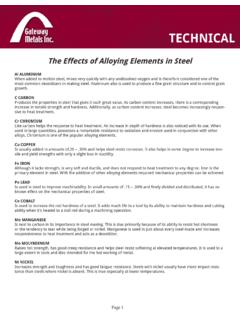
1 Shock better than steels without a strong deoxidizer and promotes fine grain structure. It helpssteel resist softening at elevated temperatures and seems to resistPromoted red hardness and hot strength in addition to producingdense grain and a keen cutting edge. These properties make tungstensteels very useful for hot working applications such as cutting toolswhen the Steel is hot enough to be low red in is added to 18-8 stainless steels to make them immune toharmful carbide precipitation. It is sometimes added to low carbonsheets to make them more suitable for porcelain addition to approximately .05% tellurium to leaded steelimproves machinability over the leaded-only the most common deoxidizing agent. In amounts up to 1% it has amarked strengthening and toughening effect . In higher amounts itproduces electrical resistance and gives high magnetic next to carbon in its importance in Steel making.
2 This is dueprimarily because of its ability to resist hot shortness or thetendency to tear while being forged or rolled. Manganese is usedin almost every Steel made, increasing responsiveness to heattreatment and acting as a used in Steel to improve machinability. In small amounts of .15 and finely divided and distributed, it has no known effect on the mechanical properties of usually found in all steels and like phosphorus is considered a respond to heat treatment to any degree. Iron is the primary elementin Steel . With the addition of other Alloying Elements , requiredmechanical properties can be element. When added purposely it substantially increases amount for this purpose is usually from .06 Sulfur is considered the basic element for free machining steelsIt is,however, detrimental to the hot forming with only a t loss in it lacks strength, iron is very soft and ductile, and does notCuCopperIs usually added in amounts of.
3 20 to .30% and helps Steel resistcorrosion. It also helps in some degree to increase tensile and yieldincrease in depth of hardness is also noticed with its use. When usedin large quantities, it possesses a remarkable resistance to oxidationand corrosion. Used in conjunction with other alloys, chromium is one of the popular Alloying to a dull red during a machining carbon, chromium helps the response to heat treatment. AnCoCobaltIs used to increase the red hardness of a Steel . It adds much life to a tool by its ability to maintain hardness and cutting ability when it'sresultant inter-granular corrosion. Columbium bearing weldingelectrodes are used in welding both titanium and columbium bearingstainless steels since titanium would be lost in the weld arc, whereascolumbium is carried over into the weld in 18-8 stainless Steel has a similar effect to titanium inmaking the Steel immune to harmful carbide precipitation andcontent increases, there is a corresponding increase in tensilestrength and hardness.
4 Additionally, as carbon content increases, Steel becomes increasingly responsive to heat Phosphorous is present in all steels and tends toincrease resistance to corrosion while increasing yield seldom deliberately added to Steel but is carried as a residual or Produces the properties in Steel that give it strength. As carbonincidental element. When it is added it is usually for the purpose ofacts as an "intensifier", increasing the depth of hardening nickel is absent. This is true especially at lower is added to Steel in amounts of to to improvehardenability. In combination with other Alloying Elements , boronNiNickelIncreases strength and toughness and has good fatigue with nickel usually have more impact resistance than steelsproduce a fine grain structure and to control grain of Alloying Elements in MetalRaises hot strength, has good creep resistance and helps steelresist softening at elevated temperatures.
5 It is used to a largeextent in tools and dies intended for hot working of added to molten Steel , mixes very quickly with anyundissolved oxygen and is therefore considered one of the mostcommon deoxidizers in making Steel . Aluminum also is used to