Transcription of Hearing protection - osha.oregon.gov
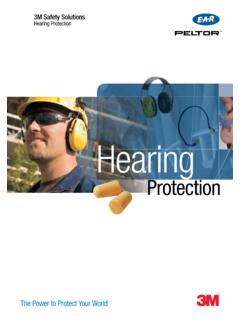
1 Hearing protection When your employees are exposed to noise at levels that exceed the permissible exposure limit (PEL) an 8-hour, time-weighted average (TWA-8) of 90 decibels (dBA) you must reduce their noise exposure to or below the PEL. You must establish a hierarchy of control to reduce noise exposure, including engineering and administrative (work-practice) controls. If these types of controls are still insufficient to reduce exposure below the PEL, then Hearing protection is required in conjunction with the other controls to reduce exposures to the lowest achievable the right Hearing protectionYou must provide a variety of Hearing protectors at no cost to the employees, ensure that their Hearing protectors fit properly, and that they are using them correctly. Focus on comfort, convenience, and compatibility when choosing the right Hearing protectors. Employees will not wear Hearing protectors that are uncomfortable, difficult to use, or interfere with their work.
2 They should be able to choose, with the help of a person trained in fitting Hearing protectors, from among a variety of appropriate types and are two main types of Hearing protectors: earplugs and earmuffs. Earmuffs fit over the entire outer ear they will not seal properly over glasses, hats, or long hair. They are typically held in place by a headband that must be properly adjusted to hold the earmuff firmly around the ear. Earplugs fit in the outer part of the ear canal. To be effective, they must totally block the entire circumference of the ear canal with an airtight seal. They are available in different shapes and sizes and can be custom made. An improperly fitted, dirty, or worn-out plug will not seal and can also irritate the ear protection OAR 437 Division 2/G Division 3/D Division 4/G Division 7/DOregon OSHAS alem Central Office350 Winter St. NESalem, OR 97301-3882 Phone: 503-378-3272 Toll-free: 80 0 -922-2689 Fax: 503 - 9 47-74 61 WORKER HEALTH AND SAFETYFACT SHEETE ffectiveness of Hearing protectionHearing protectors must reduce (attenuate) noise levels to a maximum TWA-8 of 90 dBA (85 dBA for employees who have had a standard threshold shift).
3 To determine the reduced noise level with Hearing protectors, use the following method, as described in Appendix B to the employee s noise exposurewithout protection in 7dB from the noise reduction rating(NRR) of the Hearing protector, as listed on theproduct this difference from the unprotectednoise exposure. This estimates the exposure levelwith the Hearing : Without protection , an employee is exposed to a TWA-8 of 92 dBA. The NRR of an ear plug is listed as 26dB. Calculated dBA with the employee noiseexposure = 92 NRR = 26dB (- 7dB) = exposure with hearingprotection = (92 dBA - 19dB) = 73 Hearing protection involves wearing two forms of Hearing protection simultaneously (typically, both earplugs and ear muffs). To estimate the noise exposure for workers wearing dual protection : the employee s noise exposurewithout protection in 7 dB from the noise reduction rating(NRR) of the Hearing protector with the higherrated NRR of the two types 5 dB to this field-adjusted NRR to accountfor the use of the second Hearing the remainder from the unprotectednoise exposure.
4 This estimates the exposure levelunder the dual Hearing protection (It is important to note that using such double protection only adds 5 dB of attenuation.)EXAMPLE: Without protection , an employee is exposed to a TWA-8 of 110 dBA. The NRR of an ear plug is listed as 32 dB; The NRR for available ear muffs is listed at 15 dB. To calculate the dBA with the dual employee noiseexposure = 110 of the NRRs listed on twoprotectors = 32 dB ( 7 dB) = 25 adjusted dB =25 dB + 5 dB(for second protector) = 30 exposure with dual hearingprotection =(110 dBA 30 dB) = 80 Oregon OSHA s noise topic page Occupational noise Exposure Rules and related information noise exposure fact sheet Oregon OSHA s Quick Guide to Hearing ProtectionThe Technical Section of Oregon OSHA produced this fact sheet to highlight health and safety programs and rules. The information is intended to supplement the rules and provide best practices to PROTECTIONA Division of the Department of Consumer and Business (4/18) FS-80