Transcription of EPA Unregulated Contaminants Monitoring Rule 3: The ...
1 EPA Unregulated Contaminants Monitoring Rule 3: The Results So Far and What They Might Mean For The FutureMassachusetts Water Works AssociationJanuary 28, 2016 The Unregulated Monitoring Rule is part of an interconnected set of regulations and processes that EPA uses to determine what Contaminants to regulate in drinking water. The following presentation gives a very short summary of how these processes are connected, and then goes into some detail with the current UCMR 3 dataset. This is followed by a short review of the recently proposed UCMR 4 regulation, which is scheduled to run from January 1, 2018 through December 31, CCL Rule, Regulatory Determination, the 6 Year Regulation Review, and the Unregulated contaminant Monitoring RuleHow Are They All Tied Together to Produce What the Local Public Water Systems Are Ultimately Required to Do?
2 3 Discussion Topics contaminant Candidate List (CCL) and Regulatory Determination Processes Six Year Regulatory Review UCMR3 The Results So Far UCMR4 What s Next? contaminant Candidate List The drinking water CCL is a list of Contaminants that are currently not subject to any proposed or promulgated national primary drinking water regulations, but are known or anticipated to occur in public water systems. Contaminants listed on the CCL may require future regulation under the Safe Drinking Water Act (SDWA).SDWA requires EPA to publish the CCL every five years.
3 SDWA directs the Agency to consider the health effects and occurrence information for Unregulated Contaminants as the Agency makes decisions to place Contaminants on the list. SDWA further specifies that the Agency place those Contaminants on the list that present the greatest public health concern related to exposure from drinking uses the CCL to identify priority Contaminants for regulatory decision making and information collection. EPA is about to propose the fourth CCL list in early Determination Process (RegDet) A regulatory determination is a formal decision on whether EPA should initiate a process to develop a national primary drinking water regulation for a specific contaminant .
4 The law requires EPA to make regulatory determinations for at least five Contaminants from the most recent CCL within five years after the completion of the previous round of regulatory regulate a contaminant SDWA requires that EPA determine contaminant may have an adverse effect on the health of persons; contaminant is known to occur or there is a substantial likelihood the contaminant will occur in public water systems with a frequency and at levels of public health concern; the sole judgment of the Administrator, regulation of the contaminant presents a meaningful opportunity for health risk reductions for persons served by public water systems.
5 For more info on the CCLs and RegDet, go to: #what-is-reg-det6 Most Recent Regulatory Determination Every five years, the EPA determines whether we should regulate at least five Contaminants in drinking water with a national primary drinking water regulation (NPDWR). In October 2009, the EPA published the third Drinking Water contaminant Candidate List (CCL3). After extensive review of health effects and occurrence data, on October 20, 2014, the agency announced its preliminary regulatory determinations for five Contaminants listed on CCL3.
6 The EPA is making preliminary determinations to regulate strontium in drinking water and to not regulate four Contaminants ( , dimethoate, 1,3-dinitrobenzene, terbufosand terbufossulfone). Following the comment period EPA has just finalized the contaminant determinations in the Federal Register (dated 1/4/16). The four Contaminants listed above in the preliminary determination will not be regulated, and the fifth, Strontium, has had the determination delayed following the reception of additional data during the comment period. A final determination for Strontium will be issued at some time in the future,76 Year Regulatory Review Process EPA is required to review its National Primary Drinking Water Regulations (NPDWRs) every six years for possible revision.
7 The second review of 71 NPDWRs was completed in 2010. The third review is expected to be completed in 2016. The results of the 2010 review are very briefly summarized in the next slide. To learn more about the process, please visit the EPA website listed below: of 2010 6 Year Review The following 4 chemicals were recommended for regulatory revision: Acrylamide, Epichlorohydrin, Tetrachloroethylene, and Trichloroethylene The following chemicals and organisms are already in the process of having their regulatory provisions reviewed and changed.
8 Bromate, Chloramines, Chlorine, Chlorine dioxide, Chlorite, Coliform, Copper, Cryptosporidium, Giardia lamblia, HAA5, Lead, Legionella, TTHMs, and VirusesThe remaining 53 NPDWR Contaminants either remain appropriate, are lower priority for revision, or do not yet have sufficient health effects data available to make a determination for revision. 9 About the Unregulated contaminant Monitoring Rule EPA uses the Unregulated contaminant Monitoring Rule (UCMR)to collect data for Contaminants that are suspected to be present in drinking water and do not have health-based standards set under the Safe Drinking Water Act (SDWA).
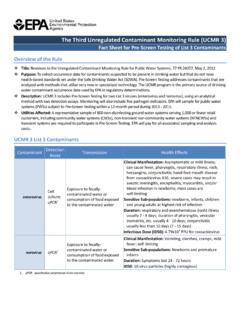
9 The SDWA Amendments of 1996 provide for: Monitoring no more than 30 Contaminants every five years Monitoring large systems anda representative sample of small public water systems serving less than10,000 people Storing analytical results in a National contaminant Occurrence Database (NCOD) EPA s selection of Contaminants for a particular UCMR cycle is largely based on a review of the contaminant Candidate List (CCL). EPApays for the analysis of all samples from systems serving 10,000 or fewer people. EPA coordinates an approval program forlaboratories that wish to analyze public water system HAD TO MONITOR?
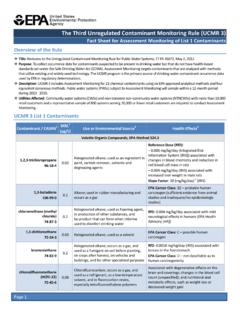
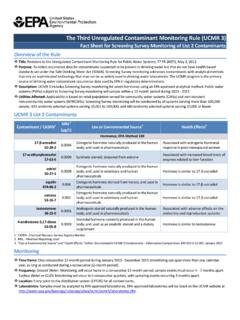
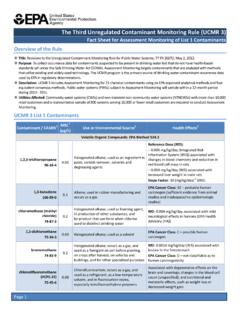
10 Assessment Monitoring (List 1 Contaminants ) All PWSs serving more than 10,000 people and 800 representative PWSs serving 10,000 or fewer people monitor for 21 List 1 Contaminants during a 12-month period from January 2013 through December 2015. Screening Survey (List 2 Contaminants ) All PWSs serving more than 100,000 people, 320 representative PWSs serving 10,001 to 100,000 people, and 480 representative PWSs serving 10,000 or fewer people monitor forseven List 2 Contaminants during a 12-month period from January 2013 through December 2015.