Transcription of Frequently Asked Questions EPA’s Third Unregulated ...
1 GENERAL Questions : 1. Is my water safe? Yes. Continued testing of our water is one way we ensure we re doing all that we can to keep it safe and clean. Our team of treatment operators, scientists, and technicians work in collaboration with our state and federal partners, like the EPA and DHEC, to advance water quality research. Because the equipment we use to test water is advancing rapidly, we have the ability to measure and respond to the presence of contaminants in your water that would have been impossible to detect just a few years ago. We report these findings to keep you aware of what we re doing to gather information to ensure that we continue to provide the highest quality drinking water to you, our customers. It s a vital part of our mission.
2 2. What is a part per billion? I see that measurement referenced in your Water Quality Report. There are so many scientific terms of measurement, and we understand that it may be hard to cut through the jargon. An easier way to understand the concept of a part per billion is to consider it in the context of a few examples. A part per billion is also: 1 penny in 10 million dollars 1 second in 32 years 1 foot in a trip to the moon 1 blade of grass on a football field 1 drop of water in an Olympic-size swimming pool Despite the miniscule measurements, it s our job and our goal to safeguard your water from potentially harmful substances. That s why we test, and that s why we test so Asked Questions EPA s Third Unregulated contaminant monitoring Rule (UCMR3)3.
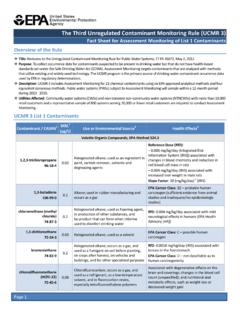
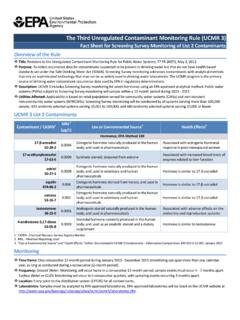
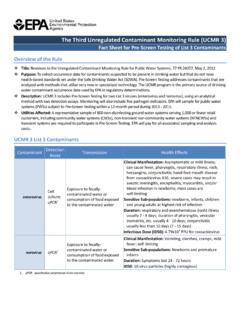
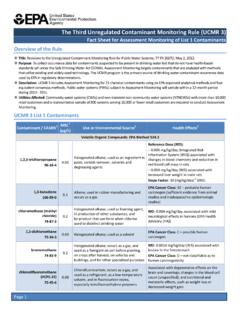
3 Why are these Unregulated ? What does that really mean? Greenville Water is on the cutting edge of safety and innovation in the science of drinking water. In coordination with the EPA and DHEC, Greenville Water is supporting a project that requires the collection of data for as-yet Unregulated contaminants. Every five years the EPA is required to develop a new list of up to 30 potential Unregulated contaminants for which public water systems must monitor. The purpose of the project is to determine if these Unregulated potential contaminants are present in sources that supply the nation s drinking water. The testing also provides information on how often these substances are found and at what concentrations they occur. These substances are outlined in the EPA s UCMR3.
4 The intent of this rule is to provide useful data that the EPA can combine with toxicological research to make decisions about potential future drinking water regulations. The data assist the EPA in determining whether or not to regulate those contaminants listed in UCMR3. SUBSTANCE-RELATED Questions : VANADIUM What is Vanadium? Vanadium is a naturally occurring element found in the earth s crust and fossil fuel deposits. It is also commonly found in sea food and nutritional supplements. Are there any known health effects of Vanadium? Health experts are actually debating the value of vanadium as an essential nutrient. There is not a drinking water standard or health advisory level for vanadium at this time. It has been known to cause cancer in extremely high levels.
5 The levels indicated in testing of our water sources are much lower. Why are you testing for Vanadium? Every five years the EPA is required to develop a new list of up to 30 potential Unregulated contaminants for which public water systems must monitor. Greenville Water is participating in this monitoring , which includes Vanadium. Although testing for these contaminants is mandated by the EPA, Greenville Water enforces its own self-imposed set of rigorous standards to ensure the safety of drinking water sources. Do we have Vanadium in our water?Initial analysis of Greenville Water s source and treated water has detected levels of vanadium at very low concentrations, less than 1 part per billion. That measurement is actually equal to less than one foot in a trip to the moon.
6 What is Greenville Water doing? Greenville Water in cooperation with the EPA and the South Carolina Department of Health and Environmental Control will monitor our source water and our treated water. EPA will evaluate the information gathered as well as health effects studies to determine if regulatory limits are needed. As regulatory decisions are made, Greenville Water will share updates with you. Greenville Water is committed to meeting all regulatory limits and protecting the health of its customers. STRONTIUM What is Strontium? Strontium is a naturally occurring metal. Strontium occurs nearly everywhere in small amounts. Air, dust, soil, foods and drinking water all contain traces of strontium. Are there any known health effects of Strontium?
7 While there is no evidence to suggest that ingestion of foods or beverages that naturally contain traces of strontium is harmful, exposure to high levels of strontium during infancy and childhood can affect bone growth and cause dental changes. The EPA has developed a lifetime health advisory of 4000 parts per billion for strontium in drinking water. Due to the sensitivity of testing, a very small trace of Strontium was detected, but at a level that is far below the amount that would result in any adverse health problems. Why are you testing for Strontium? Every five years the EPA is required to develop a new list of up to 30 potential Unregulated contaminants for which public water systems must monitor. Greenville Water is participating in this monitoring , which includes strontium.
8 Do we have Strontium in our water? Initial analysis of Greenville Water s source and treated water has detected levels of strontium at very low concentrations, concentrations 100 times less than EPA s 4000 part per billion lifetime health advisory limit for drinking water. What is Greenville Water doing? Greenville Water in cooperation with the EPA and the DHEC will monitor our source and treated water. The EPA will evaluate the information gathered as well as health effects studies to determine if regulatory limits are needed. As regulatory decisions are made, Greenville Water will share updates with you. Greenville Water is committed to meeting all regulatory limits and protecting the health of its CHROMIUM What is Hexavalent Chromium?
9 Hexavalent chromium, also known as chromium 6 or chromium VI is one of the chemical forms of the metal chromium. Hexavalent chromium occurs naturally in the environment from the erosion of natural chromium deposits, but it can also be introduced into the environment by industrial processes. Are there any known health effects of Hexavalent Chromium? The health effects of hexavalent chromium when it is ingested are under rigorous review. It s widely used in a number of industries, which can account for its presence in some water sources. Hexavalent chromium oxide is actually used to manufacture magnetic tape used in high-performance audio-tape and standard audio cassettes. It is known that some forms of hexavalent chromium are carcinogenic when inhaled, but in much larger concentrations that those that appeared in our initial testing.
10 Some animal studies have suggested a link between the consumption of water containing hexavalent chromium and gastrointestinal cancers. These studies are currently under review by the EPA. Why are you testing for Hexavalent Chromium? Every five years the EPA is required to develop a new list of up to 30 potential Unregulated contaminants for which public water systems must monitor. Greenville Water is participating in this monitoring , which includes hexavalent chromium. A regulatory limit of 100 parts per billion has been established for total chromium. Hexavalent chromium is one component of total chromium. Greenville Water conducts monitoring for total chromium and has always been in compliance with the established regulatory limit for total chromium.