Transcription of The Bhagavad Gita - Theosophical Society in America
1 Produced by the Department of Education The Theosophical Society in America The Bhagavad Gita A Study Course By John Algeo Analysis and commentary in 28 lessons 2000 The Theosophical Society in America Box 270, Wheaton, Illinois 60189-0270 The Theosophical Society in America The Bhagavad Gita 2000 The Theosophical Society in America 2 THE Bhagavad GITA, Lesson 1 A. Preface to the Bhagavad Gita The Bhagavad Gita is one of the world s most important books indeed, one of the great books of human culture, Eastern and Western alike. In India, the Gita is many things: it is the major guidebook to the spiritual life in the Hindu tradition; it is an eirenicon a work that harmonizes the diverse views of life that find a place within traditional Indic religious philosophy, and it is an inspirational and culture-defining book that is to Indian Society what the gospels are to the West.
2 It is hard to overstate the importance and centrality of the Gita to Indian life. The Gita has been also, however, a powerful influence in the West. It is indeed part of a remarkable chain of links connecting East and West. The New England Transcendentalists a group of nineteenth-century Americans who were an important school of thinkers and writers, in a number of respects anticipating later Theosophical thought read the first English translation of the Gita. Henry David Thoreau, one of that group, in particular wrote about reading the Gita on the shore of Walden Pond, and its philosophy inspired a famous essay of his, On Civil Disobedience, about how to cope with societal injustice.
3 Much later, when Mohandas Gandhi was a young man and a law student in England, he was introduced to the Gita by Theosophists, and then he read Thoreau s essay, which in turn inspired his policy of satyagraha or passive resistance. Later Martin Luther King was in turn inspired by Gandhi s policy to create his own program of nonviolence. So the Gita has echoed back and forth across the globe between India and America , as a defining document of contemporary thought and action. No other work has had a comparable influence across cultures in binding together East and West. But what is the Gita in itself? The Gita is a poem (the word gita means song ).
4 It is a very small part of the greatest and longest epic ever written the Mahabharata, which is far longer than the Greek Odyssey and Iliad combined. It recounts the story of a great civil war. Epics typically show the values and defining characteristics of a people. The Mahabharata is in that way the quintessential story of India. But it is also the story of all human beings, a universal epic, for it deals with fundamental human motives, frustrations, quandaries, and joys. The Gita deals with a basic theme in the Mahabharata dharma or the way we should act because of who and what we are. In particular, the Gita is about a moral quandary in which the hero in the Mahabharata war faces fundamental questions about the right way to live.
5 The poem operates on two levels historical and archetypal. It is a history of an actual battle fought near modern Delhi at a turning point in human history. But it is also an archetypal myth about the struggle that each one of us experiences within ourselves. The dual level of the poem is made clear in the opening two words of the poem: Dharmakshetre, Kurukshetre, which mean On the field of dharma, on the Field of the The Theosophical Society in America The Bhagavad Gita 2000 The Theosophical Society in America 3 Kurus. The Kurus were the ruling family of India at the time of the poem, and Kurukshetra is an actual geographical location, a field, near modern Delhi where the ancient civil war was fought.
6 So the second word of the poem tells us that we are dealing with a particular place and time, millennia ago, in the heroic age of India, and half way around the globe from twenty-first century America . But the first word of the poem tells us that we are dealing with a timeless reality. Dharma (a central word in the poem) means, among other things, the essential nature of a thing or person. And so the poem is about the field or subject matter of what is essentially real in life. In reading the Gita, we cannot ignore its historical setting, on the Field of the Kurus, but what is most important for all peoples everywhere is what the poem has to say about the field of dharma.
7 The story centers on Prince Arjuna, the middle of five sons of the royal house (called Pandavas after their father Pandu). Their father has died, leaving them as wards of their uncle, who himself has a hundred sons. Arjuna s cousins (called Kauravas descendents of the ancient king Kuru), under the leadership of the eldest, the wicked Duryodhana, have plotted to cheat Arjuna and his brothers out of their legitimate inheritance and even to murder them. Arjuna, who belongs to the kshatriya or warrior caste, is called upon by his duty in life to fight against evil and for the right. He therefore is required by his social duties to defend his brothers legitimate claim to their kingdom against their usurping cousins.
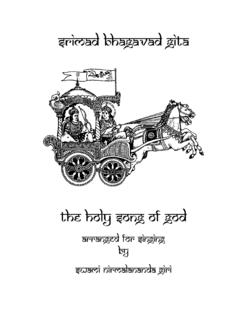
8 On the eve of the battle, however, Arjuna experiences a crisis of conscience. On the one hand, he knows that his duty as a kshatriya warrior compels him to defend his brothers rights; on the other hand, however, his duty to his family requires that he harm none of them, whatever they may be or have done. And those he will be fighting include his cousins, his grandfather, and even his teacher, with whom the bond of support is even stronger than with blood relatives. Arjuna sees the terrible price to be paid for killing members of his own family. He sees no good coming from the battle and only evil from his own part in it. He therefore calls upon his friend and charioteer, Shri Krishna, for advice.
9 Krishna is a cousin of Arjuna s and a childhood friend, but he is not merely human. Though Arjuna does not realize it at the start of the poem, Krishna is a divine incarnation god made flesh. The Bhagavad Gita, which means The Lord s Song, is Krishna s answer to Arjuna s desperation. The archetypal meaning of the poem is that within each of us a battle rages between selfish impulses that ignore the claims of justice and mercy and a realization that ultimately we are all connected in a unity that embraces all humanity and the whole world. Arjuna is our The Theosophical Society in America The Bhagavad Gita 2000 The Theosophical Society in America 4conscious mind, which must make the choice of how we will live.
10 The wicked cousins are our impulses to self-centeredness and greed. Krishna is the divine spark within us, our higher Self, which is always available to rein in the horses of our feelings and thoughts and to guide us in the battle of life, if we will only seek that help. Arjuna s quandary is a threefold one. Generalized to the common human situation, its three aspects can be formulated as follows: 1. How can we act freely and unconditionedly? 2. How can we have confidence in the power of goodness to make all things right? 3. How can we choose between unclear alternatives to resolve the dilemmas we face? The message that Krishna, our higher Self, gives to Arjuna, our conscious mind, is a threefold one.