Transcription of PART A: INTRODUCTION TO THE OLD TESTAMENT
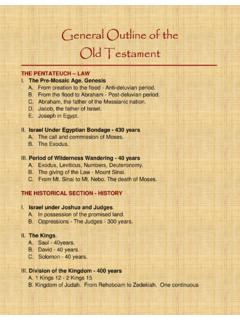
1 LESSON 2: OLD TESTAMENT . PART A: INTRODUCTION TO THE OLD TESTAMENT . The OT begins with two accounts of creation. The first account is in Gen 1:1-2:4a and the second account takes up the remainder of Gen 2. Gen 3 is the story of the Fall. Sin continues to spread with the Flood occupying much of Gen 6-9. The first of five OT covenants is God's promise to Noah never again to destroy the world with water. The story of Babel is in Gen 11. The beginning of salvation history occurs with the call of Abraham in Gen 12. He was asked to leave his country and settle in Canaan. God promised him the land in perpetuity and many descendants. This is the second of five covenants in the OT. For their part the Hebrews were to circumcise all males. Abraham was a patriarch, a father of a clan or family.
2 The succeeding patriarchs were his son Isaac (whom he had been asked to sacrifice in Gen 22), and his son Jacob. Jacob stole his birthright from his brother Esau. Jacob was always in trouble. During a night time struggle with God he was renamed Israel (Gen 32:23-33). His son Joseph was thrown down a well and then sold to passing traders who in turn sold him to one of Pharaoh's officials in Egypt. He was thrown in prison on false charges and released after he interpreted Pharaoh's dreams and therefore made vice-regent in Egypt. During this time there was a famine in Canaan and his brothers came for food. He revealed himself to them and asked that his entire family come down and settle in Egypt. They would remain in Egypt for 430 years (Ex 12:40). Now we come to the Book of Exodus.
3 God called Moses to lead them out of Egypt. He grew up in Pharaoh's palace as Pharaoh's grandson. He had to flee after killing an Egyptian and while he was away God spoke to him from the burning bush. He went back to Egypt and with the help of his brother Aaron led the Hebrews out of Egypt. There was a series of 10 plagues before their departure. The worst was the last plague on the night of their departure, the death of the firstborn of the Egyptian. Before the Hebrews departed they celebrated a Passover meal which Jesus took over and turned into the Last Supper. After their departure the greatest miracle of the OT occurred, the passage through the sea. Scholars are divided on whether it means the Sea of Reeds or the Red Sea because it is not clear in the Hebrew. Scholars are divided over the date of the exodus but a plausible date is between 1350-1250 BC.
4 The exodus is the first of two great divisions of time in the OT, time before the exodus and time after the exodus. While wandering in the desert God fed them with manna and quails, and gave them water from a rock. A month after their departure they arrived at Mt Sinai. While there God formed a covenant with them and gave them the Ten Commandments. This is the third covenant of the OT. This covenant bound them to God and God to them. So they have a new relationship with God. Therefore they had a new relationship with each other because they were all bound to God, so a new horizontal and vertical relationship resulted from this covenant. That new relationship was expressed in Law and therefore most of the rest of the Pentateuch (first five books of the OT) is Law. They spent a year at Sinai before moving on but due to lack of faith in God they spent forty years wandering in the desert before entering Canaan.
5 Num 25:13 gives us the fourth covenant in the OT, God's promise that the priesthood would remain forever. Only two of those who left Egypt were allowed by God to live long enough to enter the Promised Land, Joshua and Caleb. Even Moses died before entering but he was Fr. Tommy Lane 2012 Page 1. privileged to see it from Mount Nebo. A glorious account of the conquest of Canaan is given us in Joshua. As they crossed the river Jordan stopped flowing, mimicking the earlier miracle of the sea as they left Egypt. The land was divided among the tribes. Judah in the south absorbed the tribe of Simeon but the tribe of Levi, the priests and their assistants received no portion, since their income was to be provided from the tithes of the remainder of the people. Joshua was the first ruler in Canaan and the Israelite leaders who ruled after him were called judges but their main function was to act as military rulers.
6 You are surely already familiar with the story of one of them, Samson. Their account is in the book of Judges. The last of the judges was Samuel (1 Sam). The people decided to copy the surrounding nations and form a monarchy. God asked Samuel to anoint the first king. His name was Saul (1020-1000 BC). His story is recounted in 1. Sam. Samuel also anointed the second king, David (1000-961 BC). His story begins in 1 Sam, continues in 2 Sam and concludes at the beginning of 1 Kings. He is famous for his sin of adultery with Bathsheba the wife of Uriah and then engineering the death of Uriah by having him sent to the front line of battle. The fifth covenant in the OT was between God and David. God sent Nathan to him to promise that there would be a son on his throne forever. We understand this promise to refer to Jesus.
7 What is the throne Jesus is sitting on? It is his seat on the right- hand side of his Father in heaven since his ascension. David conquered Jerusalem which had not been under Israelite control up to now and he made it the political and religious center of the country. The third king was Solomon (961-922 BC). Under his reign the kingdom was at its height and it would be all downhill from now on. During his reign there was tension between the 10 northern tribes and Judah in the south. This came to a head during the reign of Solomon's son, Rehoboam (922-915 BC). The ten northern tribes split from Judah in the south in 922 BC, and so from now on there are two kings and two centers of worship. The northern kingdom is called Israel and the southern Judah. The northern kingdom did not survive for very long, only 200 years.
8 In 722 BC Assyria invaded Israel (2 Kings 17). The Samaritans intermarried with the foreign invaders and it is from that time that the tension between the Samaritans and Jews stems that we read about in the Gospels. Most of the remaining kings of Judah were not good. There are two exceptions; one was King Hezekiah (715-686 BC) but the two kings that followed undid most of his good work. The next king, King Josiah (640-609 BC) was another very good king and began a big reform but the monarchy steadily declined after him. The southern kingdom finally came to an end in 587 BC when it too was invaded and came to an end. Judah was invaded by Babylon whose king was Nebuchadnezzar. Many of the Jews were taken as slaves to Babylon and Ps 137 describes their sorry plight there. We call this time the exile.
9 This is the second great time division in the OT, time before the exile and time after the exile. Many Jews also went to Egypt during the exile, especially to Alexandria. Since the language in Egypt at this time was Greek they would eventually need a Greek translation of the OT since they gradually lost their Hebrew. Hence the Greek Septuagint translation (LXX). Babylon itself was conquered by Persia in 539 BC and the following year Cyrus king of Persia allowed the Jews to return to Jerusalem and rebuild Jerusalem. God raised up prophets to call the Israelites back to live according to the covenant. They arose during the monarchy so the prophets are simultaneous with the kings. There are pre-exilic prophets, exilic prophets promising a return, and post-exilic prophets. Palestine was now under Persian control.
10 In 332 Alexander the Great conquered Palestine and after his death in 323 his empire was split in two between the Seleucids in Syria and the Ptolemies in Egypt. Israel was stuck in the Fr. Tommy Lane 2012 Page 2. middle and was ruled by them alternately. It was a tough time for Israel because Hellenistic customs began to be introduced gradually. The worst of this came when one of the Seleucid kings, Antiochus IV Epiphanes, desecrated the Temple and set up worship of Zeus in the temple. For three years sacrifice to Yahweh ceased in the Temple (167-164 BC). There was a resistance movement begun by the Maccabees and they succeeded in rededicating the temple. In 63 BC. Palestine was conquered by Rome and was still ruled by Rome at the time of Jesus, hence the Roman soldiers in the Gospels.