Transcription of Material Safety Data Sheet 91164 Invisible Glass®
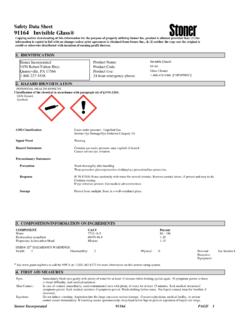
1 Stoner Incorporated 91164 PAGE 1 Material Safety data Sheet 91164 Invisible Glass Copying and/or downloading of this information for the purpose of properly utilizing Stoner Inc. product is allowed provided that: (1) the information is copied in full with no changes unless prior agreement is obtained from Stoner Inc., & (2) neither the copy nor the original is resold or otherwise distributed with intention of earning profit thereon. 1. CHEMICAL PRODUCT AND COMPANY IDENTIFICATION Stoner Incorporated Product Name: Invisible Glass 1070 Robert Fulton Hwy. Product Code: 91164 Quarryville, PA 17566 Version Date: 01/06/12 1-800-227-5538 24-hour emergency phone: 1-800-424-9300 [CHEMTREC] 2.
2 COMPOSITION / INFORMATION ON INGREDIENTS Exposure Limits COMPONENT CAS # ACGIH TLV OSHA PEL OTHER Hydrocarbon blend Mixture 400 ppm Not established 50 ppm (skin) Not established 500 ppm STEL Not established Hydrocarbon propellant 68-476-86-8 800 ppm Not established Not established 3. HAZARDS IDENTIFICATION POTENTIAL ACUTE [single or short term] HEALTH EFFECTS OF OVEREXPOSURE Eye : May cause eye irritation. Symptoms may include stinging, tearing, and redness. May cause frostbite and irritation. Skin : Skin contact may cause irritation. Symptoms may include redness, discomfort, drying and cracking, or rash. Liquid may cause frostbite. Ingestion : Swallowing small amounts during handling is not likely to cause harmful effects. Swallowing large amounts may be harmful. This Material can enter the lungs during swallowing or vomiting and cause lung inflammation and/or damage.
3 Frostbite of the lips and mouth may result from contact with the liquid. Inhalation : Breathing small amounts during handling is not likely to cause harmful effects. Breathing large amounts may be harmful. Symptoms are more typically seen at air concentrations exceeding the recommended exposure limits. Symptoms of exposure may include: initial Central Nervous System excitation (euphoria, exhilaration, light-headedness) followed by CNS depression (dizziness, drowsiness, weakness, fatigue, nausea, headache, unconsciousness) and other CNS effects, such as confusion, impaired coordination, coma, and death. May cause nausea, vomiting, coughing and pulmonary irritation. POTENTIAL CHRONIC [long term] HEALTH EFFECTS OF OVEREXPOSURE: General Effects: This Material (or a component) has been shown to cause harm to the fetus in laboratory animal studies. Harm to the fetus occurs only at exposure levels that harm the pregnant animal.
4 The relevance of these findings to humans is uncertain. This Material (or a component) shortens the time onset or worsens the liver and kidney damage induced by other chemicals. Acute lethal exposures in animal studies of a product component has resulted in congestion of organs including kidney, spleen and lungs. Overexposure to this Material (or its components) has been suggested as a cause of the following effects in laboratory animals: mild, reversible kidney effects. mild, reversible liver effects. blood abnormalities. Cancer Information: THIS PRODUCT CONTAINS NO COMPONENTS LISTED AS CARCINOGENIC BY IARC, NTP, OR OSHA 1910(Z) Mutagenicity: No data available to indicate product or any components present at greater than is mutagenic or genotoxic. MEDICAL CONDITIONS AGGRAVATED BY OVEREXPOSURE: Skin contact may aggravate an existing dermatitis. Respiratory related chronic illnesses ( asthma, etc.)
5 HMIS III* HAZARDOUS WARNINGS: Health: 2 Flammability: 2 Physical: 0 Personal Protective Equipment: See Section 8 * See or call the NPCA at 1 (202) 462-6272 for more information on this current rating system. 4. FIRST AID MEASURES Eyes: Immediately flush eyes gently with plenty of water for at least 15 minutes while holding eyelids apart. If symptoms persist or there is visual difficulty, seek medical attention. Skin Contact: In case of contact, immediately wash contaminated area with plenty of water for at least 15 minutes. Seek medical attention if symptoms persist. Seek medical attention if symptoms persist. Wash clothing before reuse. For liquid contact, treat for frostbite if necessary. Ingestion: Do not induce vomiting. Aspiration into the lungs can cause serious damage. Contact a physician, medical facility, or poison control center immediately. If vomiting occurs spontaneously, keep head below hips to prevent aspiration of liquid into lungs.
6 Inhalation: Remove to fresh air. If not breathing, give artificial respiration. If breathing is difficult, give oxygen. Continue your efforts until help arrives or the victim starts to breathe on his own. Do not leave victim alone. Seek immediate medical attention. Keep the victim warm and quiet. NOTES TO PHYSICIAN: This Material is an aspiration hazard. Potential danger from aspiration must be weighed against possible oral toxicity when deciding whether to induce vomiting. Preexisting disorders of the following organs (or organ systems) may be aggravated by exposure to this Material : skin; lung (for example, asthma-like conditions); liver; kidney; blood forming system; 5. FIRE FIGHTING MEASURES Fire and/or Explosion Hazards: Product is water based Material , containing minor amounts of flammable ingredients. This product contains a component(s) that is considered an extremely flammable gas(es), which has vapors that are heavier than air and may travel along the ground or be moved by ventilation and ignited by heat, pilot lights, or other flames and ignition sources at locations distant from the Material 's handling point.
7 Fire Fighting Instructions: Use alcohol foam, water fog, dry chemical, or CO2. Fire fighters should wear normal protective equipment and positive-pressure self-contained breathing apparatus. Aerosol Flame Projection Test: Non-flammable aerosol, as determined by ASTM D3065-94. However, this product contains components which may be ignited under certain circumstances. Do not use near ignition sources such as sparks or open flames. Stoner Incorporated 91164 PAGE 2 6. ACCIDENTAL RELEASE MEASURES STEPS TO BE TAKEN IF Material IS RELEASED OR SPILLED: Remove all sources of ignition. Wear appropriate personal protective equipment (PPE). Stop or reduce discharge if it can be done safely. Ventilate contaminated area. Avoid run-off into storm sewers and ditches which may lead to natural waterways.
8 If runoff occurs, notify authorities as required. Clean up with absorbent Material . Place absorbent materials into container and close it tightly. Dispose of container properly. 7. HANDLING AND STORAGE Handling: Do not use near ignition sources. Use with adequate ventilation. If ventilation is not sufficient, wear proper respiratory equipment. Avoid prolonged or repeated contact with skin. Avoid prolonged or repeated breathing of vapor. Do not store containers in excessive heat or direct sunlight. Protect container against physical damage. Do not use near ignition sources. Use with adequate ventilation. Protect container against physical damage. Normal precautions common to safe manufacturing practice should be followed in handling and storage. Avoid prolonged or repeated contact with skin. Avoid prolonged or repeated breathing of vapor. This Material can be harmful or irritating.
9 Storage: Store in a cool, dry, well ventilated area away from all sources of ignition. Normal precautions common to safe manufacturing practice should be followed in handling and storage. Empty container may contain residues which are hazardous. Do not store at temperatures above 120 degrees F. Store away from incompatible materials such as materials that support combustion (oxidizing materials) and corrosive materials (strong acids or bases). 8. EXPOSURE CONTROLS / PERSONAL PROTECTION Engineering Controls: Ventilation should be adequate to prevent exposures above the limits indicated in "Section 2" of this MSDS (from known, suspected or apparent adverse effects). Local exhaust should be used in areas where exposure limits may be exceeded. Ventilation is required to maintain operator exposure below published exposure limits. Eye Protection: Wear chemically resistant Safety glasses with side shields when handling this product.
10 Wear additional eye protection such as chemical splash goggles and/or face shield when the possibility exists for eye contact with splashing or spraying liquid or airborne Material . Do not wear contact lenses. Have an eye wash station available. Skin Protection: The use of chemically resistant gloves is recommended if there is any possibility of prolonged or repeated liquid contact with skin. Respiratory Protection: No respiratory protection required under normal conditions of use. A supplied air respirator should be used if ventilation is not sufficient to maintain exposure limits. Use NIOSH approved respirator where there is likelihood of inhalation of the product mist, spray or aerosol. 9. PHYSICAL AND CHEMICAL PROPERTIES Physical State: Aerosol can Vapor Density: [air = 1] Appearance: Clear Colorless Evaporation Rate: (n-Butyl acetate = 1) Odor: Mild Alcohol Solubility in Water: Not determined Specific Gravity: (H2O=1) Boiling Point: Not applicable F Vapor Pressure: PSIG @ 70 F pH: Not applicable 10.