Transcription of Fact Sheet – Children’s Python page 1 - Dolittle Farm
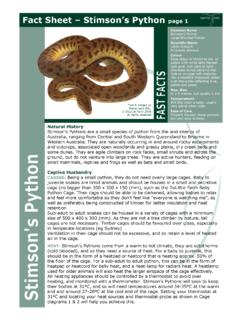
1 fact Sheet children 's Python page 1. Common Name children 's Python Scientific Name Liasis childreni Anteresia childreni Colour Base colour of brown to tan/grey with white belly, with dark to light chocolate dorsal patterns that fade or smudge with maturity. Has a beautiful iridescent sheen over the scales reflecting blue, yellow and green Max. Size to metres, but usually Temperament Will bite when a baby, usually very placid when older. Ease of Care Text & images by Properly housed, these pythons Steve Leisk BSc. are very easy to keep, and Dolittle Farm 2008 even offer the opportunity for all rights reserved breeding by novices. Natural History Childrens Pythons are a small species of Python from the northern parts of Australia, ranging from Mt Isa in Queensland to the Kimberley of Western Australia.
2 They are naturally occurring in and around rocky escarpments and outcrops, associated open woodlands and grassy plains. They are agile climbers on rock faces, small shrubs and across the ground, but do not venture into large trees. They are active hunters, feeding on small mammals, reptiles and frogs as well as bats and small birds. Captive Husbandry CAGING: Being a small Python , they do not need overly large cages. Baby to juvenile snakes are timid animals and should be housed in a small and secretive cage (no bigger than 300 x 300 x 150 (mm), such as the Dolittle Farm Baby Python Cage. Their cage should be able to be darkened, allowing babies to relax and feel more comfortable, as well as preferably being constructed of timber so they don't feel like everyone is watching me.)
3 Sub-adult to adult snakes can be housed in a variety of cages with a minimum size of 500 x 400 x 300 (mm). As they are not a tree climber by nature, tall cages are not necessary. Timber cages should be favoured over glass, especially in temperate locations (eg Sydney). Ventilation in their cage should not be excessive, and so retain a level of heated air in the cage. HEAT: Childrens Pythons come from a hot climate, they are ectotherms (cold blooded), and so they need a source of heat. For a baby to juvenile, this should be in the form of a heatpad or heatcord that is heating approx. 50% of the floor of the cage. For a sub-adult to adult Python , this can be in the form of heatpad or heatcord for belly heat, and a heat-lamp for radiant heat. A heatlamp used for older animals will also heat the larger airspace of the cage effectively.
4 All heating appliances should be controlled by a thermostat to avoid over heating, and monitored with a thermometer. children 's Pythons will seek to keep their bodies at 31 C, and so will need temperatures around 34-35 C at the warm end and around 27-28 C at the cool end of the cage. Setting your thermostat at 31 C and locating your heat sources and thermostat probe as shown in Cage diagrams 1 &. 2 will help you achieve this. fact Sheet children 's Python page 2. LIGHTING: These pythons are semi nocturnal in nature, and so will be most active when the lights are out. It is still important to have a day/night cycle in their cage of 14 hrs of day, 10 of night, which can be delivered by fluorescent lighting or by strong room lighting. The use of UV reptile lighting can have a positive effect on these animals, but the use of bulbs exceeding UVB could be detrimental.
5 Newly acquired or baby animals should have minimal light until they have settled into their new cage and have eaten. HABITAT: Childrens Pythons will use almost anything as habitat. A varied selection of caves, rocks, logs, plastic plants and similar items will all be beneficial to them. Make sure any natural wood products have as much bark as possible removed before use. Clean flooring is important, with wood shavings, barks or paper cat litters providing a clean and effective litter. All floorings should be completely changed every 4 weeks, with spot cleaning occurring weekly. All furnishings should be thoroughly scrubbed every 4 weeks, with a change of scenery provided at this time to keep your snake enthusiastic for new smells and new territories. Cleaning of walls, floor and furnishings should be done with a reptile safe cage cleaner.
6 Don't use household chemicals. SETTING UP A CAGE: Below are some diagrams of how a cage should be set up. Obviously, your own artistic flair will alter how your cage looks Baby/Juvenile Cage = Thermostat Probe = Heat Pad Climbing twig Hide Substrate Cage Feet Sub-Adult/Adult Cage Heatlamp and Cage Basking/climbing branch Rocky / boulder decore Hide Water bowl Substrate Cage Feet fact Sheet children 's Python page 3. Biological Cycles FEEDING: In captivity, children 's Pythons will feed on mice. They can also feed on small quails and small rats, however we prefer that rats be avoided. Under no circumstances should small skinks or frogs be offered as food. We recommend you feed Dolittle Farm Frozen Foods, and follow this procedure;. 1) Check that your Python is warm and happy (and so is enthusiastic to feed), and is not in a shed cycle 2) Wash your hands 3) Remove your bag of food from the freezer eg mice, unseal the bag and remove the desired amount of food.
7 Reseal the bag and return it to the freezer 4) Thaw and then warm up the mouse to 38 C by placing it on a hot surface, such as a heatpad or the DVD/video player. Using a piece of paper towel under the food might be a good idea. We do not recommend you use hot water to thaw your food, and definitely don't use the microwave. 5) You will need to turn' the food over at least once during thaw/warming. 6) When the mouse is nice and warm (as warm as your armpit - 38 C), roll the food between index finger and thumb to ensure no iceblocks remain in the abdomen of the mouse. 7) Wash your hands 8) Offer the mouse to your snake using blunt nosed feeding tweezers or with your fingers (holding the tail of the mouse). You may need to gently wiggle the mouse around to make it appealing.
8 9) Once the snake strikes the mouse, it will instantly wrap around it and squeeze. If this doesn't occur at the strike, give the mouse a tug or two to simulate it trying to escape. 10) Leave the snake alone until it has finished its meal. By all means watch, but keep still. 11) Wash your hands and leave your snake alone for a day or two. Feeding regularity is up to the owner, however we suggest feeding baby snakes every 5 days, and juvenile+ snakes every 7-10 days. This will obviously vary with the size of food offered and the characteristics of each individual snake. Purchasing your food in the morning, transporting it in a cooler bag/esky, and taking it straight home, is important for maintaining quality. Always store your frozen foods in the back of the freezer, where temperature is most stable.
9 DEFECATION: Your snake has to get rid of its excrement just like any other animal. It will usually defecate 5-7 days after eating, and it will have 3. components; a white chalk (uric acid urine), a discoloured conglomeration of fur (the pelt), and a dark brown stool (the poo). There will be a fair amount of fluid at the same time. Snakes feeding on Pinkies will not have the pelt in their defecation. If you would like to make cleaning easier, take your snake out onto the grass at the 5 day mark and allow him to roam supervised for 10 minutes or so. This will usually result in him defecating on the grass. fact Sheet children 's Python page 4. SHEDDING: If children 's Pythons are feeding on the correct amount of food, they will shed every 6-8 weeks (approx) when young, and 8-10 weeks (approx) when mature.
10 The shedding process usually goes for 9 days, but is affected by temperature, with prolonged lower temperatures extending the time between sheds and the time taken to shed. The shedding process (in days) is as follows;. Under the tail is milky. Snake refuses food Under body and tail are milky Eyes are milky, looking like it has cataracts Eyes milky, skin darker and wrinkly. Snake will seek our higher humidity Eyes are clear, body is wrinkly. Snake is usually cranky Snake will seek out moisture. Snake is usually cranky Snake will seek out moisture. Snake is usually cranky Snake will seek out moisture. Snake is usually cranky Snake will rub its nose on something abrasive (like a rock). The skin will peel back, and he will wriggle out with slow undulations of the body.