Transcription of The Elements of Scrum - Dymaxicon - dynamic
1 The Elements of ScrumChris Sims & Hillary Louise JohnsonMarch, 2011Co-authored by Chris Sims, one of the country s leading Scrum trainers, and author and business journalist Hillary Louise Johnson, The Elements of Scrum is a field guide to the popular software development methodology known as Scrum . The book grew out of what I learned from my students, says Sims. It was written iteratively every time we taught a class, we d add some new material. When it had reached a certain heft we started giving it out to people who asked us what Scrum was all about. The feedback we got, even from people who had studied and practiced Scrum , was usually something like, Oh, now I actually get it.
2 The book s accessibility is entirely intentional. We never wanted our book to read like a technical manual or look like one, adds Johnson, who has written for Inc and the Los Angeles Times, but developed her writing chops as a novelist and essayist. Chris classes are based on games and simulations, with next to no lecturing involved. Translating that kind of kinesthetic learning experience into a book full of words was a challenge. We decided that the best tool for creating an experiential book was to rely heavily on vivid, engaging storytelling. Scrum is a software development framework named after the rugby field phenomenon wherein players lock arms to press forward as one body, an apt metaphor for the Scrum team s organic unity of purpose and self-organizing structure.
3 The practices of Scrum are designed to help small teams of software developers achieve the team equivalent of Abraham Maslow s concept of self-actualization, a higher state of being characterized by flow, performance and synergy. Simply put, Scrum helps teams increase their happiness and productivity, says Scrum as a discipline evolved in the arena of software development, the methodology has applications beyond the world of software, in any work environment where small teams of people collaborate to get things done. My mom read the book, to my great surprise, and is using Scrum to organize her work on a book project of her own, says Elements of Scrum ($ print/$ kindle) is available directly from the publisher or from Amazon.
4 Bulk purchase discounts are available, as are favorable terms for retail outlets. For more information, visit Elements of ScrumReviewed by Bruce HagenReprinted with permission from the BayAPLN Website Giving a software development methodology a name like Scrum required both a sense of humor and an aptitude for metaphor. Chris Sims and Hillary Louise Johnson of Agile Learning Labs didn t give Scrum its name, but in their new book The Elements of Scrum , they write about it with the same whimsically wise approach. The combination of crisp clarity and intelligent humor make it an excellent choice for introducing your co-workers and managers to agile and and for convincing them to try it.
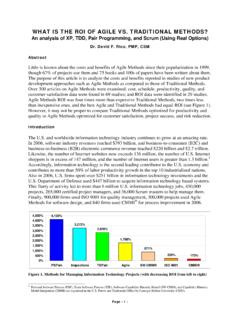
5 Chris and Hillary cover the spectrum of Scrum knowledge in a small but scrumptious package. True to its title and topic, the book strolls through the key Elements of Scrum while avoiding the mire of arcana. It begins with a Week in the Life story of a Scrum team: a happy tale which entices the reader to wonder how it s done. Elements then chronicles the history of agile, beginning with its roots in the weakness of waterfall, followed by concise explanations of the Agile Manifesto and agile principles. The agile introduction section ends with The Agile vs Waterfall Business Value Smackdown, aptly demonstrating with pictorial transparency how the early and often approach to software delivery not only mitigates risk, but maximizes chapter on Scrum history reveals some deep thinking, particularly Jeff Sutherland s concept of the Scrum team, recounted by fellow Agilista Mike Beedle, as a team that would resemble artificial life, a that would adapt and learn through social intelligence.
6 And before Chris and Hillary get down to the practical details of scrumming, they introduce a pair of quotes by Chicago Bulls Phil Jackson and Michael Jordan that made me wonder if my affinity for Scrum may have roots in my years of high school discussions of Scrum roles, ceremonies, and artifacts are clear and down-to-earth. I appreciated their addition of a definition of done artifact this concept, if not nailed down from the start, has the potential to spawn much confusion and sorrow. Their explanation of the role of story points in sizing is refreshingly demystifying. Since Scrum is a main course framework that can be complemented by other agile side dish methods, Chris and Hillary share eight of their favorites, ranging from release planning and story mapping to refactoring and pair nuggets of wisdom are scattered throughout.
7 Among my favorites: traditional software development methods are plan-driven, agile projects are planning-driven, and Remember, it s not a religion, it s a tool you can use to help your team succeed. As an introductory text, you won t get the multiple case histories so useful in Ken Schwaber s Agile Project Management with Scrum , but the fundamental concepts are clearly articulated, with plenty of page-turning color commentary. This book is fun to read. Chris and Hillary have peppered the volume with quotes from the likes of Woody Allen and references to the movie Office Space. Far from gratuitous, the humor serves to illustrate important particulars, and it keeps the overall tone of the book consistent with the authors view of Scrum as a lightweight framework.
8 Any book that puns Elements and elephants on the front cover, and features a photo of the author juggling rubber chickens on the back, gets extra credit from this Scrum live beyond the world of software? Here s Jeff McKenna, quoted in beginning the chapter on Scrum history: Scrum , as defined, actually doesn t say anything about software. Scrum is about work management and team I picked up this book for review at a recent meeting of the BayAPLN. During my pre-meeting networking, and the audience interaction with guest speaker Ulrich Nettesheim, I was struck by the variety of professional backgrounds and interests of the attendees.
9 It seems that agile principles and Scrum methods can and are being applied outside the SDLC arena in education, and in management of non-profit service agencies, to name just I gotta go. It s Friday night. My product owner and I need to review the garden backlog for this weekend s sprint. 2011 Bruce Hag