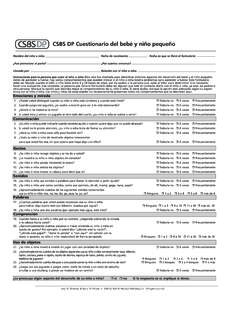
Transcription of Communication and Symbolic Behavior Scales …
1 Communication and Symbolic Behavior Scales Developmental ProfileInfant/Toddler ChecklistAmy M. Wetherby & Barry M. Prizant 2001 by Paul H. Brookes Publishing Co. All rights Is Early Identification Important?There is mounting evidence that intervention beginning during infancy or preschool age has a greater impact onoutcomes for children and families than providing services at school age (Barnett & Escobar, 1990). It is estimatedthat every dollar spent on early intervention can save $ in later special education, crime, welfare and other costs(Florida Starting Points, 1997).
2 In spite of federal mandates for early intervention, limitations of the identificationprocess diminish access to services (Meisels & Wasik, 1990). According to the 22nd Annual Report to Congress (USDOE, 2000), 11% of school-age children receive special education services. In contrast, only of preschoolchildren receive special education and only of infants and toddlers receive early intervention services. Thesestatistics indicate a significant need to improve early identification of children who are likely to require specialeducation at school age. In spite of federal legislation for early intervention, we are not reaching most of thechildren and families who need help as early as we should.
3 Brain Research. Recent advances in brain research show how the environment sculpts the young child s brain,as neurons form connections and mature in response to stimulation. The environment has the greatest potentialto influence the child s developing brain during a child s first few years of life. Early experiences affect brainstructure because the brain operates on a use it or lose it principle (Carnegie Task Force on Meeting the Needsof Young Children, 1994; Ounce of Prevention Fund, 1996). If a child does not have adequate emotional,physical, cognitive, and language stimulation, neurons can be lost permanently.
4 School Readiness. Language development is one of the most critical school readiness skills. A child s capacityto talk and the size of their vocabulary when they enter kindergarten is predictive of success in school. Childrenwith language problems in preschool are likely to face poor educational achievement at school age and are atincreased risk to develop emotional and behavioral disorders (Baker & Cantwell, 1987; Prizant, Audet., Burke, etal., 1990). Follow-up studies of preschoolers with speech and language problems consistently demonstratepersisting Communication impairments in a substantial proportion of children, and a high incidence of learningdisabilities (Howlin & Rutter, 1987).
5 Early intervention may prevent or decrease the severity of language delaysin preschoolers, enhance school readiness, and increase later academic success in school. Cumulative Effects of Poverty and Environmental Risk. Research on young children raised in povertydemonstrates the dramatic detrimental impact that impoverished environments can have on a child s capacity tolearn to talk. Strong correlations exist among the amount that parents talk to their children, socioeconomic status,children s vocabulary, and children s IQ (Hart & Risley, 1992; Walker, Greenwood, Hart, & Carta, 1994).
6 Asdocumented by Hart and Risley (1992), children's capacity for learning language is solidified by age 3, and thecumulative effects of the environment are evident. By school age, children in poverty are more likely to havedevelopmental disabilities and Behavior problems, and to require special education services than other children(Brooks-Gunn & Duncan, 1997; US DOE, 2000). Educational programs beginning at 3 or 4 years of age couldnot hope to overcome such vast differences in cumulative experience. The challenge that we face is how tointervene very early in children s lives to effectively enhance child development and impact on school Can We Find Children Earlier?
7 A child s level of Communication development may be the best indicator of a developmental delay. Delays ordisorders in Communication development are the most prevalent symptom in children with disabilities (Wetherby &Prizant, 1996). When serious health or physical impairments are not present, a delay in language development maybe the first evident symptom that a child is not developing normally. A language delay may be the primary problemor reflect delays in other domains ( , socioemotional, cognitive, motor, or sensory).Most children develop their first words between 12 and 15 months, and it is common practice to wait until a child is18 to 24 months and still not talking to refer the child for an evaluation.
8 The challenge for service providersdetermining whether to make a referral for a developmental evaluation is two-fold. First, many children who are latein talking catch up on their own and need to be distinguished from children who will have persisting languageWetherby & Prizant, 2001 Page 2problems. Second, children with delayed language skills need to be identified even earlier before language over the past two decades has identified a collection of language predictors that are indicators of laterlanguage development and promise earlier and more accurate identification (McCathren, Warren, & Yoder, 1996;Wetherby & Prizant, 1993; 1996).
9 The following 7 language predictors have been identified:1) Emotion and Use of Eye Gaze,2) Use of Communication ,3) Use of Gestures,4) Use of Sounds,5) Use of Words,6) Understanding of Words, and7) Use of studies have demonstrated that children delayed only in the use of words are very likely to catch up on theirown while children who are delayed also in several or many of the other predictors are likely to have persistingproblems. Instead of waiting for children to start using words, evaluating these language predictors is apromising solution to improve early identification.
10 Description of the ChecklistThe Communication and Symbolic Behavior Scales Developmental Profile Infant/Toddler Checklist is designed tomeasure the following 7 language predictors have been identified:1) Emotion and Use of Eye Gaze,2) Use of Communication ,3) Use of Gestures,4) Use of Sounds,5) Use of Words,6) Understanding of Words, and7) Use of Checklist is a first step in routine developmental screening for children 6 to 24 months of age to decide if acommunication evaluation is needed. It is designed for use in pediatricians offices during well-child check-ups orroutine visits or in childcare centers or other facilities serving infants and toddlers and their families.