Transcription of Project Procurement Management - pmstudy.com
1 Project Procurement Management Study Notes 2012 All rights reserved PMI, PMP, CAPM, PMBOK, PM Network and the PMI Registered Education Provider logo are registered marks of the Project Management Institute, Inc. 2 Points to Note Please read Chapter 12 from Project Management Institute, A Guide to the Project Management Body of Knowledge, (PMBOK Guide) Fourth Edition, Project Management Institute, Inc., 2008 (pages 313-344). The study notes explain topics that are important for PMP exam preparation, and you can expect several questions from these topics. It is very important to understand all the concepts discussed in this chapter, so please pay close attention to all the terms used Try to relate the concepts to real life examples.
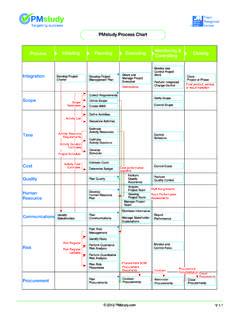
2 After reading the study notes, please answer the chapter test questions in this Knowledge Area. The chapter questions improve your understanding of the concepts discussed in the study notes. 2012 All rights reserved What is Project Procurement Management Includes the processes required to acquire goods and services from outside the performing organization to fulfill Project scope requirements The Procurement Management processes are: Plan Procurements Conduct Procurements Administer Procurements Close Procurements Please refer to figure 12-1, PMBOK Guide Fourth Edition, page 314. This provides an overview of the processes in Project Procurement Management .
3 3 2012 All rights reserved Understanding Terms and Concepts Project Procurement Management has several terms and concepts, which need to be studied and properly understood to perform well in the PMP exam. Please carefully study the terms and concepts explained in this section (also in the Terms and Concepts module of our study materials) to fare well in the PMP exam. 4 2012 All rights reserved Plan Procurements Identifies which Project needs can be best met by acquiring products and services from outside the Project organization, versus those that can be accomplished by the Project team Involves consideration of whether to procure, how to procure, what to procure, how much to procure, and when to procure 5 2012 All rights reserved Make or Buy Analysis Used to determine whether a particular product can be produced by the performing organization Analysis should include.
4 Both indirect and direct costs Prospective as well as the immediate needs of the performing organization. For example: Whether a capital goods item can be used for other current or future projects of the organization (ongoing need of the item) Additional capacity is available for use within the organization Proprietary or business critical activity, which is core business for the company ( , designing of chips in a chip manufacturing company) 6 2012 All rights reserved Make or Buy Analysis the cost of Make or Buy Question: You are considering whether to buy or make a software product: If you buy, the cost is $ 80,000, and the cost of Procurement and integrating in your company is $ 1,000 If you want to make it yourself, the product will require seven software engineers working three months.
5 Salary of each software engineer is $ 4,000 per month. The overhead costs apportioned to the Project will be $ 2,000. Which option will you choose make or buy? Answer: If you buy, cost will be: $ 80,000 + $ 1,000 = $ 81,000 If you make, cost will be: $ 4,000 x 7 x 3 + $ 2,000 = $ 86,000 So, it is better for you to buy. 7 2012 All rights reserved Make or Buy Analysis (continued) Comparing the cost of Lease or Buy: Question: You are considering whether to buy or lease a machine for your heavy engineering plant. How will the duration of the Project influence your decision? If you buy, the cost is $ 29,000, and the one-time cost of Procurement and integrating in your company is $ 1,000 If you lease, you have to pay $ 10,000 as down payment and $ 5,000 per month Answer: If you buy, cost is: $ 29,000 + $ 1,000 = $ 30,000 Assuming the lease is for M months, the cost is: $ 10,000 + $ 5,000 x M The cost of buy = cost of lease, if : $ 30,000 = $ 10,000 + $ 5,000 x M M = 20,000/5,000 = four months So, if the duration of the Project is less than four months, you should lease otherwise, you should buy.
6 8 2012 All rights reserved Contract Type Selection 9 2012 All rights reserved Types of Contracts Types of contracts include: Cost-plus percentage fee Cost-plus fixed fee Cost-plus guaranteed maximum Cost-plus guaranteed maximum and shared savings Cost-plus incentive (award fee) Cost and cost sharing Fixed price or lump sum Fixed price with redetermination Fixed price incentive fee Fixed price with economic price adjustment Fixed price incentive with successive targets Fixed price for services, material, and labor at cost (purchase orders, blanket agreements) Time and material/labor hours only Bonus-penalty Combinations Joint venture Reference.
7 Project Management - A Systems Approach To Planning, Scheduling, And Controlling, Pages 1147-1151 10 2012 All rights reserved Important Fixed Price Contracts Fixed price or lump sum: Contractor performs the work for negotiated value. If estimated target cost is low, profit for seller may be low or even nil. Lowest risk to the buyer, highest risk to the seller Usually requires a long period for preparation of bids; also buyers include many contingency provisions to protect their interests Done only when the product is very well-defined; subsequent changes made might lead to trouble and sometimes considerable expenses Fixed price incentive fee: Allows for adjustment of the total profit by a formula that depends on the final total cost at the completion of the Project .
8 There is an incentive to the seller to decrease costs. Fixed price with redetermination: Prospective: allows for future negotiations of some fixed prices contracts at specified times Retroactive: allows for adjustment of contract price after performance has been completed Fixed price with economic price adjustment: Allows for price increases, if the contract is for multiple years (for example, to account for inflation) Reference: Project Management - A Systems Approach To Planning, Scheduling, And Controlling, Pages 1147-1151 11 2012 All rights reserved Important Cost Reimbursable Contracts All cost reimbursable contracts require that the seller s books be audited.
9 Cost plus fixed fee: Cost may vary, but the fee remains the same Provides incentive to the contractor for early completion of the job Cost plus percentage of costs: Not preferred, because there is no incentive for the seller to control costs Is illegal in several companies and countries Cost plus incentive fee: Same as cost plus contracts, except that these have provision for adjustment of the fee that compares the total Project cost to the target cost. Usually used for long-term ( , R&D) contracts Reference: Project Management - A Systems Approach To Planning, Scheduling, And Controlling, Pages 1147-1151 12 2012 All rights reserved Procurement Management Plan Describes how the remaining Procurement processes (from developing Procurement documents through contract closure) will be managed and includes.
10 Types of contracts to be used Persons who prepare independent estimates and when Actions taken by the Procurement department and the Project team Sources of standardized Procurement documents Methods to manage multiple providers Ways to coordinate procurements with the other aspects of the Project 13 2012 All rights reserved Conduct Procurements Involves receipt of bids or proposals from the sellers and application of the evaluation criteria to select a seller Tools and Techniques used are: Bidder conferences Proposal evaluation techniques Independent estimates Expert judgment Advertising Internet research Procurement negotiations Important outputs are.