Transcription of Regulatory Notice 10-22 - finra.org
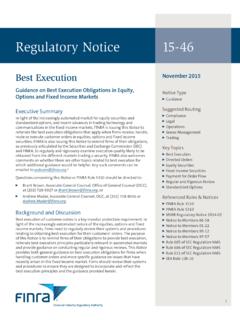
1 Regulatory Notice 10-22 . Regulation D Offerings April 2010. Obligation of Broker-Dealers to Conduct Reasonable Notice Type Investigations in Regulation D Offerings Guidance Suggested Routing Compliance Executive Summary Legal finra reminds broker-dealers of their obligation to conduct a reasonable Registered Representatives investigation of the issuer and the securities they recommend in offerings Senior Management made under the Securities and Exchange Commission's Regulation D under the Securities Act of 1933 also known as private placements.
2 Key Topics Regulation D provides exemptions from the registration requirements Communications With the Public of Section 5 under the Act. Regulation D transactions, however, are not Private Placements exempt from the antifraud provisions of the federal securities laws. A Suitability broker-dealer has a duty enforceable under federal securities laws and Supervision finra rules to conduct a reasonable investigation of securities that it recommends, including those sold in a Regulation D offering. Referenced Rules & Notices Moreover, any broker-dealer that recommends securities offered under Regulation D.
3 Regulation D must meet its suitability requirements under NASD Rule Securities Act Section 17. 2310 (Suitability), and must comply with the advertising and supervisory SEA Section 10(b). rules of finra and the SEC. Rule 10b-5. Questions regarding this Notice should be directed to: finra Rule 2010. Joseph E. Price, Senior Vice President Corporate Financing/Advertising, finra Rule 2020. at (240) 386-4623; NASD Rule 2210. Paul Mathews, Director, Corporate Financing Department, at (240) NASD Rule 2310. 386-4639; or NASD Rule 3010.
4 Gary Goldsholle, Vice President and Associate General Counsel, NTM 03-71. Office of General Counsel, at (202) 728-8104. NTM 05-18. NTM 05-48. Regulatory Notice 09-05. 1. 10-22 April 2010. Background and Discussion Part I of this Notice describes Regulation D. Part II describes broker-dealers' Regulatory responsibilities to engage in a reasonable investigation of a Regulation D offering, enforceable under the antifraud provisions of the federal securities laws and finra . rules. Part II also describes specific issues that pertain to a broker-dealer's (BD's).
5 Responsibilities and how the scope of a BD's responsibility to conduct a reasonable investigation will necessarily depend upon its affiliation with the issuer, its role in the transaction, and other facts and circumstances of the offering, including whether the offerees are retail investors or more sophisticated institutional Part III describes practices that some broker-dealers have adopted to help them discharge their reasonable investigation obligations. These practices are especially relevant to Regulation D offerings of securities of companies that are non-reporting under the Securities Exchange Act of 1934.
6 BDs, however, may find that many of the practices are appropriate for other types of offerings. I. Regulation D. The private placement market is an essential source of capital for American business, particularly small firms. According to one estimate, in 2008 companies intended to issue approximately $609 billion of securities in Regulation D While the private placement market is an important source of capital for many companies, especially smaller issuers, finra has found significant problems in several recent examinations and investigations.
7 These problems include fraud and sales practice abuses in Regulation D offerings. Recently, for example, broker-dealers were sanctioned for providing private placement memoranda and sales materials to investors that contained inaccurate statements or omitted information necessary to make informed investment Rule 504 under Regulation D provides an exemption from the registration provisions under Section 3(b) of the Securities Act for limited offerings for which the aggregate offering price of securities within a 12-month period does not exceed $1,000,000.
8 Rule 505 provides an exemption under Section 3(b) of the Act for limited offerings for which the aggregate offering price of securities within a 12-month period does not exceed $5,000,000. Rule 505 permits an offering to an unlimited number of accredited investors and up to 35 non-accredited investors. Rule 501 defines accredited investor . as any person who meets, or who the issuer reasonably believes meets, certain requirements, including natural persons with a net worth in excess of $1,000,000, or annual income in excess of $200,000 (or $300,000 jointly with a spouse).
9 2 Regulatory Notice April 2010 10-22 . Rule 506 provides a legal safe harbor for an exemption from registration under Section 4(2) of the Act for the sale of securities to an unlimited number of accredited investors and up to 35 non-accredited investors. Rule 506 (unlike Rule 505) does not limit the permissible size of the offering, but requires that non-accredited investors possess a degree of financial sophistication. Specifically, Rule 506 requires that each non- accredited investor, either alone or with his purchaser representative(s), have such knowledge and experience in financial and business matters that he is capable of evaluating the merits and risks of the prospective investment, or the issuer must reasonably believe immediately prior to making any sale that the purchaser comes within this description.
10 Rule 505 and Rule 506 do not require that an issuer provide any specific written information concerning the offering to accredited investors, although issuers must provide specified information to a non-accredited investor who purchases in an offering. In practice, issuers often provide a private placement memorandum that describes the offering to all prospective purchasers, including accredited II. BD Regulatory Requirements in Regulation D Offerings A. Antifraud Provisions and finra Rules The Securities and Exchange Commission (SEC)