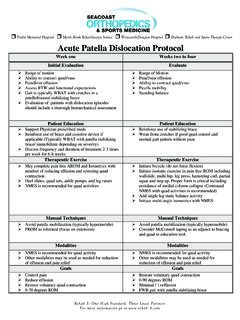
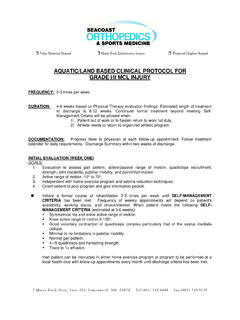
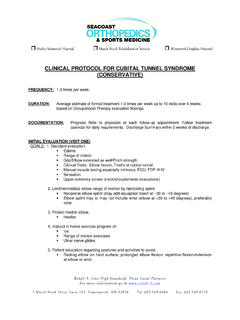
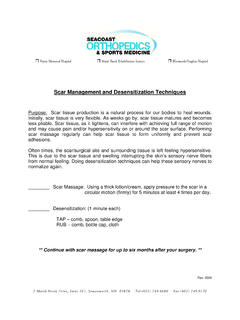
Transcription of Durham: Rehab and Sports Therapy Center ACL …
1 Frisbie Memorial Hospital Marsh Brook Rehabilitation Service Wentworth-Douglass Hospital Durham: Rehab and Sports Therapy Center ACL Reconstruction Protocol (Allograft). Week one Week two Initial Evaluation Evaluate Range of motion Range of Motion Joint hemarthrosis Joint Hemarthrosis Ability to contract quad/vmo Ability to contract quad/vmo Gait (generally WBAT in brace) Signs of infection or DVT. Patella Mobility Patella mobility Inspect for infection/signs of DVT. Assess RTW and sport expectations Patient Education Patient Education Support Physician prescribed meds Reassess crutch use; May use single crutch if Ensure compliance w/ pre-op hep appropriate Reinforce use of brace and assistive device Brace may be opened to 10 degrees less than the Restate surgical precautions patients pain free ROM if good quad contraction (No open chain knee extension) Reinforce precautions Discuss frequency and duration of treatment (2- 3x/wk is expected for the first 8 weeks, followed by intermittent appointments over another 6-8.)
2 Weeks). Therapeutic Exercise Therapeutic Exercise Review and update pre-op hep (heel slides, ankle Initiate bicycle (do not force flexion). pumps, quad sets, towel stretch) Should include early weight shifting and May complete AROM and Isometrics within proprioception surgical precautions May complete AROM and Isometrics within surgical precautions Manual Techniques Manual Techniques Grade I and II patella mobilizations Grade III-IV patella mobilization (if needed). PROM as tolerated (focus on extension) Posterior capsule mobilization (if needed). Incision mobilization Modalities Modalities NMES / Interferential / biofeedback Modalities may be used as needed Ice Goals Goals Gain full knee extension Gain full knee extension Control pain Restore voluntary quad contraction Reduce joint hemarthrosis Decrease Hemarthrosis Restore voluntary quad contraction Prevent excessive soft tissue scarring Independence with post-op precautions 0-100 degrees ROM.
3 0-80 degrees ROM. R e h ab 3 : O ne H ig h S t a ndar d, T hr ee Lo cal P ar t ne r s F or mo re i n for ma ti on g o to w ww .r eh a Frisbie Memorial Hospital Marsh Brook Rehabilitation Service Wentworth-Douglass Hospital Durham: Rehab and Sports Therapy Center Week Three Weeks Four to six Evaluate Evaluate Gait and brace needs Patella position and related symptoms Quad Contraction ROM. ROM Joint laxity Balance Gait HEP compliance Patient Education Patient Education Wean from crutches D/C brace if good quad contraction Therapeutic Exercise Therapeutic Exercise Closed chain exercises for quad contraction and Bilateral dynamic balance activity proprioception Progress to full weight bearing isotonics 90-0 degrees May initiate partial weight bearing press from at 4 weeks 70-0 degrees Initiate resistive hamstring curl Single leg stance Single leg dynamic balance activity on a stable Bilateral dynamic balance activity surface at week 6.
4 Single leg isotonic exercises at week 6. Manual Techniques Manual Techniques Patella mobilizations as indicated Patella mobilizations as indicated PROM and posterior capsule stretch as indicated PROM and posterior capsule stretch as indicated Modalities Modalities Any as Indicated Any as Indicated Goals Goals Gait with single axillary crutch FWB without brace or assistive device if good quad Continue to reduce any localized hemarthrosis control and physician in agreement Restore voluntary muscle control No pain with ADL's Single leg stance with eyes closed for at least 10 Quad strength at least 4-/5. seconds Normal ROM. 0-120 degrees ROM. R e h ab 3 : O ne H ig h S t a ndar d, T hr ee Lo cal P ar t ne r s F or mo re i n for ma ti on g o to w ww .r eh a Frisbie Memorial Hospital Marsh Brook Rehabilitation Service Wentworth-Douglass Hospital Durham: Rehab and Sports Therapy Center Weeks six to twelve Weeks twelve to discharge Evaluate Evaluate Patella mobility / crepitus Any excessive joint laxity Excessive joint laxity Isokinetic Strength test and/or functional hop testing Balance / single leg stance for comparison to be completed per physician HEP compliance preference at 16 weeks Address any deficits that may limit return to work or sport goals HEP compliance Therapeutic Exercise Therapeutic Exercise Progress to closed chain exercises on unstable Sports specific exercises surfaces at week 8 Encourage participation in the CFA.
5 Progress Isotonic strength training to include Complete agility and running activity with good test movement in multiple planes at 8 weeks results and physician approval at 16 weeks Progress balance activity to single leg dynamic May begin bilateral low level plyometrics with good activity and unstable surfaces at 10 weeks test results and physician approval at 16 weeks Cardiovascular training at 10 weeks (bike, swim and elliptical). May begin ACL group in CFA at 8 weeks (with physician approval). Goals Goals 4+/5 strength with manual testing by week ten Strength of quadriceps and hamstrings no less than Good stability across tibiofemoral joint 85% per isokinetic test at 16 weeks particularly with single leg balance and control of Functional hop test for time and distance at 85% or terminal knee extension greater at 16 weeks if applicable May complete exercise independently with Discharge with full return to work or sport activity intermittent follow up appointments when above criteria is met (Typically 10 weeks).
6 R e h ab 3 : O ne H ig h S t a ndar d, T hr ee Lo cal P ar t ne r s F or mo re i n for ma ti on g o to w ww .r eh a Frisbie Memorial Hospital Marsh Brook Rehabilitation Service Wentworth-Douglass Hospital Durham: Rehab and Sports Therapy Center Precautions and concomitant issues The completion of ACL Reconstruction using an allograft eliminates the potential issues that occur with hamstring and patella tendon harvest sites. However, the progression of exercise will be slower as longer healing times will be needed. Gaining full knee extension early in the Rehab process is crucial for return of volitional quadriceps contraction to avoid extensor mechanism dysfunction. Menisectomy No modification required Meniscal Repair No combined weight bearing and flexion, or flexion beyond 90. degrees for at least 4 weeks Micro fracture NWB typically four weeks, and PWB for two weeks MCL injury May need to use brace during exercise (Clarify with surgeon on a case by case basis).
7 May want to consider completing exercises with slight tibial IR to decrease stress on MCL. May limit motion to the sagittal plane for 4-6 weeks PCL injury Follow PCL protocol as it will be a slower Rehab than ACL. Chondromalacia Typically our physicians will give us insight into the location and severity of chondromalacia (grades I to IV). The location of chondromalacia often provides insight regarding faulty posture and biomechanics. Both location and severity should be considered when designing treatment programs Chondroplasty No modification required Consider unloading brace for return to activity if limited by pain 2009. R e h ab 3 : O ne H ig h S t a ndar d, T hr ee Lo cal P ar t ne r s F or mo re i n for ma ti on g o to w ww .r eh a