Transcription of The Guam Memorial Hospital Authority Proudly Presents ...
1 The guam Memorial Hospital Authority Proudly Presents : fall PREVENTION PROGRAM. CAUTION: fall RISK. Roseann Apuron, RNC-OB & Jasmin Tanglao, RN. February 2018. OBJECTIVES: AT THE END OF THE PRESENTATION STAFF WILL BE ABLE TO: 1. Recall the key elements of the GMHA fall Prevention Program 2. Identify components of the fall Risk Assessment Tools in the Clinical Setting for adult and pediatric populations. 3. Describe current and new nursing interventions for each risk level, for adults and the pediatric populations 4. Describe what to do after a fall incident.
2 5. Explain how everyone can be a team player in preventing falls here at GMHA. IMPORTANCE OF THE PROGRAM: Patient Safety! Comply with Joint Commission Requirements: Reduce the risk of patient harm resulting from falls Initiate evidence-based practices to reduce the incidence of falls Continue to implement an Interdisciplinary approach to fall Prevention Hospital -wide Continue our Mission: To Provide Quality Patient Care in a Safe Environment WHAT IS A fall ? It is an unplanned descent to the floor (or extension of the floor, with or without injury to the patient: All types of falls are to be included whether they result from physiological reasons (fainting) or environmental reasons (slippery floor).)
3 Include assisted falls when a staff member attempts to minimize the impact of the fall . STATS ABOUT FALLS IN HC FACILITIES: Patient falls affect between 700,000 to 1 million patients each year. Falls rank among the most frequently reported incidence in hospitals and other healthcare facilities. In acute care and rehab hospitals, between 30-51% of falls result in some injury. Up to 44% of those injuries are ones that may lead to death ( fractures, subdural hematomas, or excessive bleeding). Injured patients require additional treatment and sometimes prolonged Hospital stays.
4 The average cost for a fall with injury was about $14,000 in 2015. Today, falls with serious injuries cost hospitals an additional $27,000. Falls with serious injury are consistently among the Top 10 sentinel events reported to The Joint Commission's Sentinel Event database. Falls must now be reported to the Hospital Improvement Innovation Network (HIIN) led by CMS. WHAT CONTRIBUTES TO A fall : Analysis of falls with injury in the Joint Commission Sentinel Event database reveals the most common contributing factors pertain to: Inadequate assessment Communication failures Lack of adherence to protocols and safety practices Inadequate staff orientation, supervision, staffing levels or skill mix Deficiencies in the physical environment Lack of leadership CONTRIBUTING FACTORS TO A fall : EXTRINSIC INTRINSIC.
5 FACTORS FACTORS. EXTRINSIC FACTORS: Poor Lighting POOR Medications LIGHTING. FURNITURE/. Floor Surfaces STRUCTURAL MEDICATIONS. DESIGN. Excessive Clutter Equipment INADEQUATE. ASSISTIVE. EXTRINSIC. FACTORS. FLOOR. SURFACES. Malfunction DEVICES. Footwear Inadequate EXCESSIVE. Assistive FOOTWEAR. CLUTTER. Devices EQUIPMENT. MALFUNCTION. Furniture/. Structural Design INTRINSIC FACTORS: Previous Falls PREVIOUS. Reduced vision FALLS. INADEQUATE REDUCED. Unsteady Gait NUTRITION VISION. Musculoskeletal System Mental Status ILLNESS. UNSTEADY. GAIT. INTRINSIC.
6 Age and Gender FACTORS. Urinary Incontinence Illness MUSCULO- URINARY. INCONTINENCE. SKELETAL. SYSTEM. Inadequate Nutrition AGE & MENTAL. GENDER STATUS. PATIENT ASSESSMENT: Upon admission, and every shift, or with any ACOC, fall Risk Assessment Tool: Adults: The Morse fall Scale (18 years and older). Pediatrics: The Humpty Dumpty Falls Scale (age 3. months to 17 years). An Acute Change of Condition is a sudden, clinically important deviation from a resident's baseline in physical, cognitive, behavioral, or functional domains. Clinically important means a deviation that, without intervention, may result in complications or death.
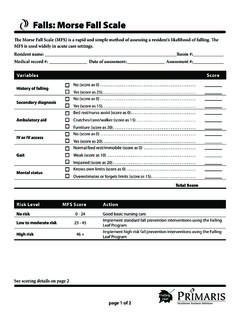
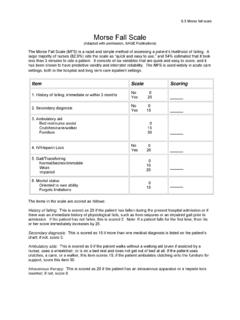
7 ADULT TOOL: Morse fall Scale Evidence- Based 6 areas of assessment: fall History Secondary Diagnosis Ambulatory Aid Saline Lock / IV. Gait Transferring Mental Status MORSE fall SCALE RISK LEVELS: Low Risk: 0-24. Moderate Risk: 25-44. High Risk: Greater then 45. ADULT MEDICATION ASSESSMENT: HIGH ALERT MEDS: ADULT MEDICATION ASSESSMENT : CAUTION MEDS: Note: Thrombolytics should be considered due to the risk of bleeding related to a fall Important info to share in post fall huddle! PEDIATRIC TOOL: The Humpty Dumpty Scale Evidence-Based 7 assessment criteria: Age Gender Diagnosis Environmental Factors Response to Surgery/Sedation/.
8 Anesthesia Medication Usage HUMPTY DUMPTY fall SCALE RISK LEVELS: Only 2 Levels Low Risk: 7-11. High Risk: 12 or Above PLAN OF CARE (POC): Implement POC based on the risk assessment score. A fall Risk Care Plan will be initiated for patients indicated as High Risk. Risk level is either low risk, moderate risk, or high risk. POC shall be modified based on changes in the patient's condition. Any significant changes in the patient's condition must be communicated to all staff members involved in the patient's care. Discontinue POC if no longer considered a fall risk NURSING INTERVENTIONS (ADULT): Low Risk (score of 0-24): Implement the Standard fall Precautions: 1.
9 Environmental orientation/re-orientation. 2. Call light use demonstrated and within reach. 3. Personal possessions within safe patient reach. 4. Handrails (bathrooms, room, and hallway). 5. Hospital bed in low position (while resting in bed); raise bed (when the patient is transferring out of bed). 6. Bed brakes locked. 7. Wheelchair wheel locks in "locked" position when stationary. 8. Patient footwear (nonslip, well-fitting). 9. Use night lights or supplemental lighting. 10. Floor surfaces kept clean and dry. 11. Keep care areas uncluttered. 12.
10 Follow safe patient handling practices. 13. Place Call Don't fall visual cues in patient rooms. 14. Encourage daily exercise or ambulation to maintain strength and reduce risk of debilitation if possible. NURSING INTERVENTIONS (ADULT): Moderate Risk (score of 25-44): Implement the Standard fall Precautions and the following: 1. Family members stay with patient or inform staff if leaving. 2. An Alert clasp identifier for fall (YELLOW clasp) will be placed on the patient's ID bracelet. 3. Place a Caution: fall Risk sign in front of the patient's room.