Transcription of Name of Instrument: Morse Fall Scale Author: Janice M. …
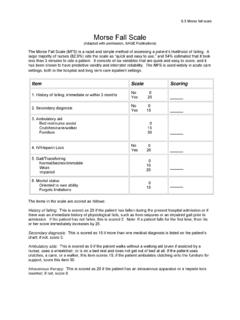
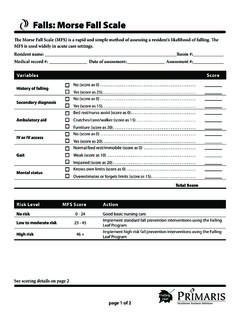
1 Name of instrument : Morse fall Scale Author: Janice M. Morse Contact Info: Name: Janice M. Morse Address: The Pennsylvania State University School of Nursing Health and Human Development East, University Park, PA. 16802-6508. Phone: Fax: E-mail: Privacy Use Cost: $. Public Use Cost: $. Year Developed: 1985. Where to obtain Instrument: Referenced article Contact author Description of the Instrument This instrument is a rater-administered instrument designed to identify individuals at risk for anticipated physiological falls. The Scale is comprised of 6 assessment items: history of falling, secondary diagnosis, use of ambulatory aid, intravenous therapy, gait and mental status.
2 Presence of a risk factor is rated as yes or no for three of the items ( history of falling). For three items, ratings are based on two or three descriptors. For example, the descriptors for the category, mental status, are: oriented to own ability and overestimates/forgets limitations . Scores assigned to each response are recorded. Scoring: Yes or no responses or descriptors for each item have been assigned a rating in five point increments ranging from 0 to 30 points. Based on the total score, individuals are categorized as high , medium or low risk of falling.
3 Form of instrument : Checklists Hazard/Risk Assessment Tools Method of delivery: In-person interview/assessment Audit of records Relevance to injury/ Percentage of the instrument specific to injury Assessment of risk of falls Time to administer or complete the instrument Rater-administered in less than one minute Methods of data analyses: Qualitative Quantitative Setting/sample instrument used in: A sample of 100 patients who had fallen and a randomly selected sample of 100. patients who had not fallen. Was it pilot tested? No Pilot test sample: Reliability Measures Validity Measures Additional testing completed by Eagle et al.
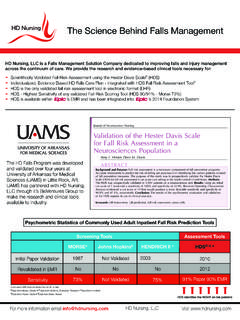
4 (1999) on a sample of elderly inpatients indicated the following: Sensitivity (ability to detect falls when they are present) = 72%. Specificity (ability to identify correctly the absence of falls) = 51%. Positive Predictive Value (how well test predicted compared to actual number of falls) = 38%. Negative Predictive Value (how well negative test correctly predicts absence of falls). = 81%. Accuracy (overall rate of agreement between the test and the actual number of falls) =. 57%. Prevalence (ratio of the number of people who have fallen divided by the total number of people at risk for falling) = 30%.
5 Reference Morse , , Morse , , & Tylko, (1989). Development of a Scale to identify the fall -prone patient. Canadian Journal on Aging, 8,366-377. Morse , Preventing patient falls. Thousand Oaks, CA: 1996 Sage Publications. Other References Cinahl Information Systems. Summary prepared by Berlin L and Sechrist K, Berlin Sechrist Associates. Eagle, J., Salamara, S., Whitman, D., Evans, , Ho, E., & Olde, J. (1999). Comparison of three instruments in predicting accidental falls in selected inpatients in a general teaching hospital. Journal of Gerontological Nursing, 25(7), 40-45.
6 Keywords: fall Scale , falls, risk.