Transcription of Fall Protection - Safeticorp LTD
1 fall Protection Training Guide 206 Bones in the human body = 206 Reasons for fall Protection Occupational Safety and Health Administration (OSHA) Regulations Effective January 1, 1998 body belts are not acceptable as a part of a fall arrest system. The use of a body belt in a positioning device is acceptable. A fall creating an impact of 1,800 lbs. or greater will require a shock absorbing device. (Lanyards shall have and attached energy absorbing device with a maximum arrest force not exceeding 900 lbs.) Standard lanyards shall be used for positioning or restraint only.
2 Belts and Harness: Side D rings are used for positioning only and are NOT to be used for fall arrest. Shoulder D rings are used for retrieval only and are NOT to be used for fall arrest. Lanyards: For fall arrest, OSHA requires that the free fall distance must never exceed 6 feet ( meters) What can be done to reduce falls? OSHA requires that fall Protection be provided at elevations of; four feet in general industry workplaces, five feet in shipyards, six feet in the construction industry and eight feet in longshoring operations.
3 To prevent employees from being injured from falls, employers must: Guard every floor hole into which a worker can accidentally walk (using a railing and toe board or a floor hole cover) Provide a guard rail and toe board around every elevated open sided platform, floor or runway Regardless of height, if a worker can fall into or onto dangerous machines or equipment (such as a vat or acid or a conveyor belt) employers must provide guardrails and toe boards to prevent workers from falling and getting injured Other means of fall Protection that may be required on certain jobs include safety and harness and line, safety nets, stair railings and hand rails OSHA requires employers to.
4 Provide working conditions that are free of known dangers Keep floors in work areas in a clean and, so far as possible, a dry condition Select and provide required personal protective equipment at no cost to workers Train workers about job hazards in a language that they can understand fall Protection Categories All fall Protection products fit into four functional categories. 1. fall Arrest; 2. Positioning; 3. Suspension; 4. Retrieval. fall Arrest: A fall arrest system is required if any risk exists that a worker may fall from an elevated position, as a general rule, the fall arrest system should be used anytime a working height of six feet or more is reached.
5 Working height is the distance from the walking/working surface to a grade or lower level. A fall arrest system will only come into service should a fall occur. A full body harness with a shock absorbing lanyard or a retractable lifeline is the only product recommended. A full body harness distributes the forces throughout the body, and the shock absorbing lanyard decreases the total fall arresting forces. Positioning: This system holds the worker in place while keeping his/her hands free to work. Whenever the worker leans back, the system is activated.
6 However, the personal positioning system is not specifically designed for fall arrest purposes. Suspension: This equipment lowers and supports the worker while allowing a hands free work environment, and is widely used in window washing and painting industries. This suspension system components are not designed to arrest a free fall , a backup fall arrest system should be used in conjunction with the suspension system. Retrieval: Preplanning for retrieval in the event of a fall should be taken into consideration when developing a proactive fall management program.
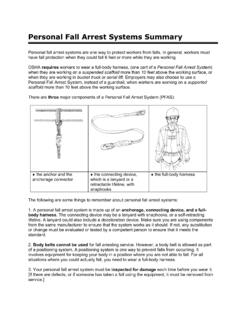
7 fall Protection Systems Class 1: Body belts (single or double D ring) are designed to restrain a person in a hazardous work position and to reduce the possibility of falls. They should not be used when fall potential exists; positioning only. Class 2: Chest harnesses are used when there are only limited fall hazards (no vertical free fall hazard), or for retrieving persons such as removal of persons from a tank or a bin. Class 3: Full body harnesses are designed to arrest the most severe free falls. Class 4: Suspension belts are independent work supports used to suspend a worker, such as boatswain's chairs or raising or lowering harnesses.
8 Rope Lanyard: Offers some elastic properties for all arrest; used for restraint purpose. Web Lanyard: Ideal for restraint purposes where fall hazards are less than 2 feet. Cable Positioning Lanyards: Designed for corrosive or excess heat environments and must be used in conjunction with shock absorbing devices. Shock Absorbers: When used, the fall arresting force will be greatly reduced if a fall occurs. Rope Grabs: A deceleration device which travels on a lifeline, used to safely ascend or descend ladders or sloped surfaces and automatically, by friction, engages the lifeline and locks so as to arrest the fall of an employee.
9 Retractable Lifeline Systems: Gives fall Protection and mobility to the user when working at height or in areas where there is a danger of falling. Safety Nets: Can be used to lesson the fall exposure when working where temporary floors and scaffolds are not used and the fall distance exceeds 25 feet. Rail Systems: When climbing a ladder, rail systems can be used on any fixed ladder as well as curved surfaces as a reliable method of fall prevention. Personal fall Arrest Systems *Limit maximum arresting force on an employee to 900 lbs.
10 (4 kiloNewtons) when use with a body belt *Limit maximum arresting force on an employee to 1,800 lbs.(8 kiloNewtons) when use with a body harness *Be rigged so that an employee can neither free fall more than 6 feet ( meters) nor contact any lower level *Bring an employee to a complete stop and limit maximum deceleration distance an employee travels to feet ( meters) *Have sufficient strength to withstand twice the potential impact energy of an employee free falling a distance of 6 feet ( meters) Personal fall arrest systems must be inspected prior to each use for wear damage, and other deterioration.