Transcription of In The Biginning - Nice Air Aviation
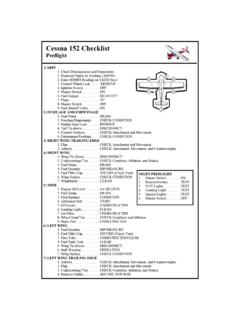
1 Nice Air Operation Procedure cessna 152 1. In The Biginning Check how many hours remains for next 100h inspection and check squawk before take airplane. Perform pre-flight inspection using check list. Report to the front desk if you need fuel, oil or found some- thing need to be checked by mechanic. If the hobbs meter doesn't much with the one in the tach sheet, report to front desk or instructor before start the engine. Pull out the airplane with tow bar before start the engine. Use tow bar by one hand and pull the airplane by other hand. After pull out, make sure tow bar is stored in the baggage compartment.
2 Do not grab the dash board or post to adjust the seat position. Grab the bottom of instrument panel or win- dow frame. Grab the window frame to close the door. Do not use the black strap to close the door. Use both hand to open the door. Sometimes the wind blow out the door. Do not put anything on the dash board. It will make scratch on the window shield and affect magnetic com- pass deviation. After secure the seat belt and shoulder harness, put the remaining belt in between the legs. The toes must be kept at the bottom of the rudder pedal unless it is necessary to use the brake.
3 Try to mini- mize the use of the brake during taxi. Taxi up to the yellow box before contact ground. If you see other airplanes come back and waiting for you to come out, you can taxi out of parking row but do not enter movement area without contacting ground. Make tear drop entry and take #1 spot in run up area if possible to maximize the run up area. Before landing, make sure toes don't touch the brakes. After landing, perform after landing check list. After come back to the parking, keep airplane parallel to the center line. DO NOT TURN in the parking row. Use tow bar to park the airplane.
4 NEVER push the tail and move the airplane. Instructor must help the student to park the airplane. Use securing check list. If the hobbs meter stop in the middle of two numbers, take higher number. If you find any deficiency, make entry in the squawk sheet and report to the front desk. Copy Right Nice Air 2575 Robert Fowler Way, San Jose, CA 95148 Phone(408)729-3383. Nice Air Operation Procedure cessna 152 2. Before Maneuver Check 1. Seat belt, harness-Fasten. 2. Fuel shut off 3. Mixture-Rich. 4. Carburetor heat-Off 5. Ignition switch-Both 6. Master switch-On 7. Primer-Lock Clearing turn Complete 90 degrees turn to the left, and 90 degrees turn to the right.
5 Depend on the airspace and terrain, right turn may be the first. Watch the blind spot on the left, right, behind and below. Bank should be 15 to 20. degrees. Copy Right Nice Air 2575 Robert Fowler Way, San Jose, CA 95148 Phone(408)729-3383. Nice Air Operation Procedure cessna 152 3. Slow Flight Entry 1. Carburetor heat-On. 2. Throttle-1500 RPM, maintain altitude. As you reduce power, you should anticipate pitch down and yaw to the right Don't watch tachom- eter needle to move from cruise to 1500 RPM. Look at the horizon and cowling as you use peripheral vision. Adjust control pressure to avoid nose from dropping and adjust rudder to keep the heading constant.
6 3. Airspeed 80kt-Flap 10 70kt-Flap 20 60kt-Flap 30 The extension of flap cause nose to move up. If you allow it, you will gain altitude and airspeed decreases too quick. Anticipate this and you need to add slight forward pressure on the control wheel to avoid this. Watch horizon and cowling. Don't fix your eyes on the airspeed indicator and the flap switch. After you set full flap, you need to apply back pressure to keep the altitude constant. 4. Airspeed 40kt-2000 RPM Add right rudder as you add power to compensate the left turning tendency. PTS require you to main- tain minimum controllable airspeed which is almost 35kt for , you need to be able to fly at any speed.
7 Use trim. After this point, generally, pitch controls airspeed and power controls altitude. Remember the pitch attitude which gives you 35 kt. Climb Apply full power. Adjust pitch to maintain the airspeed. Add right rudder to maintain the heading. For level off, reduce power necessary to maintain the altitude. Adjust pitch to maintain the airspeed. Descent Reduce power as necessary. Adjust pitch to maintain the airspeed. Reduce right rudder to maintain the head- ing. For level off, add power necessary to maintain the altitude. Adjust pitch to maintain the airspeed. Add right rudder to compensate the left turning tendency.
8 Turn Use 10 degrees bank. For the right turn, you need to use more right rudder because of the left turning tenden- cy. On the other hand, the left turn dose not require much left rudder. Just reduce right rudder a little bit. Recovery 1. Throttle-Full, maintain the altitude. Add right rudder to compensate the left turning tendency. Adjust pitch gradually to maintain the alti- tude. Don't push nose down quickly. Pitch should be changed slowly from slow flight attitude(high) to cruise attitude(level). Look at the horizon and cowling as you scan the altimeter. 2. Carburetor heat-Off, Flap-20.
9 3. Airspeed 60kt-Flap 10. 4. Airspeed 70kt-Flap Up The flap retraction cause the nose to move down. You need to anticipate and add back pressure as necessaryto maintain the altitude. As airspeed increases, you don't need much right rudder anymore. Reduce right rudder as needed. 5. Airspeed 80kt-Throttle CruiseReturn to cruise flight. Use trim. Copy Right Nice Air 2575 Robert Fowler Way, San Jose, CA 95148 Phone(408)729-3383. Nice Air Operation Procedure cessna 152 4. Power Off Stall Entry 1. Carb heat-On 2. Throttle-1500 RPM Maintain altitude 3. Airspeed 80kt-Flap 10 70kt-Flap 20 60kt-Flap 30 1 through 3 are same as slow flight.
10 4. Start descend at 60 kt 5. Throttle-Idle Increase back pressure to keep altitude to reach stall. If you do this too gentle, it will not stall because the airflow over the elevator is too slow to create enough tail down force to cause stall. Recovery 1. Release back pressure. You don't need to push nose down too steep. 2. Throttle-Full, Maintain level flight attitude. Don't look inside the cockpit. Your right hand is already on the throttle. Just move it forward. Look horizon and cowling. Adjust control pressure to establish level flight attitude. 3. Carb heat-Off, Flap-20 After retract the flap to 20, return your right hand on the throttle.