Transcription of FAIRY TALES AND SCRIPT DRAMA ANALYSIS - Karpman …
1 FAIRY TALES AND SCRIPT DRAMA ANALYSIS Stephen B. Karpman , FAIRY TALES help inculcate the norms of society into young minds consciously, but subconsciously may provide an attractive stereotyped number of roles, locations, and timetables for an errant life SCRIPT . To date, the scientific structural ANALYSIS of scripts has been based on the SCRIPT Matrix (See Steiner, TAB April 1966). In this paper I will present some diagrams for DRAMA ANALYSIS of the SCRIPT , using familiar examples from well known FAIRY TALES . DRAMA can be analyzed as switches in role and location on a time continuum. The intensity of the DRAMA is influenced by the number of switches in a time period ( SCRIPT Velocity) and the contrast between the positions switched ( SCRIPT Range).
2 Low velocity or range is boredom. The time for each switch varies independently, from surprise through suspense. 1. ROLE DIAGRAM. As ego state ANALYSIS is part of structural and trans- actional ANALYSIS , role ANALYSIS is part of game and SCRIPT ANALYSIS , in defining the identities involved in the action. The slogan-identity on a man s sweatshirt usually represents the slogan of his SCRIPT role. With this slogan it can be ascertained, often with a direct question, what role he is playing in life. A person living in a FAIRY tale usually has a simplified view of the world with a minimum of dramatic characters. The role diagram provides a means of fixing this set number of key identities visually in therapy.
3 When a person knows his favorite FAIRY tale the key roles can be listed in a circle and from there the life roles can be fit. Less often this is worked in reverse, and the classic story found that fits the roles. This vividness and imagery in circumscribing the action has a usefulness similar to game ANALYSIS . The arrows in the diagram indicate not sequential action, but the rule that all roles are interchangeable, and that a person may play each of them at one time or another, and may see other people, such as the therapist, in each of them at one time or another. Some people may show expressions or mannerisms of several of these at once, as in the case of Little Red Riding Hood (presented below) who at times looked like a grandmother and walked like the woodsman.
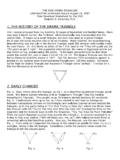
4 Ageing, for Little Red Riding Hood, probably means first playing her mother and later her grandmother. The rule of interchangeability is the same as in game ANALYSIS where at one time or another, a person plays each of the hands in his game, and in dream ANALYSIS where every person in the dream is the dreamer. A treatment may not be complete until a person s position in each of the roles is analyzed 2. DRAMA TRIANGLE. Only three roles are necessary in DRAMA ANALYSIS to depict the emotional reversals that are DRAMA . These action roles, in contrast with the identity roles referred to above, are the Persecutor, Rescuer, and Victim, or P, R, and V, in the diagram. DRAMA begins when these roles are established, or are anticipated by the audience.
5 There is no DRAMA unless there is a switch in the roles. This is indicated by a change in the vector direction along the diagram. Examples will be given from three FAIRY TALES to illustrate some of the ways of using this. A. In the Pied Piper, the hero begins as Rescuer of the city and Persecutor of the rats, then becomes Victim to the Persecutor mayor s double-cross (fee withheld), and in revenge switches to the Persecutor of the city s children. The mayor switches from Victim (of rats), to Rescuer (hiring the Pied Piper), to Persecutor (double-cross), to Victim (his children dead). The children switch from Persecuted Victims (rats) to Rescued Victims, to Victims Persecuted by their Rescuer (increased contrast).
6 B. In Little Red Riding Hood, the heroine starts as Rescuer (food and com- pany to grandmother, R V, and friendship and directions to the wolf, R V). In a suspense switch she becomes Victim to the wolf-Persecutor (P V), who in turn, in a surprise switch, falls Victim to the woodsman Persecutor (P V) who, in this one act, playing two roles at once (increased velocity), also Rescues LRRH and grandmother (R VV). In one version, LRRH playing all three roles, winds up as Persecutor sewing stones in the wolf s belly with the woods- man. Grandmother s switches go V R, V P, V R; the wolf, V R, P V, V P (arrow direction indicates initiative, the letters refer to the participant s position on the triangle).
7 C. In Cinderella, the heroine switches from Victim double Persecuted (mother then stepsisters), to Victim triple Rescued ( FAIRY godmother then mice then prince), to Victim Persecuted again (after midnight) then Victim Rescued again. A rough quantitative ANALYSIS can be made of the intensity of the DRAMA for her by totaling up the switches; Vpp Vrrr Vpp Vr = 8 switches. DRAMA compares to transactional games, but DRAMA has a greater number of events, a greater number of switches per event, and one person often plays two or three roles at once. Games are simpler and there is one major switch, in I m Only Trying to Help You there is one rotation (counterclockwise) in the DRAMA triangle: the Victim switches to Persecutor and the Rescuer becomes the new Victim.
8 3. LOCATION DIAGRAM. A. DRAMA . The Location Diagram simplifies the switches in location to the major vector axis Near and Far, both of which have minor divisions into Closed and Open, and Public and Private. The DRAMA is in the switch in location, and is intensified by the SCRIPT Range (house to castle ballroom, Wuthering Heights to China, front yard to Oz, etc.) and SCRIPT Velocity (changing adventures of Pinocchio, Ulysses, etc.). Many other factors can be added to step up the degree of contrast experienced as well as intensifying the role DRAMA , such as time of day or season, temperature, noise level, lighting, dimensions, unconscious symbols, etc.
9 Weather and landscape play a strong part in historical novels that show switches in characters during a switch in history. The diagram is numbered here only for reference to the list of examples below it. which draws from FAIRY tale as well as real life locations. 1. Clearing in the woods, pond, front yard, rooftop, open pram. 2. Market place, playground, street parade, swimming pool, stadium, freeways. 3. Pond, oven, burrow, bedroom, consultation room, brain. 4. Tavern, theatre, witness stand, delivery table, conference rooms, elevators, locker rooms, supermarket, gambling casinos, hospitals. 5. Flying carpet, hilltop, enchanted garden, milky way, tundra, sky, desert, prairie, quiet beach, safari trail.
10 6. Magic kingdoms, ships, ski resorts, battlefields, summer beaches, European cities, Timbuktu, Heaven. 7. Cave, grotto, gingerbread house, whale s belly, castle tower, space station, Egyptian tomb, igloo, diving bell, underground passages, casket. 8. Wonderland, castles, vacation hotel, reform school, slave quarters, barracks, cabarets, cathedrals. Imagining an actual trip between any two of the above in one day reveals the DRAMA in the switch in locations. A diagram within a diagram for a finer location ANALYSIS could be made by redrawing the entire location diagram within anyone of the eight subdivisions. Some examples from that would include the contrast of being closed in an open space (outdoor telephone booth, rocket ship, etc.)