Transcription of Ages & Stages Questionnaires 16 Month Questionnaire
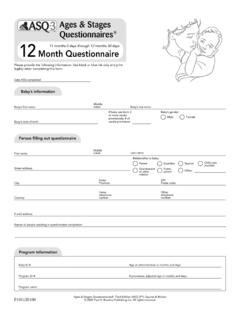
1 ages & Stages Questionnaires . 16 Month Questionnaire 15 months 0 days through 16 months 30 days Please provide the following information. Use black or blue ink only and print legibly when completing this form. Date ASQ completed: Child's information Middle Child's first name: initial: Child's last name: If child was born 3 Child's gender: or more weeks Male Female prematurely, # of Child's date of birth: weeks premature: Person filling out Questionnaire Middle First name: initial: Last name: Relationship to child: Parent Guardian Teacher Child care provider Street address: Grandparent Foster or other parent Other: relative State/ ZIP/.
2 City: Province: Postal code: Home Other telephone telephone Country: number: number: E-mail address: Names of people assisting in Questionnaire completion: Program Information Child ID #: Age at administration in months and days: Program ID #: If premature, adjusted age in months and days: Program name: ages & Stages Questionnaires , Third Edition (ASQ-3 ), Squires & Bricker P101160100 2009 Paul H. Brookes Publishing Co. All rights reserved. 16 Month Questionnaire 15 months 0 days through 16 months 30 days On the following pages are questions about activities babies may do. Your baby may have already done some of the activities described here, and there may be some your baby has not begun doing yet.
3 For each item, please fill in the circle that indi- cates whether your baby is doing the activity regularly, sometimes, or not yet. Important Points to Remember: Notes: Try each activity with your baby before marking a response. _____. Make completing this Questionnaire a game that is fun for . _____. you and your child. Make sure your child is rested and fed. _____. Please return this Questionnaire by _____. _____. At this age, many toddlers may not be cooperative when asked to do things. You may need to try the following activities with your child more than one time. If possible, try the activities when your child is cooperative.
4 If your child can do the activity but refuses, mark yes for the item. COMMUNICATION YES SOMETIMES NOT YET. 1. Does your child point to, pat, or try to pick up pictures in a book? 2. Does your child say four or more words in addition to Mama and Dada ? 3. When your child wants something, does she tell you by pointing to it? 4. When you ask your child to, does he go into another room to find a fa- miliar toy or object? (You might ask, Where is your ball? or say, Bring me your coat, or Go get your blanket. ). 5. Does your child imitate a two-word sentence? For example, when you say a two-word phrase, such as Mama eat, Daddy play, Go home, or What's this?
5 Does your child say both words back to you? (Mark yes even if her words are difficult to understand.). 6. Does your child say eight or more words in addition to Mama and Dada ? COMMUNICATION TOTAL. GROSS MOTOR YES SOMETIMES NOT YET. 1. Does your child stand up in the middle of the floor by himself and take several steps forward? 2. Does your child climb onto furniture or other large objects, such as large climbing blocks? 3. Does your child bend over or squat to pick up an object from the floor and then stand up again without any support? page 2 of 6. ages & Stages Questionnaires , Third Edition (ASQ-3 ), Squires & Bricker E101160200 2009 Paul H.
6 Brookes Publishing Co. All rights reserved. 16 Month Questionnaire page 3 of 6. GROSS MOTOR (continued) YES SOMETIMES NOT YET. 4. Does your child move around by walking, rather than crawling on her hands and knees? 5. Does your child walk well and seldom fall? 6. Does your child climb on an object such as a chair to reach something he wants (for example, to get a toy on a counter or to help you in the kitchen)? GROSS MOTOR TOTAL. FINE MOTOR YES SOMETIMES NOT YET. 1. Does your child help turn the pages of a book? (You may lift a page for her to grasp.). 2. Does your child throw a small ball with a forward arm motion?
7 (If he simply drops the ball, mark not yet for this item.). 3. Does your child stack a small block or toy on top of another one? (You could also use spools of thread, small boxes, or toys that are about 1. inch in size.). 4. Does your child stack three small blocks or toys on top of each other by herself? 5. Does your child make a mark on the paper with the tip of a crayon (or pencil or pen) when trying to draw? 6. Does your child turn the pages of a book by himself? (He may turn more than one page at a time.). FINE MOTOR TOTAL. PROBLEM SOLVING YES SOMETIMES NOT YET. 1. After you scribble back and forth on paper with a crayon (or pencil or pen), does your child copy you by scribbling?
8 (If she already scribbles on her own, mark yes for this item.). 2. Can your child drop a crumb or Cheerio into a small, clear bottle (such as a plastic soda-pop bottle or baby bottle)? 3. Does your child drop several small toys, one after another, into a con- tainer like a bowl or box? (You may show him how to do it.). ages & Stages Questionnaires , Third Edition (ASQ-3 ), Squires & Bricker E101160300 2009 Paul H. Brookes Publishing Co. All rights reserved. 16 Month Questionnaire page 4 of 6. PROBLEM SOLVING (continued) YES SOMETIMES NOT YET. 4. After you have shown your child how, does she try to get a small toy that is slightly out of reach by using a spoon, stick, or similar tool?
9 5. Without your showing him how, does your child scribble back and forth *. when you give him a crayon (or pencil or pen)? 6. After a crumb or Cheerio is dropped into a small, clear bottle, does your child turn the bottle upside down to dump it out? (You may show her how.). PROBLEM SOLVING TOTAL. *If Problem Solving Item 5 is marked yes, mark Problem Solving Item 1 as yes.. PERSONAL-SOCIAL YES SOMETIMES NOT YET. 1. Does your child feed himself with a spoon, even though he may spill some food? 2. Does your child help undress herself by taking off clothes like socks, hat, shoes, or mittens?
10 3. Does your child play with a doll or stuffed animal by hugging it? 4. While looking at himself in the mirror, does your child offer a toy to his own image? 5. Does your child get your attention or try to show you something by pulling on your hand or clothes? 6. Does your child come to you when she needs help, such as with wind- ing up a toy or unscrewing a lid from a jar? PERSONAL-SOCIAL TOTAL. OVERALL. Parents and providers may use the space below for additional comments. 1. Do you think your child hears well? If no, explain: YES NO. ages & Stages Questionnaires , Third Edition (ASQ-3 ), Squires & Bricker E101160400 2009 Paul H.