Transcription of 1. SILENT GENERATION / MATURES/ VETERANS / …
1 The GENERATION we belong to is one of the many differences we may have with our co-workers. These differences can cause stress, discomfort, conflict, and frustration. They can also become a source for creativity and productivity. Claire Raines. The ability to relate and communicate effectively with all types of people is one of today's leadership skills. There are many situations that are, and many that are not, generational in nature. Today's most effective organizations seek out the diversity represented by our multi-generational workforce. Today's best companies also recognize and appreciate the variety of perspectives, styles, and opinions of these groups.
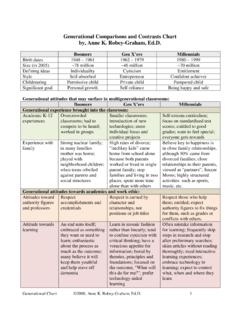
2 Let's identify these Generations: 1. SILENT GENERATION / MATURES/ VETERANS / TRADITIONALISTS / WORLD WAR II : Born before 1940-45. 2. BABY BOOMERS / GREAT MAJORITY: Born about 1940-45 to 1964. 3. GENERATION X / X'ers/ POST BOOMERS / THE 13TH GENERATION : Born 1960-54 to 1980. 4. MILLENNIALS / GENERATION Y / ECHO BOOMERS / BABY BUSTERS / GENERATION NEXT: Born 1981. to 1999. ACTIVITY: Handout #1. Ask participants to separate themselves into generational smaller groups. Have them identify the following profiles for their groups: a. How would you introduce yourself today? Where are you on your career path? b. What was the mood of the era you grew up in?
3 What compelling programming messages did you get from the media, in school, and at home? c. How did those messages affect who you are on the job today? How did they impact your work ethic? Post profiles on flip chart. In light of their answers, which GENERATION do individual participants associate with the most? _____. Let's look at the different profiles: Profile WW II Baby Boomer GENERATION X Millennial Outlook Practical Optimistic Skeptical Hopeful Work Ethic Dedicated Driven Balanced Ambitious View of Respectful Love/Hate Unimpressed Relaxed/polite Authority Leadership Hierarchy Consensus Competence Achievers By Relationships Personal Personal Reluctant to Loyal sacrifice gratification commit Perspective Civic Team Self Civic Technology Adapted Acquired Assimilated Integral Focus Task Relationships Task and and results Discuss these differences.
4 Now let's look at some of the compelling messages each GENERATION has: GENERATION Messages WW II Make do or do without Stay in line Sacrifice Be heroic Consider the common good Baby Boomers Be anything you want to be Change the world Work well with others Live up to expectations Duck and cover GENERATION X Don't count on it Remember heroes aren't Get real Survive stayin' alive Ask why . Millennials Be smart - you are special Leave no one behind Connect 24/7. Achieve now! Serve your community Discuss the validity of these messages and see if participants can add any more. Here are the Parenting Styles for the Generations: GENERATION Parenting Style WW II Discipline Schedules Conformity Strict obedience Spare the rod and spoil the child.
5 Baby Boomer Dr. Spock Throw away the schedule Love and nurture, pamper and cherish Stay-at-home moms GENERATION X Parenting by proxy Working moms Latchkey kids Soaring divorce rates Autonomy and independence Millennials Parent advocacy Put children first Soccer moms Supervision Strictness on drugs, drinking, and driving Discuss these styles and see if participants can come up with any additional styles. Have you ever had an experience when you simply connected with someone else? Wherever the encounter took place, there was a special quality to the interaction. You clicked with the other person. The conversation seemed effortless, relaxed, and enjoyable.
6 The two of you seemed to be on the same wavelength, cut from the same cloth, a good fit. Of course, we've also had just the opposite experience the encounter from hell, a complete disconnect. The interaction was exhausting, as if the two of you were speaking a different language. It took all of your concentration to keep up with the topics you were discussing. Many times, these disconnects happen when two people are from different generations. So how is it that some of these work and others just don't? It's a matter of establishing rapport. When we adjust our styles to the other person's preferences, we can become more effective communicators.
7 Establishing rapport is based on the principle that people connect with people who are like them. Didn't we all learn the Golden Rule Do unto others as we would have them do unto us? Well, when it comes to different generations, we should do unto others, keeping their preferences in mind. Whenever we feel that disconnect, there are three things we can do to deal with it: 1. Acknowledge it and let it go. 2. Change our behavior. 3. Use a generational template to talk it over. So with #1 we simply acknowledge that there's a generational difference involved and we move on, letting go of our frustrations or annoyances.
8 If you choose the #2 response, you actually change something you do- what you say or don't say, the words you choose, or they way you respond. For the #3 response, both of you need to speak the language of generations you make agreements about more effective ways to communicate with each other. ACTIVITY: Handout #2. Think of a situation where you experienced a disconnect with someone from another GENERATION . where no matter how hard you tried, things simply didn't click. How did you respond? Level 1, 2, or 3? How might you have responded at each of these 3 levels? Level 1: Acknowledge it and let it go. Level 2: Change our behavior.
9 Level 3: Use a generational template to talk it over. IDENTIFYING PEOPLE'S GENERATIONAL PROFILES: You can observe people's generational profiles by observing their: Perspectives on work Communication style View of authority Need for approval Perspective on resources Response to policies and procedures Relationship to the team . Work ethic Focus on work projects Relationship to technology General outlook ACTIVITY: Handout #3. In small groups, have participants identify a common work assignment you need to give others. Construct messages for each generational style. Discuss the implications for supervisors as they manage their staff.
10 Managing generationally diverse workgroups requires diplomacy, understanding generations, and helping them to understand each other, getting them to communicate more effectively, negotiating differences, resolving conflicts, and suggesting ways they might work together more effectively. Here are some suggestions for mixing generations successfully: 1. Initiate conversations about their generations. 2. Ask people about their needs and preferences. 3. Offer options. 4. Personalize your style. 5. Build on strengths. 6. Pursue different perspectives. ACTIVITY: Handout #4a-b Here's a checklist to see if your workgroup is generations-friendly.

![Welcome! [transportation.wv.gov]](/cache/preview/0/e/7/9/c/d/0/2/thumb-0e79cd02df2a7ea6db8598b4ea88f5d8.jpg)