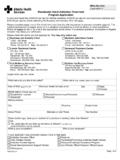
Transcription of Goals of Care Designation (GCD) Order
1 Affix patient label within this box Goals of Care Designation (GCD) Order Date (yyyy-Mon-dd) Time (hh:mm). Goals of Care Designation Order To Order a Goals of Care Designation for this patient, check the appropriate Goals of Care Designation below and write your initials on the line below it. (See reverse side for detailed definitions). Check R1 R2 R3 M1 M2 C1 C2. Initials _____ _____ _____ _____ _____ _____ _____. Check here if this GCD Order is an interim Order awaiting the outcome of a Dispute Resolution Process. Document further details on the ACP/GCD Tracking Record. Specify here if there are specific clarifications to this GCD Order . Document these clarifications on the ACP/GCD Tracking Record as well. _____. _____. _____. _____. Patient's location of care where this GCD Order was ordered (Home; or clinic or facility name).
2 Indicate which of the following apply regarding involvement of the Patient or alternate decision- maker (ADM). This GCD has been ordered after relevant conversation with the patient. This GCD has been ordered after relevant conversation with the alternate decision-maker (ADM), or others. (Names of formally appointed or informal ADM's should be noted on the ACP/GCD Tracking Record). This is an interim GCD Order prior to conversation with patient or ADM. History / Current Status of GCD Order Indicate one of the following This is the first GCD Order I am aware of for this patient. This GCD Order is a revision from the most recent prior GCD (See ACP/GCD Tracking Record for details of previous GCD Order ). This GCD Order is unchanged from the most recent prior GCD. Name of Physician/Designated Most Responsible Health Discipline Practitioner who has ordered this GCD.
3 Signature Date (yyyy-Mon-dd). 103547(Rev2014-01) Page 1 Side A. Goals of Care Designations Guide for Clinicians Page 1 Side B. R: Medical Care and Interventions, Including M : Medical Care and Interventions, Excluding Resuscitation. C: Medical Care and Interventions, Focused on Comfort. Resuscitation if required followed by Intensive Care Focus of Care and interventions are for cure or control of the Patient's Focus of Care and interventions are for the active palliative Unit admission. condition. The Patient either chooses to not receive or would not be treatment of the Patient who has a terminal illness, and support Focus of Care and interventions are for cure or control of expected to benefit from attempted resuscitation followed by life- for those close to them. This includes medical care for symptom the Patient's condition.
4 The Patient would desire and is sustaining care in an ICU. In Pediatrics, ICU can be considered if that control and psychosocial and spiritual support in advance of expected to benefit from attempted resuscitation and ICU location is deemed the best location for delivery of specific short-term death. Care can be provided in any location best suited for care if required. symptom-directed care. these aims, including an ICU, a Hospice or any location that is the most appropriate for symptom-based care for this particular Patient. R1: Patient is expected to benefit from and is accepting of M1: All clinically appropriate medical and surgical interventions directed any appropriate investigations/interventions that can be at cure and control of condition(s) are considered, excluding the offered including attempted resuscitation and ICU care.
5 Option of attempted life-saving resuscitation followed by ICU care. C1: All care is directed at maximal symptom control and Resuscitation: is undertaken for acute deterioration, See above, regarding Pediatrics and ICU. maintenance of function without cure or control of an and may include intubation and chest compression Resuscitation: is not undertaken for cardio respiratory arrest. underlying condition that is expected to cause eventual Life Support Interventions: are usually undertaken death. Treatment of intercurrent illnesses can be Life Support Interventions: should not be initiated, or should be Life Sustaining Measures: are used when appropriate contemplated only after careful discussion with the Patient discontinued after discussion with the Patient. Major Surgery: is considered when appropriate.
6 About specific short-term Goals . Life Sustaining Measures: are used when appropriate. Transfer: is considered for diagnosis and treatment, if Resuscitation: is not undertaken. Transfer: to another location of care is considered if that location required Life Support Interventions: should not be initiated, or provides more appropriate circumstances for diagnosis and treatment should be discontinued after discussion with the Patient. Major Surgery: is considered when appropriate. Resuscitation during Life Sustaining Measures: are used only for goal directed R2: Patient is expected to benefit from and is accepting of surgery or in the recovery room can be considered, including short term symptom management. any appropriate investigations/interventions that can be physiologic and mechanical support in an ICU, in Order to return the Major Surgery: is not usually undertaken, but can be offered including attempted resuscitation, intubation and Patient to prior level of function.
7 The possibility of intra-operative death or contemplated for procedures aimed at symptom relief. ICU care, but excluding chest compression life-threatening deterioration should be discussed with the Patient in Resuscitation during surgery or in the recovery room can Resuscitation: is undertaken for acute deterioration, but advance of the proposed surgery and general decision-making guidance be considered, including short term physiologic and chest compression should not be performed agreed upon and documented. mechanical support in an ICU, in Order to return the Patient Life Support Interventions: may be offered without to prior level of function, but this would be a rare chest compression M2: All clinically appropriate interventions that can be offered in the circumstance. The possibility of intra-operative death or Life Sustaining Measures: are used when appropriate current non-hospital location of care are considered.
8 Life-threatening deterioration should be discussed with the Major Surgery: is considered when appropriate If a patient does not respond to available treatments in this location of Patient in advance of the proposed surgery and general Transfer: is considered for diagnosis and treatment, if care, discussion should ensue to change the focus to comfort care. decision-making guidance agreed upon and documented. required Life-saving resuscitation is not undertaken except in unusual Transfer: to any appropriate location of care can be circumstances (see below in Major Surgery). considered at any time, to better understand or R3: Patient is expected to benefit from and is accepting of See above, regarding Pediatrics and ICU. control symptoms. any appropriate investigations/interventions that can be offered including attempted resuscitation and ICU care, Resuscitation: is not undertaken for cardio respiratory arrest.
9 C2: All care is directed at preparation for imminent death but excluding intubation and chest compression Life Support Interventions: should not be initiated, or should be [usually within hours or days] with maximal efforts Resuscitation: is undertaken for acute deterioration discontinued after discussion with the Patient. directed at symptom control. but intubation and chest compression should not be Life Sustaining Measures: are used when appropriate. Resuscitation: is not undertaken. performed Transfer: is not usually undertaken, but can be contemplated if symptom Life Support Interventions: should not be initiated, or Life Support Interventions: may be offered without management or diagnostic efforts aimed at understanding symptoms can should be discontinued after discussion with the Patient. Intubation and without chest compression be best undertaken at that other location.
10 Life Sustaining Measures: should be discontinued Life Sustaining Measures: are used when appropriate Major Surgery: can be considered, in Order to prevent suffering from an unless required for symptom management. Major Surgery: is considered when appropriate unexpected trauma or illness. Resuscitation during surgery or in the Major Surgery: is not appropriate. Transfer: is considered for diagnosis and treatment, if recovery room can be considered, including short term physiologic and mechanical support in an ICU, in Order to return the Patient to prior level of Transfer: is usually not undertaken but may be considered if required function. The possibility of intra-operative death or life-threatening required. deterioration should be discussed with the Patient in advance of the proposed surgery and general decision-making guidance agreed upon and noted as special circumstances on the GCD Order Form and Tracking Record.