Transcription of Code of practice - Occupational safety and health in call ...
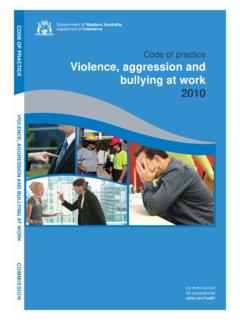
1 code OF practice Occupational safety AND health IN CALL CENTRES. code OF practice . Occupational safety AND health . IN CALL CENTRES. 2005. Foreword The introduction of the Occupational safety and health Act 1984 ( the Act') enabled the establishment of the tripartite Commission for Occupational safety and health . The Commission, which comprises representatives of employers, unions and government, as well as experts, has the function of developing the Occupational safety and health legislation and supporting guidance material, and making recommendations to the Minister for their implementation. To fulfil its functions, the Commission is empowered to establish advisory committees, hold public inquiries, and publish and disseminate information.
2 This code of practice has been developed through a tripartite consultative process and the views of the employers and unions, along with those of government and experts, have been considered. The Commission's objective is to promote comprehensive and practical preventive strategies that improve the working environment of Western Australians. The Occupational safety and health Act 1984. The Act provides for the promotion, co-ordination, administration and enforcement of Occupational safety and health in Western Australia. The Act places certain duties on employers, employees, self-employed people, manufacturers, designers, importers and suppliers.
3 It also places emphasis on the prevention of accidents and injury. In addition to the broad duties established by the Act, the legislation is supported by a further tier of statute, commonly referred to as regulations, together with a lower tier of non-statutory codes of practice and guidance notes. Regulations Regulations have the effect of spelling out specific requirements of the legislation. Regulations may prescribe minimum standards and have a general application, or they may define specific requirements related to a particular hazard or particular type of work. They may also allow the licensing or granting of approvals and certificates etc.
4 Codes of practice A code of practice is defined in the Act as a document prepared for the purpose of providing: practical advice on preventive strategies; and a practical means of achieving any code , standard, rule, provision or specification relating to Occupational safety and health in Western Australia. A code of practice may contain explanatory information. The preventive strategies outlined do not represent the only acceptable means of achieving a certain standard. A code of practice does not have the same legal force as a regulation and is not sufficient reason, of itself, for prosecution under the Act. Guidance notes A guidance note is an explanatory document providing detailed information on the requirements of legislation, regulations, standards, codes of practice or matters relating to Occupational safety and health , as approved by the Commission.
5 This publication is available on request in other formats to assist people with special needs. code OF practice Occupational safety AND health IN CALL CENTRES. Authority On 24 April 2005, the Hon Minister for Consumer and Employment Protection approved the code of practice : Occupational safety and health in Call Centres pursuant to Section 57 of the Occupational safety and health Act 1984. Scope This code of practice applies to all workplaces in Western Australia covered by the Occupational safety and health Act 1984. It provides guidance on Occupational safety and health management in call centres. The practical guidance in this code of practice should be considered in conjunction with the general duties in the Occupational safety and health Act 1984.
6 Who should use this code of practice ? This code of practice has been developed by the Commission for Occupational safety and health to assist employers, employees, people in control of workplaces and safety and health representatives to comply with the Occupational safety and health Act 1984 and the Occupational safety and health Regulations 1996. Copyright The Western Australian legislation is reproduced by permission of the copyright owner, the State of Western Australia. However, these versions are not official or authorised versions. Official copies can be purchased from the State Law Publisher, 10 William Street, Perth [Tel. 08 9321 7688].
7 The Occupational safety and health Act 1984 and Occupational safety and health Regulations 1996 can also be purchased from WorkSafe, Westcentre, 1260 Hay Street, West Perth [Tel. 1300 307 877]. code OF practice Occupational safety AND health IN CALL CENTRES. CONTENTS. 1. INTRODUCTION ..1. 2. GENERAL DUTIES AT THE WORKPLACE ..2. 3. HAZARD IDENTIFICATION, RISK ASSESSMENT AND RISK CONTROL THE RISK. MANAGEMENT PROCESS ..4. An overview ..4. Identifying Assessing and analysing risks ..5. Controlling Monitoring and review of control 4. INSTRUCTION AND 5. WORKING ENVIRONMENT .. 10. Workspace ..10. Electrical installations ..11. Drinking water ..11. Air quality and environmental tobacco Access and egress.
8 12. Lighting ..12. General facilities ..13. 6. WORKSTATIONS AND WORK ORGANISATION .. 14. Muscle and soft tissue injuries ..14. Workstation design and setup ..15. Work Work-related stress ..19. Threatening behaviours ..22. 7. FATIGUE .. 24. General fatigue ..24. Vocal fatigue ..25. Visual fatigue and visual display 8. ACOUSTIC INCIDENTS AND NOISE CONTROL .. 28. Acoustic Noise 9. HOTDESKING .. 32. 10. HEADSET HYGIENE .. 33. 11. EMERGENCY PROCEDURES .. 34. CONTINUED OVER >. code OF practice Occupational safety AND health IN CALL CENTRES. CONTENTS CONT'D. APPENDIX 1: OTHER SOURCES OF INFORMATION .. 35. APPENDIX 2: LEGISLATIVE FRAMEWORK FOR Occupational safety AND.
9 health IN WESTERN AUSTRALIA .. 37. APPENDIX 3: ACTS AND REGULATIONS REFERENCED IN THIS code OF 39. APPENDIX 4: POSITIONING OF EQUIPMENT .. 49. APPENDIX 5: CHECKLIST OF safety AND health ISSUES .. 52. SURVEY OF USERS OF THIS code OF 55. code OF practice Occupational safety AND health IN CALL CENTRES. 1. INTRODUCTION. The call centre industry is one of the fastest growing industries in Australia. Employees are usually casual workers and mostly women. The aim of this code of practice is to help employers and employees address Occupational safety and health issues related to call centre work. It recommends ways in which safety and health hazards commonly See Appendix 2 for further associated with call centre work can be addressed in accordance with the Occupational safety and health Act explanation on 1984 (referred to in this document as the Act), the Occupational safety and health Regulations 1996 (referred the legislation.)
10 To in this document as the Regulations) and other relevant Commission for Occupational safety and health (referred to in this document as the Commission) codes of practice and standards. The Act and the regulations should be read in conjunction with this code of practice . What is a call centre? A call centre' is any workplace where the main work of employees is providing customer services by telephone or by a combination of telephone and computer. The term usually refers to organisations that employ teams of people on shift work to provide or obtain information. Call centre work may include: work where the primary role is to respond to telephone and other electronic requests such as emails from clients.