Transcription of Unit 1: Manage Team Performance
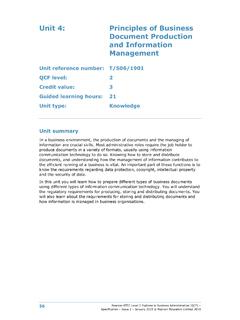
1 Pearson BTEC Level 3 Diploma in Management (QCF) Specification Issue 1 September 2014 Pearson Education Limited 2014 28 unit 1: Manage team Performance unit reference number: A/506/1821 QCF level: 3 Credit value: 4 Guided learning hours: 21 unit type: Competence unit summary In this unit , you will look at how to Manage team Performance through benchmarking that includes setting and maintaining standards and other quality management techniques. When used properly, benchmarking can be a great way to improve the Performance of a team , and so help the business to stay competitive. Having a carefully designed process to ensure high Performance and quality of work is the key to getting the most out of teams. You will learn how to Manage the work of a team and assess its Performance to ensure the optimum outcome. You will also learn about the importance of communication within a team , and how to Manage communications to ensure that everyone understands the purpose of the team and its goals.
2 Learning outcomes and assessment criteria To pass this unit , the learner needs to demonstrate that they can meet all the learning outcomes for the unit . The assessment criteria outline the requirements the learner is expected to meet to achieve the unit . Learning outcomes Assessment criteria 1 Understand the management of team Performance Explain the use of benchmarks in managing Performance Explain a range of quality management techniques to Manage team Performance Describe constraints on the ability to amend priorities and plans Pearson BTEC Level 3 Diploma in Management (QCF) Specification Issue 1 September 2014 Pearson Education Limited 2014 29 Learning outcomes Assessment criteria 2 Be able to allocate and assure the quality of work Identify the strengths, competences and expertise of team members Allocate work on the basis of the strengths, competences and expertise of team members Identify areas for improvement in team members Performance outputs and standards Amend priorities and plans to take account of changing circumstances Recommend changes to systems and processes to improve the quality of work 3 Be able to Manage communications within a team Explain to team members the lines of communication and authority levels Communicate individual and team objectives, responsibilities and priorities Use communication methods that are appropriate to the topics.
3 Audience and timescales Provide support to team members when they need it Agree with team members a process for providing feedback on work progress and any issues arising Review the effectiveness of team communications and make improvements Pearson BTEC Level 3 Diploma in Management (QCF) Specification Issue 1 September 2014 Pearson Education Limited 2014 30 unit amplification : Explain the use of benchmarks in managing Performance Benchmarks: definition ( Performance measurement standards); based on an organisation s own experience, industry practice or regulatory requirements Benchmarking: definition; types, internal, external, strategic, Performance , process Using benchmarking in Performance management: maintain team Performance in line with industry and/or organisational standards; identify areas for targeted improvement activities, training needs; set standards for reward systems, Performance -related pay; evaluate the effectiveness of workforce Performance initiatives : Explain a range of quality management techniques to Manage team Performance team Performance management: purpose, establishing Performance goals; identifying any gap between current and desired Performance ; planning, implementing and monitoring changes to improve Techniques: Performance objectives, strategic and operational; Performance review meetings, one-to-one meetings, appraisal meetings; 360 degree feedback; personal development plans (PDPs); reward systems, Performance -related pay, bonus payments, team -based pay : Describe constraints on the ability to amend priorities and plans Constraints: resource availability in other functional areas; regulatory, industry or organisational requirements.
4 Deliverables and timescales agreed with internal and/or external customers; existing workload and competence of team members Pearson BTEC Level 3 Diploma in Management (QCF) Specification Issue 1 September 2014 Pearson Education Limited 2014 31 Information for tutors Suggested resources Books Jones S, Schilling D Measuring team Performance (Jossey-Bass, 2000) ISBN 9780787945695 Muller-Camen M, Croucher R, Leigh S Human Resource Management: A Case Study Approach (CIPD, 2008) ISBN 9781843981657 Websites the Charted Institute of Personnel and Development (CIPD), offers a range of guidance on HR, learning and development and employment law issues, for example a Performance Management factsheet. Membership is required for full access the Chartered Institute of Management, offers practical advice on management issues with a range of online resources on management topics. Membership is required to access the materials resources on many business and management topics, including team management Assessment This unit is internally assessed.
5 To pass this unit the evidence that the learner presents for assessment must demonstrate that they have met the required standard specified in the learning outcomes and assessment criteria and the requirements of the Assessment Strategy. To ensure that the assessment tasks and activities enable learners to produce valid, sufficient, authentic and appropriate evidence that meets the assessment criteria, centres should apply the unit Assessment guidance and the requirements of the Assessment Strategy below. Wherever possible, centres should adopt a holistic approach to assessing the units in the qualification. This gives the assessment process greater rigour and minimises repetition, time and the burden of assessment on all parties involved in the process. unit assessment requirements This unit must be assessed in the workplace in accordance with Skills CFA Business Administration, Customer Service and Management and Leadership Assessment Strategy in Annexe A.
6 Simulation is not allowed for this unit . All evidence of occupational competence should be generated through Performance under workplace conditions; this includes evidence of achievement for knowledge-based learning outcomes and associated assessment criteria. unit assessment guidance This guidance supports assessors in making decisions about how best to assess each unit and the evidence needed to meet the requirements. Centres can adapt the guidance as appropriate for learners and the particular assessment context. Pearson BTEC Level 3 Diploma in Management (QCF) Specification Issue 1 September 2014 Pearson Education Limited 2014 32 This guidance supports assessors in making decisions about how best to assess each unit and the evidence needed to meet the assessment requirements of the unit . Centres can adapt the guidance for learners and the particular assessment context, as appropriate.
7 Evidence to demonstrate achievement of learning outcomes 2 and 3 is likely to come from a combination of direct observation, review of the learner s work products, witness testimony and professional discussion or reflective account. Wherever possible, and with the appropriate permissions, the learner could be observed in team /departmental meetings, one-to-one meetings, appraisal meetings and other relevant contexts. Evidence from any direct observation of the learner should be supported by a professional discussion around the learner s Performance and work products to provide further evidence for the assessment criteria. The learner s work products could include minutes from team meetings, team work plans, team rotas/allocations, anonymised personal development plans and any relevant communications to team members or colleagues (for example email to team members detailing the lines of communication and authority).
8 The work products should be reviewed by the assessor and used to support the professional discussion to evidence the knowledge and understanding underpinning the learner s Performance . Within the professional discussion, the learner could explain how they determined the strengths, competences and expertise of team members, how they used this information in allocating/planning the team s work and the decision making and rationale for any work plans in terms of priorities, critical activities and resource availability ( and ). The professional discussion could also cover the reasons for the choice of communication methods used and the criteria used to assess the effectiveness of team communications, and how they relate to the improvements made ( and ). Alternatively, a reflective account could be used in a similar manner to assess the underpinning knowledge and understanding. Witness testimony from team members and the line manager could also be used to confirm evidence for a number of assessment criteria ( , and ), as well as confirm that the learner has consistently met the requirements over a period of time.
9 Evidence to confirm the achievement of learning outcome 1 could be integrated into the professional discussion or reflective account for learning outcome 2, giving the learner the opportunity to link and apply their knowledge to the workplace activities. For example, the learner could comment on how they have used benchmarks in managing the team Performance ; where the learner has not used these they could explain how these may be used in the future to better Manage their team s Performance . This would link to In a similar manner, if appropriate, the learner could be asked to describe any constraints they faced in amending work plans to meet changing circumstances and how they dealt with these constraints; if the learner did not face any actual constraints they could describe possible constraints relative to their context and how they would have dealt with them ( linked to ). The learner s responses or statements to meet the requirements of to must be in sufficient depth and breadth to meet the level of demand relative to the operative verbs.
10 For example, for , the learner would need to explain at least two techniques and show clearly how they have used them, or could use them, to Manage their team s Performance . Evidence of Recognition of Prior Learning (RPL) can also be used within the unit to confirm competence. Wherever possible, the learning outcomes in this unit should be assessed holistically across the qualification.