Transcription of Hospital and Community Patient Review Instrument …
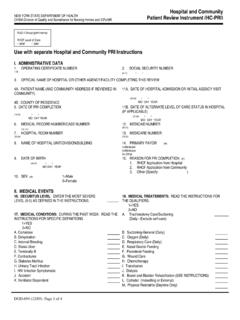
1 NEW YORK STATE DEPARTMENT OF HEALTHDIVISION OF HEALTH CARE FINANCINGINSTRUCTIONS: Hospital AND Community Patient Review INSTRUMENTGENERAL CONCEPTS:1. PURPOSE: Pre-admission Review to a Residential Health Care Facility (RHCF) from the hospitaland Community based residences and facilities, such as personal dwelling, domiciliary carefacility/adult home and congregate ASSESSORS: As qualified through the New York State Department of Health PRI TrainingProgram - Hospital discharge planners, certified home health care agency registered nurses,RHCF registered nurses, county public health nurses and other utilization Review personnel USING THESE instructions : These instructions should be read before completing the H/C PRIand should be kept with the H/C PRIs as they are being completed.
2 FREQUENT REFERENCE TOTHE instructions WILL BE NEEDED IN ORDER TO COMPLETE THE H/C PRI ANSWER ALL QUESTIONS: Answer all questions using the numeric codes provided. DO NOTLEAVE ANY QUESTIONS TOTALLY BLANK. UNUSED BOXES FOR A QUESTION SHOULD REMAINBLANK. For example, Medical Record Number: /_ / 9 / 6 / 2 / 1 / 0 /. If there are unused boxes,they should be the left side of the number as shown in the QUALIFIERS: Many of the PRI questions contain multiple criteria which are labeled qualifiers. Allqualifiers must be met for a question to be answered yes.
3 These qualifiers take the followingforms. Time Period: The time period for the questions is the past week. For the patients whohave been in the Hospital for less than one week use the time from admission to H/C PRIcompletion as the time frame. If the Community assessor ( certified home healthcare agency, RHCF assessor) does not have any history on the Patient , then the day ofthe H/C PRI assessment is the timeframe. See Sources of Information below. Frequency The frequency specifies how often something needs to occur to meet thequalifier.
4 For example. Suctioning needs to occur daily for at least one week or the PRIcannot be checked for this Patient as receiving this care. Documentation. Some of the questions require specific medical record documentation tobe present. Otherwise, the question cannot be answered yes for the Patient . Exclusions - Some of the questions specifically state to omit certain types of care orbehavior when answering the question. For example, inhalators are excluded fromoxygen SOURCES OF INFORMATION: For Community based referred patients, the sources of informationmay not be as accessible as in the Hospital .
5 Discussion with the Patient s family members, othercaregivers and personal physician(s) will help provide more accurate information. The patientmay be receiving Community services or may have in the ACTIVITIES OF DAILY LIVING (ADLs): The approach to measuring ADLs is slightly different fromother PRI questions. Measure how capable the Patient is in completing each ADL sixty percent(60%) or more of the time that it needs to be performed. CAPABILITY: Reviewing the Patient s2physical and mental status, measure the present capability of the Patient to perform each is in contrast to how the Patient may be actually performing the ADLs in the Hospital /facilityor in the Community .
6 Read the specific instructions on ADLs to understand the CHANGEDCONDITION RULE, the specific ADL definitions and the measurement of CORRECTIONS: Cross out any response which you wish to change and reenter clearly to theright of the original response. Example: /3/43 instructions : H/C-PRI QUESTIONSI. ADMINISTRATIVE CERTIFICATENUMBER:Enter the seven (7) or eight (8) character identifier statedon the facility s / agency operating certificate. For ahospital there will always be seven (7) numbers followedby an H in the eighth box.
7 For a certified home healthagency and a county Department of Health, there will onlybe seven (7) numbers with no letters. This means thatthe first answer box to the left will remain blank. For aresidential health care facility, there will be seven (7)numbers followed by a P , for a health related facility(HRF) or an N for a skilled nursing facility (SNF). SECURITYNUMBER:Do not leave blank; enter zero in far right hand box ifpatient does not have a FACILITY NAME:Print the formal name of the Hospital / Community agency, NAME:When completing the H/C PRI do not use last name first ( , Brant, Diana C).
8 RECORDNUMBER/CASE NUMBER:Enter the unique number assigned by the Hospital /agencyto identify each Patient . It is not the Medicaid, Medicareor Social Security number, unless that is the number usedto identify patients. If there is no assigned case numberfor the Community based Patient , leave this ROOM NUMBER: Enter the numbers and/or letters which identify thepatient s room in the Hospital or other applicablecommunity facility. If the Patient is residing in thecommunity when the H/C-PRI Review is completed, thenprint the address in Question 4, Patient Name.
9 ( Community is defined as a personal dwelling, AdultHome, congregate housing or other domiciliary type offacilities/dwellings.) OF HOSPITALUNIT/BUILDING/DIVISION:Print the name of the Hospital unit, such as med-surgery, where the Patient was reviewed. Include anyother unique Hospital location identifiers, such as specificbuilding names where the unit is located. However, if thepatient has changed units or buildings or will be moving,then print instead where the Patient can be located in thefuture (if known). If the Patient is reviewed in thecommunity, then this question is not applicable and canbe left OF HOSPITALADMISSION OR INITIALE nter in numerical format the month, day and year thepatient was admitted to this Hospital for purposes of this4 AGENCY VISIT: Review .
10 (Use most recent hospitalization date for multiplehospitalizations.) Do not include the date of AlternateLevel of Care status, rather enter this date, if applicable,in Question the Patient is being reviewed in the Community , enterthe date of the initial Patient visit by the certified homehealth care agency, nursing home or any other qualifiedagency/organization. This visit may be a followup to areferral made by the Patient , the Patient s family, thepatient s physician, OF ALTERNATELEVEL OF CARE STATUS:Enter in numerical format the day, month and year thepatient went onto Alternate Level of Care status (ALC) inthe Hospital .