Transcription of The Individuals with disabilities act (PDF)
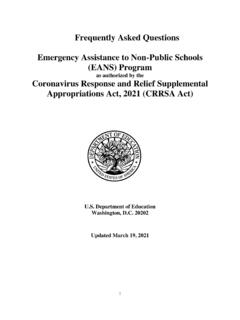
1 The Individuals with disabilities education Act Provisions Related to Children with disabilities Enrolled by Their Parentsin Private SchoolsU . S . D E P A R T M E N T O F E D U C A T I O Department of EducationProvisions Related to Children with disabilities Enrolled by Their Parents in Private SchoolsThe Individuals with disabilities education ActOffice of Innovation and ImprovementOffice of Non-Public EducationOther than statutory and regulatory requirements included in the document, the contents of this guidance do not have the force and effect of law and are not meant to bind the public in any way. This document is intended only to provide clarity to the public regarding existing requirements under the law or agency Department of EducationArne DuncanSecretary of EducationOffice of Innovation and ImprovementJames H.
2 Shelton IIIA ssistant Deputy SecretaryOffice of Non-Public EducationMaureen DowlingDirectorMarch 2011 This publication is in the public domain. Authorization to reproduce it in whole or in part is granted. While permission to reprint this publication is not necessary, the citation should be: Department of education , Office of Innovation and Improvement, Office of Non-Public education , The Individuals with disabilities education Act: Provisions Related to Children with disabilities Enrolled by Their Parents in Private Schools, Washington, , order copies of this publication:Write to EDPubs, education Publications Center, Department of education , Box 22207, Alexandria, VA 22304Or fax your request to e-mail your request to call in your request toll free to 1-877-433-7827 (1-877-4-ED-PUBS). Those who use a telecommunications device for the deaf (TDD) or a teletypewriter (TTY) should call 1-877-576-7734.
3 If 877 service is not available in your area, call 1-800-872-5327 (1-800-USA-LEARN).Or order online at publication is available on the Department s website request, this publication is available in alternate formats, such as Braille, large print or compact disc. For more information, please contact the Department s Alternate Format Center at 202-260-0852 or at .. 1 Equitable Participation.. 2 LEA Responsible for Conducting Child Find and Ensuring the Provision of Equitable Services.. 4 Consultation .. 5 Written Affirmation and Complaints .. 6 Child Find.. 7 Parental Consent .. 8 Data Collection and Record Keeping.. 9 Expenditures and Proportionate Share of Federal IDEA Funds .. 9 Formula for Expenditures ..10 Provision of Services ..11 Services Plan.. 11 Service Delivery (Including On-site).
4 11 Complaint Procedure Regarding Consultation ..12 Preschool Children with disabilities ..12 Further Information ..13iii1 IntroductionThe Individuals with disabilities education Act (IDEA) is a federal law that requires each state to ensure that a free appropriate public education (FAPE) is available to all eligible children with disabilities residing in that state. The information in this booklet explains the provisions related to, and benefits available to, children with disabilities who are enrolled by their parents in private schools, including religious schools, when the provision of FAPE is not at issue. In IDEA, these children are often referred to as parentally placed private school children with disabilities , and the benefits available to them differ from the benefits for children with disabilities in public is designed to improve educational results for all children with disabilities .
5 Therefore, it provides benefits and services to children with disabilities in public schools and requires school districts to make services and benefits available to children with disabilities enrolled by their parents in nonpublic (private) schools. The law includes language requiring state education agencies (SEAs) and local education agencies (LEAs) to ensure the equitable participation of parentally placed children with disabilities in programs assisted by or carried out under the equitable participation requirements that apply to them. The LEA s obligations to parentally placed private school children with disabilities are different from its responsibilities to those enrolled in public schools or to children with disabilities placed in a private school by a public agency (rather than by parents) as a means of providing FAPE.
6 Parentally placed children with disabilities do not have an individual entitlement to services they would receive if they were enrolled in a public school. Instead, the LEA is required to spend a proportionate amount of IDEA federal funds to provide equitable services to this group of children. Therefore, it is possible that some parentally placed children with disabilities will not receive any services while others will. For those who receive services, the amount and type of services also may differ from the services the child would receive if placed in a public school by the parents or in a private school by a public agency. LEAs are required to consult with private school representatives and representatives of parents of parentally placed children with disabilities during the design and development of special education and related services for these August 2006, the Department of education released new regulations for Part B of IDEA, which went into effect Oct.
7 13, 2006. These regulations are designed to assist SEAs, LEAs, private school representatives, and representatives of parents of parentally placed private school children with disabilities in understanding the requirements of IDEA. These groups must work together with parents so that the children can receive the benefits available to them under ParticipationThe 2004 Amendments to IDEA expand upon the 1997 reauthorization and include new requirements to ensure that LEAs provide parentally placed private school children with disabilities an opportunity for equitable participation in programs assisted or carried out under IDEA, the foundation of which is the consultation process. The major provisions regarding children with disabilities enrolled by their parents in private, including religious, elementary and secondary schools are located in the statute at section 612(a)(10)(A) and in the regulations at 34 CFR and are summarized in the sections below.
8 They concern: Agency responsibility for conducting child find activities and determining equitable services (34 CFR ); Consultation requirements (34 CFR ); Written affirmation of timely and meaningful consultation (34 CFR ); Child find activities (34 CFR ); Data collection requirements (34 CFR (c)); Determination and provision of equitable services (34 CFR ); Services plans for children with disabilities receiving equitable services (34 CFR (b), (c) and (b));3 Permission for delivery of services at the private schools by LEAs, to the extent consistent with law (34 CFR (a)); Determination of the proportionate share of federal IDEA funds to be spent on equitable services (34 CFR ); Non-availability of an individual entitlement of parentally placed private school students to special education and related services (34 CFR (a)); and Complaint procedures for private school officials regarding consultation (34 CFR ).
9 This booklet is not intended to be a replacement for careful study of IDEA and the regulations, which are available at A number of additional provisions found in the law and regulations but that are not covered in this booklet also affect parentally placed children with disabilities . Therefore, it is important for all stakeholders to be familiar with these provisions as well. They concern: Requirement that state and local funds supplement, not supplant, the proportionate share of federal funds (34 CFR (d)); Right to file due process complaints regarding child find and state complaints regarding equitable participation requirements (34 CFR ); Requirements that funds not benefit a private school (34 CFR ); Requirements regarding use of public and private school personnel to provide equitable services (34 CFR ); Prohibition of separate classes based on school enrollment or religion under certain circumstances (34 CFR ); Funds for equitable participation remaining in control of public agency (34 CFR (a)); Definition of child with a disability (34 CFR );4 Special procedures for identifying specific learning disabilities (34 CFR ).
10 Requirements for highly qualified public school special education teachers (34 CFR ); Parental consent for evaluation and provision of services (34 CFR ); 60-day evaluation timeline or state-established timeline (34 CFR (c)); State advisory panel (34 CFR ); Arrangement for a bypass (if LEAs are barred by state law from providing services to private school students or if a public agency has failed or is unwilling to provide for equitable participation) (34 CFR ); Prohibition of mandatory medication (34 CFR ); Changing services plans without a formal team meeting (34 CFR (a)(4)); Accommodation guidelines/alternate assessments (if private school children with disabilities participate in statewide assessments) (34 CFR ); and Reducing litigation to provide an opportunity for resolution within 30 days following a due-process complaint regarding the child find process (34 CFR ).