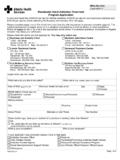
Transcription of Basal Bolus Insulin Therapy (BBIT)
1 Form TitleForm Number 2018, Alberta Health Services, CKCMThis work is licensed under the Creative Commons Attribution-NonCommercial-NoDerivatives International License. The license does not apply to content for which the Alberta Health Services is not the copyright view a copy of this license, : This material is intended for use by clinicians only and is provided on an DV LV ZKHUH LV EDVLV $OWKRXJK UHDVRQDEOH HIIRUWV ZHUH PDGH WR FRQ UP WKH DFFXUDF\ RI WKH information, Alberta Health Services does not make any representation or warranty, express, LPSOLHG RU VWDWXWRU\ DV WR WKH DFFXUDF\ UHOLDELOLW\ FRPSOHWHQHVV DSSOLFDELOLW\ RU WQHVV IRU a particular purpose of such information. This material is not a substitute for the advice of a TXDOL HG KHDOWK SURIHVVLRQDO $OEHUWD +HDOWK 6 HUYLFHV H[SUHVVO\ GLVFODLPV DOO OLDELOLW\ IRU WKH XVH of these materials, and for any claims, actions, demands or suits arising from such Bolus Insulin Therapy (BBIT)20889 Basal Bolus Insulin Therapy (BBIT)Adult Inpatient Subcutaneous Insulin Order Set20889(Rev2019-06) 1.]
2 Discontinue all previous Insulin and blood glucose monitoring Glucose (BG) Monitoring 4 times per day (15 - 30 minutes before scheduled meals and at bedtime), as well as PRN for suspected hypoglycemia and: o 0200h x _____ days o 2 hours after meal time o Other (specify) _____ If BG less than mmol/L initiate Hypoglycemia Procedure. Do Not Hold Insulin without prescriber order If BG greater than mmol/L initiate Hyperglycemia Procedure and call prescriberTotal Daily Dose (TDD) See calculation instructions on reverse for Prescriber Guidance onlyCalculated TDD for this order (Physician to use as guide for Basal , Bolus & Correction Calculations) Basal InsulinHome dose or TDD (given initially as equal, twice daily doses at breakfast and bedtime; glargine may be given once daily)Choose One Basal Insulin o glargine (Lantus ) o glargine ( basaglar ) o detemir (Levemir )o HumuLIN N Bolus and Correction Insulin Use the same Insulin (rapid or short-acting) for Bolus and One Bolus /Correction Insulin o Iispro (HumaLOG ) sc with mealo aspart (Novorapid ) sc with mealo HumuLIN R sc 30 min before mealBolus Insulin Home dose (consider reduction of 25-50% for hospital diet) or TDD divided initially into 3 equal doses Hold if no caloric intake, NPO or Bolus feeds stopped.
3 Continue Basal and correction Insulin . o Patient may determine and administer own dose and report dose to nurse (Order Insulin type and acceptable dose range)Correction for hyperglycemia: Choose one based on current Total Daily Dose (TDD) Correction dose to be determined and administered with/before meal/feed OR at scheduled mealtime if NPO. Bedtime dose not routinely recommended. Correction and Bolus doses can be combined and administered as a single subcutaneous injection. Prescriber Name (print)SignatureDate (yyyy-Mon-dd)Time (hh:mm)Units _____o With Breakfast oro Time (hh:mm) _____Units _____o At Bedtime oro Time (hh:mm) _____Units _____o With Breakfast or feed at time (hh:mm) _____Units _____o With Lunch or feed at time (hh:mm) _____Units _____o With Dinner or feed at time (hh:mm) _____Units _____o With Other _____ at time (hh:mm) _____o TDD 15-30 unitso TDD 31-50 unitso TDD 51-80 unitso TDD 81 units or moreo + + + + + + + + + + + + + + + + + +102. All adult subcutaneous BBIT Insulin orders (except STAT orders) must be documented using this order set.
4 Any change in Insulin orders requires completion of a new BBIT order set (Stroke out entire page and initial, when starting new order set).3. Orders marked with are active by default, unless crossed out and initialed by prescriber. Boxed orders (o) require prescriber check mark ( ) to be for the completion of the BBIT Adult Inpatient Order Set This guide does not replace clinical judgment. Refer to for further information and educational resources. Use home dosing of oral/injectable antihyperglycemic agents and/or Insulin if safe and blood glucose targets are being met. Basal Bolus Insulin Therapy (BBIT) should be used if the patient is poorly controlled at home, requires oral/injectable antihyperglycemic agents to be held, or is not achieving glycemic targets in hospital. BBIT is recommended even if Therapy is expected to be temporary, peri-procedural, or for patients not previously requiring Insulin . Diabetic Therapy will be optimized to suit patient needs prior to discharge.
5 Review glucose record daily. If targets of are not achieved, consider the causes and adjust Insulin doses where appropriate. Total Daily Dose (TDD): Total number of all units of Basal + Bolus + correction Insulin used in 24 hour period How to calculate TDD: If currently on BBIT in hospital and requires titration (see titration table below): TDD = all Insulin doses within past 24 hour period. If on Basal and Bolus Insulin at home with good control: TDD = all Insulin doses in a usual 24 hour period. If patient has poor control or requires Insulin (even transiently) in hospital to achieve targets of mmol/L: Use LOWER TDD IF Type 1 DM, slim Type 2 DM, history of hypoglycemia unawareness, reduced renal function (eGFR less than 30mL/min), liver failure, age greater than 70 with moderate/severe frailty TDD=Weight (kg) x to Units/kg/day Use HIGHER TDD IF Insulin resistance, overweight Type 2 DM, steroid treatment, infection TDD=Weight (kg) x to 1 Units/kg/day Basal Insulin : Intermediate/long-acting Insulin required to cover rising blood glucose between meals and overnight How to calculate Basal Insulin If patient is well controlled on Insulin at home, use pre-admission Basal Insulin doses and timing.
6 If Insulin required in hospital or patient requires titration of BBIT: Total Basal = TDD x glargine (Lantus / basaglar ) dosed once daily OR detemir (Levemir ) or HumuLIN N dosed twice daily breakfast and bedtime. Clinical Pearls At optimal doses, Basal Insulin should never cause hypoglycemia, even if the patient is not eating. All patients with Type 1 Diabetes require Basal Insulin , even when not eating, in order to prevent rapid development of diabetic ketoacidosis (DKA). No Basal required if patient well controlled without Basal at home and meeting hospital targets OR if receiving continuous enteral feeds and achieving targets on QID timed Bolus plus correction Insulin alone. Bolus Insulin : Rapid/short acting Insulin , required to cover rising blood glucose after meals caused by carbohydrate intake How to calculate Bolus Insulin If patient is well controlled on Insulin at home, use pre-admission Bolus Insulin doses. Consider reducing Bolus doses by 25-50% if hospital diet less than home diet.
7 If Insulin required in hospital or patient requires titration of BBIT: Total Bolus = TDD x divided by 3 (three equal doses with meals) lispro (HumaLOG ), aspart (Novorapid ), or HumuLIN R. Blood glucose testing and Bolus Insulin administration are to be coordinated with meal/feed. Correction Insulin : Additional rapid/short acting Insulin administered to correct blood glucose if above target Selection based on TDD. May be combined with the scheduled Bolus Insulin dose and administered as a single subcutaneous injection. If NPO, correction dose to be administered at scheduled meal/feed time, in coordination with blood glucose testing. Use of bedtime Correction dose is not routinely recommended. Prescriber may use discretion for STAT bedtime Insulin dose if blood glucose over Titration: For most patients, the recommended target is a blood glucose range of If Breakfast BG is: If Lunch BG is: If Supper BG is: If Bedtime BG is: If Overnight BG is: LOW (below ) HIGH (above ) LOW (below ) HIGH (above ) LOW (below ) HIGH (above ) LOW (below ) HIGH (above ) LOW (below ) Decrease Increase Decrease Increase Decrease Increase Decrease Increase Decrease Bedtime Basal Breakfast Bolus Lunch Bolus or Breakfast Basal Supper Bolus Bedtime Basal If ALL BG are HIGH (greater than ), Calculate TDD from last 24 hours, Increase TDD by 10-20% and Recalculate all Basal , Bolus and Correction Doses If HYPERGLYCEMIA OR HYPOGLYCEMIA: Discuss with patient to determine if change in activity or oral intake was the cause.
8 If yes, monitor carefully. If otherwise unexplained, increase or decrease doses by 10-20% as per Titration Table above. Enteral Tube Feeds / Parenteral Nutrition: Insulin requirements will vary depending on rate and carbohydrate content For more details: see How to BBIT document on website.