Transcription of Summary of Indiana Size and Weight Laws under TITLE 9 ...
1 Summary of Indiana Size and Weight Laws under TITLE 9 Article 20 Except for Interstate highway travel, the following vehicles are exempt from size and Weight requirements: 1. Machinery or equipment used in highway construction or maintenance by the Indiana department of transportation, counties, or municipalities. 2. A highway construction vehicle when engaged in highway construction and movement is restricted to areas under construction and not open to public is exempt from size and Weight . 3. Farm drainage machinery. 4. Implements of husbandry when used during farming operations or when so constructed can be moved without damage to the highway.
2 5. Firefighting equipment owned or operated by a political subdivision or volunteer fire department. 7. And except for interstate highways does not limit the width or height of a farm vehicle loaded with a farm product, which would include unprocessed leaf tobacco. 8. Recovery vehicles are exempt from size and Weight requirements when moving a disabled vehicle or combination of vehicles for a distance not exceeding 50 miles. However, these vehicles must meet requirements of IC 9-20-9-9 and IC 9-20-9-10. With some exceptions, the maximum legal weights, with load, allowed under the law can be summarized as follows.
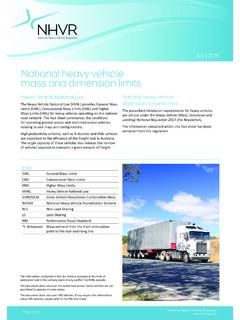
3 Maximum possible gross Weight : 80,000 pounds Maximum single axle Weight : 20,000 pounds Maximum tandem axle Weight : 34,000 pounds Maximum tri axle Weight : 50,000 pounds Maximum wheel Weight : 800 pounds per inch of tire width measured between the flanges of the rim. For anything beyond these maximum weights, a permit has to be obtained from the Indiana Department of Revenue and certain requirements have to be met. For further information on permits and other information the Indiana Department of Revenue maintains a website at or at (317) 615-7320. Vehicle License Plates and Registered Weight Indiana has a registered Weight limit, which is based on the declared gross Weight (referred to as registered Weight ) for a vehicle when it is registered with the Bureau of Motor Vehicles or International Registration Plan (IRP) and only refers to the amount of registration fee paid according to the amount of Weight declared on the registration.
4 Weight limits for vehicles; rules In 1975, Indiana adopted the Bridge Formula as state law as stipulated in IC 9-20-40-1. The formula is used to calculate the maximum legal gross Weight and axle weights allowed for a vehicle or combination of vehicles. W = 500 {[(LN) (N-1)] + 12N + 36} W = the overall gross Weight on any group of two or more consecutive axles, to the nearest 500 pounds. L = the distance between the extreme of any group of two or more consecutive axles. (The measurement is taken at center of the wheel hubs). N = the number of axles in the group under consideration, except that two consecutive sets of tandem axles may carry a gross load of 34,000 pounds each, providing the first and last axles of the consecutive sets of tandem axles are at least 36 feet apart or more.
5 FEDERAL BRIDGE FORMULA EXAMPLES OF BRIDGE FORMULA MEASUREMENTS Indiana has a grandfather law built into its Weight law retaining the Weight limits that were in effect on January 4, 1975. This retention protects vehicles from losing Weight capability based upon their configuration when the bridge formula is applied to them. The maximum gross Weight , with load, under this subsection is seventy-three thousand two hundred eighty (73,280) pounds. The maximum Weight on an individual axle of a tandem axle group is sixteen thousand (16,000) pounds for each axle .
6 And limited to a maximum wheel Weight of eight hundred (800) pounds per inch width of the tire measured between the flanges of the rim, or a maximum axle Weight of eighteen thousand (18,000) pounds. Examples of vehicles where the grandfather law , applies are: When the outer bridge measurement is less than 40 feet for total gross Weight and the tandem axles or inner bridge measurement between axles 2-5 is less than 36 feet, one set of tandems will get at least thirty four thousand (34,000) pounds, but both sets of tandem axles (axles 2-5) would not be able to gross more than sixty four thousand (64,000) pounds when added together as combination axle Weight .
7 In this example, this vehicle would be penalized for allowable gross Weight if the bridge formula were applied; the grandfather law allows both axles the potential to weigh twenty thousand (20,000) pounds depending on the size of the rims (tires) and effects potential gross Weight . While this vehicle would be penalized for total gross Weight if the bridge formula were applied, under the grandfather law it has the potential to have a gross Weight of no more than seventy thousand (70,000) pounds. The tri- axle assembly itself can weigh fifty thousand (50,000) pounds.
8 This can be broken down to thirty-four thousand (34,000) pounds on the tandem and sixteen thousand (16,000) pounds on the single axle , or thirty-two thousand (32,000) pounds on the tandem axle and eighteen thousand (18,000) pounds on the single axle . Again, size of the rim determines wheel Weight and gross Weight . This vehicle is also penalized for gross Weight if the bridge formula was applied to it. Depending on wheel and axle configuration it has the potential to gross no more than seventy three thousand two hundred eighty (73,280) pounds under the grandfather law.
9 And again rim size determines wheel Weight and gross Weight . Exceptions: farm commodities and the Weight law. A vehicle or combination of vehicles transporting farm commodities from the place of production to the first point of delivery where the commodities are weighed and TITLE to the commodities are transferred are allowed ten percent additional Weight to the maximum gross Weight . For example, if a combination vehicle is allowed a gross Weight under the Bridge Formula of eighty thousand (80,000) pounds, with this exception of ten percent, the total gross allowed would be eighty-eight thousand (88,000) pounds.
10 However, this increase in Weight is not applicable when the following apply: 1. Weight limits imposed for bridges or sections of highways under IC 9-20-1-4. 2. A vehicle operated on any part of an interstate system. axle weights and registered Weight is not applicable as long as the two aforementioned instances are not involved, or the vehicle does not exceed the 10 percent tolerance. Farm commodities include logs, wood chips, bark, sawdust, and bulk milk. In the case of wood chips, bark, and sawdust, the ten percent tolerance is applicable at all times for gross Weight and axle weights Exceptions: Refuse vehicles and the Weight law Special restrictions apply to a garbage truck, truck-trailer combination, or a truck-wagon combination that is either: 1.