Transcription of Examples of Chromatography Chromatography in Real Life
1 12/20/2011. What is Chromatography ? Chromatography (from Greek word for _____ chromos for color) is the collective term for a family of laboratory techniques for the separation of mixtures. It involves passing a mixture through a stationary phase, which separates it from other molecules in the mixture and allows it to be isolated. Which means .. physical separation Chromatography is the _____. individual components of a mixture into its _____. We can use Chromatography to separate the components of inks and dyes, such as those found in Applications in pens, markers, clothing, and even candy shells. Chromatography can also be used to separate the Forensic Science colored pigments in plants or used to determine the chemical composition of many substances.
2 Examples of Chromatography Chromatography in Real Life Liquid _____ Chromatography is used in many different industries and labs. Chromatography The police and other investigators use Chromatography to identify Used to identify unknown plant pigments & other compounds. clues at a crime scene like blood, ink, or drugs. More accurate Chromatography in combination with expensive equipment is used to make sure a food company's processes are working Thin-layer _____. correctly and they are creating the right product. This type of Chromatography Uses thin plastic or glass trays to identify Chromatography works the same way as regular Chromatography , the composition of pigments, chemicals, and other unknown substances.
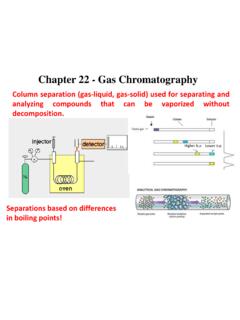
3 But a scanner system in conjunction with a computer can be used to identify the different chemicals and their amounts. Chemists use Chromatography in labs to track the progress of a reaction. Gas By looking at the sample spots on the Chromatography plate, they _____Chromatography Used to determine the chemical composition of Paper _____ can easily find out when the products start to form and when the unknown substances, such as the different Chromatography compounds in gasoline shown by each separate Can be used to separate the reactants have been used up ( , when the reaction is peak in the graph below. components of inks, dyes, plant complete).
4 Chemists and biologists also use Chromatography to compounds (chlorophyll), make-up, and many other substances identify the compounds present in a sample, such as plants. Paper Chromatography Paper Chromatography How does it work? To measure how far each component travels, we calculate the retention factor (R f value) of the sample. The Rf value is the _____between ratio how far water The _____ (solvent) is the mobile phase of the the component travels and the distance the solvent travels from a common starting point (the origin). If one of the sample components moves cm up the paper Chromatography system. The _____ is stationary paper and the solvent moves cm, then the Rf value is You can use Rf values to identify different components as long as the solvent, temperature, pH, phase.
5 Chromatography works by and type of paper remain the same. In the image below, the light blue shading represents the solvent and the dark blue spot is the chemical sample. capillary action _____. The attraction of the water to To calculate the Rf value, we use the equation: adhesion the paper (_____force) is larger than the attraction Rf =. cohesion distance traveled by the sample component of the water to itself (_____force); hence, the distance traveled by the solvent water moves up the paper. The ink will also be attracted to the In our example, this would be: paper, to itself, and to the water differently, and thus a different Rf =.
6 Cm component will move a different distance depending upon the cm = strength of attraction to each of these objects. ratio Note that an Rf value has no units because it is a _____. and the units of distance cancel. 1. 12/20/2011. Paper Chromatography Lab Marker #1. Marks A-Lot #2. vis- -vis #3. School Smart #4. Scented Complete the Colors observed Obtain the supplies you'll need. Tape Label with marker chart on and in ink sample 1 large beaker (or plastic cup) Pencil then answer the 1 small beaker (or plastic cup) filled with water questions. Filter 4 pieces of filter paper Paper 4 black markers for testing 4 small pieces of masking tape Distance Glass stirring rod (to attach to the top of the filter paper) Ink traveled by the Permanent marker Mark sample Timer component Rf value Write the pen number on a piece of masking tape with a permanent marker Questions: and place it at the top of the strip.
7 What colors did your group observe in each of the black ink samples? Choose one of the testing markers and draw a thick line near the bottom of the filter paper - about inch from the bottom. Pour a small amount of water into the large cup and then hang the paper strip Do the colors occur in the same order on all the samples? Explain. in the cup. Make sure the ink line does not touch the water only the bottom of the filter paper. Did some ink samples not work? Why? Allow the water to move up the paper for 10 minutes and then remove the strip from the water. Hang it on the side of the table to dry. Compare and contrast the Rf value for the markers.
8 Follow these directions to test the other pens. Chromatography Challenge Earlier today, the girl's bathroom was vandalized with graffiti. Fortunately, 4 girls were apprehended and questioned. Each of the girls apprehended was caught leaving the bathroom with a black marker. Suzy Q had a black Marks-A-Lot marker. Margie B had a black Vis- -vis marker. Polly X had a black Scented marker. Jeanie P had a black School Smart Marker. VonFischer asked the chemistry class to help determine which marker was used for the act of vandalism. After using paper Chromatography to test the marker it was found that the marker used had a Rf value of 0.
9 Can you single out (or narrow down) a culprit for Mr. VonFischer? 2.