Transcription of Module 5: Body Mechanics - CA-HWI
1 Module 5: body Mechanics California Community Colleges Chancellor s Office Nurse Assistant Model Curriculum - Revised December 2018 Page 1 of 34 Module 5: body Mechanics Minimum Number of Theory Hours: 2 Recommended Theory Hours: 4 Recommended Clinical Hours: 4 Statement of Purpose: The purpose of the unit is to provide students with an understanding of efficient and proper use of the body in performing tasks related to the role of the CNA. Students will understand the principles of positioning and transporting patients/residents and will implement these principles when providing patient/resident care. Terminology: 1. Activities of Daily Living (ADL) 2. Alignment 3. Ambulate 4. Base of support 5. body Mechanics 6. Dangle 7. Dorsal recumbent 8. Fowler s position 9.
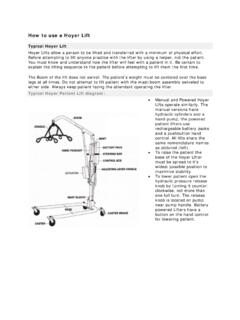
2 Gait belt 10. Grasp 11. Hoyer lift 12. Lateral position 13. Lift/draw/turn 14. Lift team 15. Lithotomy 16. Logroll 17. Mechanical lift 18. Pivot 19. Prone position 20. Sim s position 21. Supine position 22. Trapeze 23. Trendelenburg 24. Total Quality Improvement (TQI) 25. Work-related musculoskeletal disorder (WRMD Patient, resident, and client are synonymous terms referring to the person receiving care Module 5: body Mechanics California Community Colleges Chancellor s Office Nurse Assistant Model Curriculum - Revised December 2018 Page 2 of 34 Performance Standards (Objectives): Upon completion of the two (2) hours of class plus homework assignments and four (4) hours of clinical experience, the learner will be able to: 1. Define key terminology. 2.)
3 Explain the purpose and rules of proper body Mechanics . 3. Identify comfort and safety measures used to lift, turn, move, and position patients/residents in bed. 4. List and describe body positions for bedridden patients/residents. 5. Describe patient/resident transfers. 6. Describe appropriate body Mechanics used to ambulate a patient/resident. Module 5: body Mechanics California Community Colleges Chancellor s Office Nurse Assistant Model Curriculum - Revised December 2018 Page 3 of 34 References: 1. Acello, B. & Hegner, B. (2016). Nursing Assistant: A Nursing Process Approach. (11th ed). Boston, MA. Cengage Learning. 2. Acello, B. (2016). Workbook to accompany: Nursing Assistant: A Nursing Process Approach. (11th ed). Boston, MA.
4 Cengage Learning 3. Boldt, M. (2008). Back safety for long term care employees: Take a bit our of WC losses. July 21, 2008, for Convalescent Employers Safety Association of CA available at 4. Carter, P. J. (2017). Lippincott Essentials for Nursing Assistants: a Humanistic Approach to Caregiving. (4th ed.) Philadelphia, PA. Lippincott Williams & Wilkins 5. Deck, M. L. (2004). Instant Teaching Tools for the New Millennium. St Louis, MO. Mosby 6. Hedman, S. A., Fuzy, J., & Rymer, S. (2018). Hartman's Nursing Assistant Care: Long-Term Care (4th ed.). Albuquerque, NM. Hartman Publishing, Inc. 7. Hartman Publishing. (2018). Workbook for Hartman's Nursing Assistant Care: Long-Term Care (4th ed.). Albuquerque, NM. Hartman Publishing, Inc. 8. Haroun, L. & Royce, S. (2004).
5 Teaching Ideas and Activities for Health Care. Albany, NY. Delmar Publishers 9. McGinley, & Bunke, J. (2008). Best practices for safe handling of the morbidly obese patient. Bariatric Nursing and Surgical Patient Care, Dec, 3(4). Pp 255-260. 10. Pearson Vue (2018) California Nurse Assistant Candidate Handbook for National Nurse Aide Assessment Program. Philadelphia, PA. Pearson Education, Inc. 11. Sorrentino, S. A., Remmert, L., & and Kelly, R. (2018) Workbook and Competency Evaluation Review for Moby s Textbook for Nursing Assistants (9th ed.) St. Louis, MO. Mosby Company 12. Sorrentino, & Remmert, L. (2018) Mosby s Textbook for Nursing Assistants. (9th ed.). St Louis, MO. Elsevier 13. Weaver, L. & Wilding, M. (2013) The Dimensions of Engaged Teaching: a Practical Guide for Educators.
6 Bloomington, IN. Solution Tree Press. 14. The Joint Commission. (2008). National Patient Safety Goals: Long Term Care Program. 15. US Department of Labor. (2008). Healthcare Wide Hazards Module Ergonomics. Accessed 2/23/09 5: body Mechanics California Community Colleges Chancellor s Office Nurse Assistant Model Curriculum - Revised December 2018 istants - Revised September 2013 Page 4 of 34 Content Outline Recommended Teaching Strategies and Assignments Clinical Demonstration/ Method of Evaluation Objective 1 Define key terminology A. Review the terms listed in the terminology section B. Spell the listed terms accurately C. Pronounce the terms correctly D. Use the terms in their proper context A. Lecture/Discussion B. Games: word searches, crossword puzzles, Family Feud, Jeopardy, bingo, spelling bee, hangman, and concentration C.
7 Encourage use of internet, medical dictionary, and textbooks D. Create flashcards for learning purposes A. Have students select five words from the list of key terminology and write a sentence for each defining the term B. Administer vocabulary pre-test and post-test C. Uses appropriate terminology when charting and reporting to licensed personnel Objective 2 Explain the purpose and rules of proper body Mechanics . A. Proper body Mechanics ensures the Nurse Assistant is using the body in an efficient and safe way 1. Practice body Mechanics at all times 2. Everyone should use good body Mechanics even patients/residents and families 3. Protects both employee and patient/resident from injury B. Basic rules of body Mechanics 1. Assess the job to be done 2. Use wide base of support; feet 12 inches apart or shoulder width 3.
8 Use stronger, larger muscle groups like legs, not the back and arms 4. Use correct posture and keep body aligned back straight, knees bent 5. Keep objects close to body when lifting or carrying A. Lecture/Discussion B. Show pictures or video on proper body Mechanics C. Handout body Mechanics Crossword D. Handout body Mechanics Crossword- KEY A. Written test B. Uses proper body Mechanics when performing patient/resident care tasks Module 5: body Mechanics California Community Colleges Chancellor s Office Nurse Assistant Model Curriculum - Revised December 2018 istants - Revised September 2013 Page 5 of 34 6. Never twist your body , turn or pivot feet face work 7. Push, slide, or pull heavy objects instead of lifting pivot 8. Avoid sudden jerky motions; use smooth movements 9.
9 Use both hands when lifting 10. Team work one leader who communicates/directs the group 11. Explain procedure to patient/resident C. Legal and Total Quality Improvement (TQI) issues 1. Legal a. Must protect and safeguard patient/resident b. Skin abrasion is reason for citation and a reportable incident 2. TQI issue: a. Back injuries-refer to Work-related musculoskeletal disorder (WRMD) b. Patient/resident safety-refer to OSHA Objective 3: Identify comfort and safety measures used to lift, turn, move, and position patients/residents in bed. A. Comfort measures for lifting and moving patients/residents 1. Inform the patient/resident of what you are doing and why 2. Provide privacy 3. Raise bed to working height to promote safe body Mechanics 4. Position the patient/resident in proper body alignment 5.
10 Use pillows and/or foam pads to support and cushion the patient/resident and protect bony prominences 6. Protect all tubing 7. Do not slide or drag to prevent skin shearing, abrasion, tear B. Safety measures for lifting and moving patients/residents 1. Assess the task a. Size up the load b. Obtain help if needed 1) If more than two people are needed, a mechanical lift is recommended 2) Some facilities have a lift team 2. Using appropriate body Mechanics , reposition patient/resident in bed A. Lecture/Discussion B. Demonstrate stoop, reach, lift, pivot, push/pull, and carry close techniques C. Demonstrate use of pull/draw sheet, gait belt D. Show videos demonstrating techniques E. Manual Skills Turning and Positioning the Patient/resident F. Manual Skills Moving the Helpless Patient/resident to Head of Bed A.