Transcription of CHAPTER 3 RULES OF ORIGIN SECTION A RULES OF ORIGIN
1 3-1 CHAPTER 3 RULES OF ORIGIN SECTION A RULES OF ORIGIN Article : Definitions For the purposes of this CHAPTER : (a) aquaculture means the farming of aquatic organisms including fish, molluscs, crustaceans, other aquatic invertebrates, and aquatic plants from seed stock such as eggs, fry, fingerlings, and larvae, by intervention in the rearing or growth processes to enhance production such as regular stocking, feeding, or protection from predators; (b) CIF value means the value of the imported good, inclusive of the cost of insurance and freight up to the port or place of entry into the country of importation; (c) competent authority means the government authority or authorities designated by a Party and notified to the other Parties; (d) customs authority means a customs authority as defined in subparagraph (a) of Article (Definitions); (e) FOB value means the value of the good free on board, inclusive of the cost of transport (regardless of the mode of transport) to the port or site of final shipment abroad.
2 (f) fungible goods or materials means goods or materials that are interchangeable for commercial purposes, whose properties are essentially identical; (g) Generally Accepted Accounting Principles means those principles recognised by consensus or with substantial authoritative support in a Party, with respect to the recording of revenues, expenses, costs, assets, and liabilities; the disclosure of information; and the preparation of financial statements. These principles may encompass 3-2 broad guidelines of general application as well as detailed standards, practices, and procedures; (h) good means any merchandise, product , article, or material; (i) issuing body means an entity designated or authorised by a Party to issue a Certificate of ORIGIN and notified to the other Parties in accordance with this CHAPTER ; (j) material means a good that is used in the production of another good; (k) non-originating good or non-originating material means a good or material which does not qualify as originating in accordance with this CHAPTER .
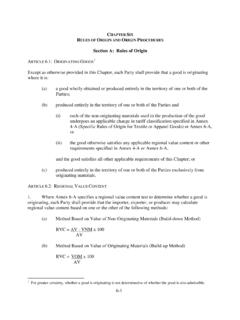
3 (l) originating good or originating material means a good or material which qualifies as originating in accordance with this CHAPTER ; (m) producer means a person who engages in the production of goods; and (n) production means methods of obtaining goods including growing, mining, harvesting, farming, raising, breeding, extracting, gathering, collecting, capturing, fishing, aquaculture, trapping, hunting, manufacturing, producing, processing, or assembling. Article : Originating Goods For the purposes of this Agreement, a good shall be treated as an originating good if it is: (a) wholly obtained or produced in a Party as provided in Article (Goods Wholly Obtained or Produced); (b) produced in a Party exclusively from originating materials from one or more of the Parties; or (c) produced in a Party using non-originating materials, provided the good satisfies the applicable requirements set out in Annex 3A ( product - specific RULES ), 3-3 and meets all other applicable requirements of this CHAPTER .
4 Article : Goods Wholly Obtained or Produced For the purposes of Article (Originating Goods), the following goods shall be considered as wholly obtained or produced in a Party: (a) plants and plant goods, including fruit, flowers, vegetables, trees, seaweed, fungi, and live plants, grown and harvested, picked, or gathered there; (b) live animals born and raised there; (c) goods obtained from live animals raised there; (d) goods obtained by hunting, trapping, fishing, farming, aquaculture, gathering, or capturing conducted there; (e) minerals and other naturally occurring substances, not included in subparagraphs (a) through (d), extracted or taken from its soil, waters, seabed, or subsoil beneath the seabed.
5 (f) goods of sea-fishing and other marine life taken by vessels of that Party1, and other goods taken by that Party or a person of that Party, from the waters, seabed, or subsoil beneath the seabed outside the territorial sea of the Parties and non-Parties, in accordance with international law, provided that, in case of goods of sea-fishing and other marine life taken from the exclusive economic zone of any Party or non-Party, that Party or person of that Party has 1 For the purposes of this Article, factory ships of that Party or vessels of that Party respectively, means factory ships or vessels: (a) which are registered in that Party; and (b) which are entitled to fly the flag of that Party.
6 Notwithstanding the preceding sentence, any factory ship or vessel operating within the exclusive economic zone of Australia that meets the definition of Australian boat under the Fisheries Management Act 1991 (Commonwealth), as amended from time to time, or any successor legislation, shall be considered to be a factory ship or vessel of Australia respectively. For greater certainty, when such a factory ship or vessel is operating outside of the exclusive economic zone of Australia, the requirements of subparagraphs (a) and (b) of this footnote shall apply. 3-4 the rights to exploit2 such exclusive economic zone, and in case of other goods, that Party or person of that Party has rights to exploit such seabed and subsoil beneath the seabed, in accordance with international law; (g) goods of sea-fishing and other marine life taken by vessels of that Party from the high seas in accordance with international law; (h) goods processed or made on board any factory ships of that Party, exclusively from the goods referred to in subparagraph (f) or (g).
7 (i) goods which are: (i) waste and scrap derived from production or consumption there, provided that such goods are fit only for disposal, for the recovery of raw materials, or for recycling purposes; or (ii) used goods collected there, provided that such goods are fit only for disposal, for the recovery of raw materials, or for recycling purposes; and (j) goods obtained or produced there solely from goods referred to in subparagraphs (a) through (i), or from their derivatives. Article : Cumulation 1. Unless otherwise provided in this Agreement, goods and materials which comply with the ORIGIN requirements provided in Article (Originating Goods), and which are used in another Party as materials in the production of another good or material, shall be considered as originating in the Party where working or processing of the finished good or material has taken place.
8 2. The Parties shall commence a review of this Article on the date of entry into force of this Agreement for all signatory States. This review will consider the extension of the application of cumulation 2 For the purposes of determining the ORIGIN of goods of sea-fishing and other marine life, rights to exploit in this subparagraph include those rights of access to the fisheries resources of a coastal State, as accruing from any agreements or arrangements between a Party and the coastal State. 3-5 in paragraph 1 to all production undertaken and value added to a good within the Parties. The Parties shall conclude the review within five years of the date of its commencement, unless the Parties agree otherwise.
9 Article : Calculation of Regional Value Content 1. The regional value content of a good, specified in Annex 3A ( product - specific RULES ), shall be calculated by using either of the following formulas: (a) Indirect/Build-Down Formula or (b) Direct/Build-Up Formula where: RVC is the regional value content of a good, expressed as a percentage; FOB is the FOB value as defined in subparagraph (e) of Article (Definitions); VOM is the value of originating materials, parts, or produce acquired or self-produced, and used in the production of the good; VNM is the value of non-originating materials used in the production of the good; RVC = FOB VNM _____ FOB x 100 RVC = VOM + Direct Labour Cost + Direct Overhead Cost + Profit + Other Cost x 100 _____ FOB 3-6 Direct Labour Cost includes wages, remuneration, and other employee benefits; and Direct Overhead Cost is the total overhead expense.
10 2. The value of goods under this CHAPTER shall be calculated, mutatis mutandis, in accordance with Article VII of GATT 1994 and the Customs Valuation Agreement. All costs shall be recorded and maintained in accordance with the Generally Accepted Accounting Principles applicable in the Party where the goods are produced. 3. The value of non-originating materials shall be: (a) for imported materials, the CIF value of the materials at the time of importation; and (b) for materials obtained within a Party, the earliest ascertainable price paid or payable. 4. A material of undetermined ORIGIN shall be treated as a non-originating material.