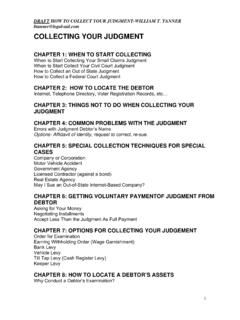
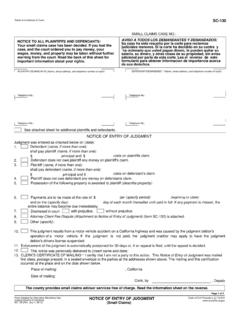
Transcription of Collecting Your Judgment: A Step-By-Step Approach
1 Collecting Your Judgment: A Step-By-Step Approach YOUR LEGAL RIGHTS Employees who win money judgments against their employers often need help Collecting those judgments on their own or in court. This packet provides a Step-By-Step explanation of how you can try to collect your successful judgment. Also attached are the forms you will need to follow these steps, and examples of correctly completed forms. Step 1: Ask your employer to pay voluntarily. To avoid the hassle and expense of formal collection, you should first ask your employer to pay your judgment voluntarily. This is a particularly important step if you believe your employer has the money to pay, or if maintaining a good relationship with your employer is important to you. To collect a judgment voluntarily you should follow these steps: 1. Make an initial request for your money. You can do this in a letter, telephone call, or personal meeting. You should remind your employer of the judgment (including the amount), and ask to make arrangements to pay off your award.
2 This may be all the prompting that your employer needs to give you the money owed to you. 2. Send a final demand letter. If your employer does not respond to your first request for payment within a week to ten days, you should write a formal final demand letter. You should simply restate that a judgment has been entered in your favor, that you request payment of that judgment, and that if you do not receive such payment within a set period of time you will begin formal collection efforts. A sample formal demand letter is attached as Form A. If the above efforts to collect your judgment fail, you should begin formal collection procedures. To do so, you can use any or all of the legal enforcement tools discussed below. 600 HARRISON STREET SUITE 120 SAN FRANCISCO, california 94107 TEL: 415 864 8848 Collecting YOUR JUDGMENT FACT SHEET 600 HARRISON STREET SUITE 120 SAN FRANCISCO, california 94107 TEL: 415 864 8848 Step 2: Obtain a business property lien.
3 What is a lien? A lien is a legal tool that strengthens your judgment from a claim against your employer to a claim against the employer s property or assets. A business property lien attaches to property belonging to your employer so that you have a claim against that property, and not just against your employer. That doesn t mean your employer has to sell the property to pay off your judgment, but it does give you additional protection if your employer goes bankrupt, gets a new loan from the bank, tries to pay off a judgment to another person, or tries to sell off the property in the future. To what kind of property can a lien attach? A lien can attach to different types of property and assets owned by your employer. (See Step 4, below, to find out what your employer owns.) Types of property to which a lien might attach include: money that is owed to your employer because of business transactions (accounts receivable); documents, like car leases, showing that your employer owns a specific good but hasn t paid for it in full (chattel paper); business equipment, like machines or computers; crops that have been harvested from a farm; inventory that sells for more than $500 per unit; for example, if your employer is a car dealership, the cars would qualify, but if your employer is a small grocery store, the individual bottles of Pepsi would not.
4 How to Create a Business Property Lien 1. Complete a Notice of Judgment Lien. A sample Notice of Judgment Lien form is attached to this packet in Form B. The form asks for very basic information on the source and amount of your judgment. 2. Serve your employer. After you have filled out the form, you must arrange to serve a copy on your employer. You must ask someone else who is not a party to your case to do this for you. The person you ask to serve your employer must be at least 18 years old, and must be a resident or employee in the county where s/he serves the papers. S/he can be a friend or relative, or you can hire a professional registered process server. There are two basic ways to serve papers, by mail or in person. Collecting YOUR JUDGMENT FACT SHEET 600 HARRISON STREET SUITE 120 SAN FRANCISCO, california 94107 TEL: 415 864 8848 Service by mail: If you choose to serve papers by mail, you ll probably want to ask a friend or relative to do it.
5 To serve papers by mail, you must 1. complete a Proof of Service by Mail form (attached sample Form C); 2. make copies of all the papers, and keep a copy for yourself; 3. put a copy of the papers and a copy of the unsigned Proof of Service by Mail form in an envelope addressed to your employer, stamped with sufficient postage; 4. have the person you have chosen to serve your employer put the envelope in the mail; 5. have that person sign the Proof of Service by Mail form; 6. copy the signed Proof of Service by Mail form and file it with the court where you received your judgment. Service in person: Although it s best to hire a professional process server when serving papers in person, there are several ways to personally serve your employer: 1. You can ask the sheriff s office in the county where your employer will be served if it handles personal service. If it doesn t, someone there can tell you which law enforcement officers in the county do.
6 Law enforcement officers generally charge around $ for service. 2. Instead of using the sheriff s office, you can hire a registered process server to serve your employer. Hiring a registered process server is a good idea if you think your employer will be difficult to serve. Registered process servers are listed in the Yellow Pages. They typically charge a little more than law enforcement officers. 3. You can have a friend or relative serve your employer in person. The person you choose must be at least 18 years old, and must be a resident or employee in the county where s/he serves the papers. S/he will need to fill out and sign a Proof of Personal Service form (attached as sample Form D. Make sure you keep a copy of the signed Proof of Personal Service form for your files. Collecting YOUR JUDGMENT FACT SHEET 600 HARRISON STREET SUITE 120 SAN FRANCISCO, california 94107 TEL: 415 864 8848 3. File the Notice of Judgment Lien (Form B) with the Secretary of State.)
7 The Secretary of State is a state government office that oversees many businesses. You should mail the Notice of Judgment Lien form you have completed with a brief cover letter to: Secretary of State Box 1738 Sacramento, CA 95808. You should also include a copy of either the signed Proof of Service by Mail (Form C) or Proof of Personal Service (Form D) showing that you have served your employer. You must also include a fee with the form. As of January 1, 2006, the fee was $ However, you should check with the Secretary of State s office to find out if the rate has changed. 4. Wait. Your next step after successfully creating a business property lien is to wait until your employer tries to do something with the property you have attached, like sell it, or until she tries to get financing from a bank or other creditor. At that time, your employer will have to pay off the amount of your lien before s/he can proceed. Step 3: Obtain a writ of execution.
8 What is a Writ of Execution? In addition to getting a business property lien, you can also get a Writ of Execution against your employer. Unlike the business property lien, where you have to wait until the employer does something with the property subject to the lien, the Writ of Execution is a legal tool that allows you to actively go after your employer s assets to satisfy your award. Once you ve filed a Writ of Execution, it lasts for 180 days. How to obtain a Writ of Execution: 1. Fill out the Writ of Execution form. A sample, completed Writ of Execution form is attached to this packet as Form E. You need to fill out a separate form for each county in which you are trying to collect your judgment. Therefore, you should file a Writ of Execution in each county in which your employer has assets you want to obtain. 2. File the form and have the court issue a Writ of Execution. Make at least three photocopies of your completed form and take the copies and the original document to the court clerk.
9 The clerk will issue the Writ by stamping it with the date and putting the official seal of the court on it. You may have your Writ issued by mail by sending Collecting YOUR JUDGMENT FACT SHEET 600 HARRISON STREET SUITE 120 SAN FRANCISCO, california 94107 TEL: 415 864 8848 your original Writ, the copies, the necessary fee, a self-addressed stamped envelope, and a cover letter to the clerk of the court asking that your Writ be returned to you. If information is missing from your form, or if your form has been filled out incorrectly, the clerk probably will reject your Writ. She will typically let you know why the Writ is being rejected so that you may quickly correct your work. 3. Serve your Writ of Execution. After your Writ has been issued, the county s levying officer (the person in charge of enforcing Writs of Execution, often the county sheriff) will serve it upon whomever you tell him to collect against. For example, you may have the levying officer collect against your employer s bank account, or against the receipts that come into the business one day.
10 Deciding what accounts to collect from is discussed in Step 4, below. Note: Enforcing a Writ of Execution can be expensive because it authorizes the levying officer to actually take possession of property. For example, as of January 1, 2006, the San Francisco sheriff s fee for enforcing a Writ of Execution against real property (such as a land or a home) was $700 Step 4: Find out what your employer s business owns. To determine the best method of Collecting your judgment, you need to know what assets your employer has and where they are kept. There are a number of ways you can get this information. Debtor s Statement of Assets. This tool is available only if your judgment came from small claims court. After the verdict, the clerk of the small claims court should give your employer a Statement of Assets form. Your employer must fill out the form and return it to you within 30 days of the judgment. If your employer does not complete the form, you should ask the small claims court to find the employer in contempt.

![[PROPOSED] COMPLAINT IN INTERVENTION](/cache/preview/1/b/4/5/7/f/f/c/thumb-1b457ffc5eb1f52e26dd77d3237bc1ee.jpg)