Transcription of How to Get Your Evidence Glossary - California
1 How to Get Your Evidence You may collect Evidence by discovery or by subpoena. 1) Discovery Discovery is pre-trial investigation. It allows you to get either Evidence itself, or information that will lead to getting the Evidence you need. There are rules for how much time you have to do things, and how many questions you can ask in a certain way. Some common Discovery methods are: Deposition: A deposition is written or oral testimony given under oath in front of a court reporter. These take place outside of court and allow the parties to get a record of a person s testimony, or to get testimony from a witness who lives far away. The person who sets up the deposition pays the court reporter s fees.
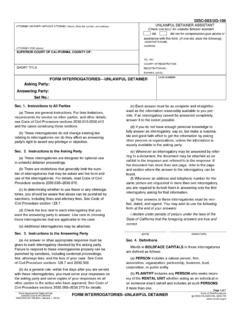
2 Interrogatories: Interrogatories are written questions sent by one side in a lawsuit to an opposing side. The side that receives the interrogatories must answer them in writing under oath, or give a legal basis for not answering them. Request for Admission: In a request for admission, one party formally and in writing asks the opposing party to admit the truth of certain facts relevant to a case. Request for Production of Things: One party may ask the other party for specific documents or things. The asking party may object to, copy or inspect these. Subpoena Duces Tecum: A subpoena duces tecum is an official court order to bring documents to a specific place at a specific time.
3 2) Subpoena A subpoena is a court order telling a person to go to court at a specific time. They are commonly used to tell witnesses to come to court to testify in a trial. The court has forms you can use to ask for these. Glossary Discovery: The gathering of information (facts, documents, or testimony) before a case goes to trial. Discovery is done in many ways, such as through depositions, interrogatories, or requests for ad-missions. It also can be done through independent research or by talking with the other side s lawyer. Evidence : Any proof legally presented at trial through witnesses, records, and/or exhibits. Exhibit: A document or an object shown and identified in court as Evidence in a case.
4 Normally, the court assigns an identifying letter or number in alphabetical or numerical order before exhibits are offered as Evidence . Hearsay: Statements by a witness who did not see or hear the incident in question but heard about it from someone else. Hearsay usually cannot be used as Evidence in court. (However, there are some important exceptions in the Evidence Code.) Material: Important (necessary). A material witness or exhibit is one that is useful in deciding an issue. Motion: An oral or written request a party makes to the court for a ruling or order on a particular point. Objection: A formal protest made to Evidence that the other side tries to introduce Party: One of the litigants in a court case.
5 At the trial level, parties are typically called the "plaintiff" or "petitioner" and the "defendant" or "respondent." Pleading: A written statement filed with the court that describes a party's legal or factual claims about the case and what the party wants from the court. Points and authorities: (Also called P s and A s ) The written argument, based on law and the facts, given to support a motion. Can refer to past cases, statutes (codes) and other statements of law. Proof: Evidence that tends to establish the existence or truth of a fact at issue in a case. Witness: A person called by either side in a lawsuit to give testimony before the judge or jury. Getting Evidence for Court Please note: There are a large number of laws which set standards for what Evidence can be used in a court.
6 Together, these laws are called the California Code of Evidence . Everyone, even a person who represents him- or herself, has to follow these laws when he or she is getting and presenting Evidence for court. Neither the judge nor the court staff can assist you in preparing or presenting your case. This pamphlet will help you to start thinking about how to present Evidence at a hearing or trial. If you started working on your case without an attorney, you may wish to seek the help of an attorney now. If, for financial reasons, you cannot hire a private attorney to handle your whole case, you can ask attorneys if they would be willing to help you for part of your case.
7 Or, you may be eligible to get help from a legal aid office. Getting Evidence - 7/2007 What Does the Court Consider Evidence ? Evidence is information you may present in court to prove your case. It can be in two main forms: 1) People: witness testimony You Other people who have direct and relevant information about the case People who keep records Experts 2) Things: exhibits Photographs Records: police, medical, bills, appraisals, school records, etc. Other documents or things In either case, the judge will want to know: Why is this witness or exhibit helpful in deciding your case? Rules of Evidence There are rules of Evidence that everyone must follow.
8 These rules help ensure that the judge gets reliable, relevant and accurate Evidence to consider when making decisions about your case. Among the most important of these rules are: Generally, people can only talk about what they know first hand what they themselves saw, heard, felt, smelled, or tasted. (There are some exceptions to this rule.) The other party has the right to cross-examine anyone whose words (whether written or spoken) are being considered. All testimony must be relevant information. NOTE: Different case types may have their own rules. For example, how long you have to do things or how many questions you can ask are ruled by case type. Read the California Evidence Code on-line at: People as Evidence : Witnesses A witness is a person called by either side in a lawsuit to give testimony before the judge or jury.
9 It could be you, other people who have direct and relevant information about the case, people who keep records, or experts who are qualified to give an opinion in an area of the case. Usually, the witness must be present in court for the hearing or trial. How do I prepare my witnesses for court? It is not cheating to prepare for court. o Write out your questions. o Practice the questions with your witness. o Be prepared for cross-examination: talk with your witness about what questions the other side might ask him or her. Remind your witnesses that they must tell the truth. It is ok to say, I don t know or I don t remember, if that is the truth. Tip: You may want to write down ahead of time why you want to offer this witness or exhibit.
10 Then, when the judge asks, you can answer even if you re nervous. What if a key witness says he or she won t come to court? You can ask the court to order a witness to appear. This is called a subpoena. o You can get subpoenas from the court that order someone: To appear To appear and produce documents or things To appear for the taking of a deposition. (Some witnesses may want to appear but need to be served with a subpoena in order to get the time off of their work to go to court.) Using Things as Evidence : Exhibits An exhibit is a document or an object used by either side in a lawsuit to prove his or her claim. Exhibits could be financial statements, medical records, counselor s reports, photographs, tools, equipment or other things.