Transcription of Material Safety Data Sheet Diethyl ether MSDS
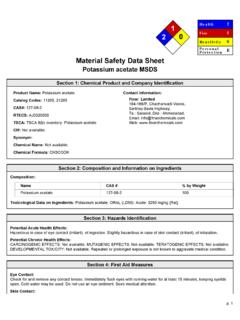
1 P. 1 4 1 1He a lt hFireRe a c t iv it yP e rs o n a lP ro t e c t io n240 HMaterial Safety Data Sheet Diethyl ether MSDSS ection 1: Chemical Product and Company IdentificationProduct Name: Diethyl etherCatalog Codes: 10580,20581,30580,70580 CAS#: 60-29-7 RTECS: KI5775000 TSCA: TSCA 8(b) inventory: Ethyl etherCI#: Not : Diethyl ether ; EtherChemical Name: Ethyl EtherChemical Formula: C4H10 OContact Information:Finar Limited184-186/P, Chacharwadi Vasna, Sarkhej-Bavla Highway, Ta.: Sanand, Dist.: Ahmedabad, Email: Web: 2: Composition and Information on IngredientsComposition:NameCAS #% by WeightDiethyl ether60-29-7100 Toxicological Data on Ingredients: Diethyl ether : ORAL (LD50): Acute: 1215 mg/kg [Rat].
2 VAPOR (LC50): Acute: 73000 ppm2 hours [Rat].Section 3: Hazards IdentificationPotential Acute Health Effects:Hazardous in case of skin contact (irritant), of eye contact (irritant), of ingestion, of inhalation. Slightly hazardous in case ofskin contact (permeator).Potential Chronic Health Effects:CARCINOGENIC EFFECTS: Not available. MUTAGENIC EFFECTS: Mutagenic for mammalian somatic cells. Mutagenic forbacteria and/or yeast. TERATOGENIC EFFECTS: Not available. DEVELOPMENTAL TOXICITY: Not available. The substancemay be toxic to skin, central nervous system (CNS). Repeated or prolonged exposure to the substance can produce targetorgans 4: First Aid MeasuresEye Contact:p.
3 2 Check for and remove any contact lenses. In case of contact, immediately flush eyes with plenty of water for at least 15minutes. Cold water may be used. Get medical Contact:In case of contact, immediately flush skin with plenty of water. Cover the irritated skin with an emollient. Remove contaminatedclothing and shoes. Cold water may be clothing before reuse. Thoroughly clean shoes before reuse. Get Skin Contact:Wash with a disinfectant soap and cover the contaminated skin with an anti-bacterial cream. Seek immediate :If inhaled, remove to fresh air. If not breathing, give artificial respiration. If breathing is difficult, give oxygen.
4 Get medicalattention if symptoms Inhalation:Evacuate the victim to a safe area as soon as possible. Loosen tight clothing such as a collar, tie, belt or waistband. Ifbreathing is difficult, administer oxygen. If the victim is not breathing, perform mouth-to-mouth resuscitation. Seek :Do NOT induce vomiting unless directed to do so by medical personnel. Never give anything by mouth to an unconsciousperson. If large quantities of this Material are swallowed, call a physician immediately. Loosen tight clothing such as a collar,tie, belt or Ingestion: Not 5: Fire and Explosion DataFlammability of the Product: Temperature: 180 C (356 F)Flash Points: CLOSED CUP: -45 C (-49 F).
5 Flammable Limits: LOWER: UPPER: 36%Products of Combustion: These products are carbon oxides (CO, CO2).Fire Hazards in Presence of Various Substances:Extremely flammable in presence of open flames and sparks, of heat. Slightly flammable to flammable in presence of oxidizingmaterials, of Hazards in Presence of Various Substances:Risks of explosion of the product in presence of mechanical impact: Not available. Highly explosive in presence of open flamesand sparks, of heat. Slightly explosive in presence of oxidizing Fighting Media and Instructions:Flammable liquid, soluble or dispersed in water. SMALL FIRE: Use DRY chemical powder.
6 LARGE FIRE: Use alcohol foam,water spray or fog. Cool containing vessels with water jet in order to prevent pressure build-up, autoignition or Remarks on Fire Hazards:Highly flammable. Will be easily ignited by heat, sparks, and flames. Vapors may travel to source of ignition and flash vapors are heavier than air. Burns with smokey greenish flame. Violent reaction or ignition on contact with halogens( , bromine, chlorine), interhalogens ( , iodine heptafluoride), oxidants ( , silver perchlorate, nitrosyl perchlorate, nitrylperchlorate, chromyl chloride, fluorine nitrate, permanganic acid, nitric acid, hydrogen peroxide, peroxodisulfuric acid, iodine(VII) oxide, sodium peroxide, ozone, and liquid air), sulfur and sulfur compounds ( , sulfur when dried with peroxidizedether, sulfuryl chloride).
7 Special Remarks on Explosion Hazards:Vapors may form explosive mixtures with air. Vapor explosion hazard indoors, outdoors, or in sewers. Run off to sewer maycreate a fire or explosion hazard. Containers may explode when heated. Tends to form explosive peroxides under influenceof light and air and evaporated to dryness. Explosive reaction with boron triazide, bromine trifluoride, bromine pentafluoride,p. 3perchloric acid, uranyl nitrate + light, wood pulp extracts + heat. Only electrical equipment of explosion proof type (group Cclassification) is permitted to be operated in ether areas. May explode when brought in contact with anhydrous nitric 6: Accidental Release MeasuresSmall Spill:Dilute with water and mop up, or absorb with an inert dry Material and place in an appropriate waste disposal Spill:Flammable liquid.
8 Keep away from heat. Keep away from sources of ignition. Stop leak if without risk. Absorb with DRY earth,sand or other non-combustible Material . Do not touch spilled Material . Prevent entry into sewers, basements or confinedareas; dike if needed. Be careful that the product is not present at a concentration level above TLV. Check TLV on the MSDSand with local 7: Handling and StoragePrecautions:Keep away from heat. Keep away from sources of ignition. Ground all equipment containing Material . Do not ingest. Do notbreathe gas/fumes/ vapor/spray. Wear suitable protective clothing. In case of insufficient ventilation, wear suitable respiratoryequipment.
9 If ingested, seek medical advice immediately and show the container or the label. Avoid contact with skin andeyes. Keep away from incompatibles such as oxidizing agents, acids, :Store in a segregated and approved area. Keep container in a cool, well-ventilated area. Keep container tightly closed andsealed until ready for use. Avoid all possible sources of ignition (spark or flame). Do not store above 30 C (86 F). Hygroscopic;keep container tightly closed. Air Sensitive Sensitive to 8: Exposure Controls/Personal ProtectionEngineering Controls:Provide exhaust ventilation or other engineering controls to keep the airborne concentrations of vapors below their respectivethreshold limit value.
10 Ensure that eyewash stations and Safety showers are proximal to the work-station Protection:Splash goggles. Lab coat. Vapor respirator. Be sure to use an approved/certified respirator or equivalent. Protection in Case of a Large Spill:Splash goggles. Full suit. Vapor respirator. Boots. Gloves. A self contained breathing apparatus should be used to avoidinhalation of the product. Suggested protective clothing might not be sufficient; consult a specialist BEFORE handling Limits:TWA: 400 (ppm) from OSHA (PEL) [United States] TWA: 400 STEL: 500 CEIL: 500 (ppm) from ACGIH (TLV) [United States]TWA: 1200 STEL: 1520 CEIL: 1500 (mg/m3) from ACGIH (TLV) [United States] STEL: 500 (ppm) [Australia] TWA: 1200 (mg/m3) from OSHA (PEL) [United States] Consult local authorities for acceptable exposure 9: Physical and Chemical PropertiesPhysical state and appearance: Liquid.