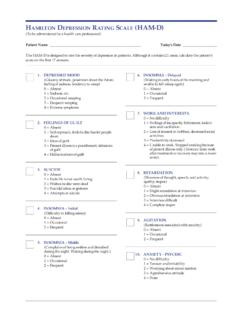
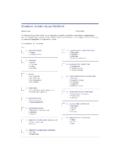
Transcription of The Hamilton Rating Scale for Depression (HAM-D)
1 The Hamilton Rating Scale for Depression (HAM-D). Name or ID: Date: Instructions: For each item, select the one cue which best characterizes the patient. 1. Depressed Mood (Sadness, hopeless, helpless, worthless) 6. Insomnia, Late 0 Absent 0 No difficulty 1 These feeling states indicated only on questioning 1 Waking in early hours of the morning but goes back to sleep 2 These feeling states spontaneously reported verbally 2 Unable to fall asleep again if he/she gets out of bed 3 Communicates feeling states nonverbally ie, through facial expression, posture, voice, and tendency to weep 7. Work and Activities 4 Patient reports VIRTUALLY ONLY these feeling states in his/her 0 No difficulty spontaneous verbal and non-verbal communication 1 Thoughts and feelings of incapacity, fatigue or weakness related to activities, work, or hobbies 2.
2 Feelings of Guilt 2 Loss of interest in activity, hobbies, or work either directly 0 Absent reported by patient, or indirect in listlessness, indecision, and 1 Self-reproach, feels he/she has let people down vacillation (feels he/she has to push self to work or activities). 2 Ideas of guilt or rumination over past errors or sinful deeds 3 Decrease in actual time spent in activities or decrease in 3 Present illness is a punishment; delusions of guilt productivity. In hospital, rate 3 if patient does not spend at least 4 Hears accusatory or denunciatory voices and/or experiences three hours a day in activities (hospital job or hobbies) exclusive threatening visual hallucinations of ward chores 4 Stopped working because of present illness.
3 In hospital, rate 4 if 3. Suicide patient engages in no activities except ward chores or if patient 0 Absent fails to perform ward chores unassisted 1 Feels life is not worth living 2 Wishes he/she were dead or any thoughts of possible death to self 8. Retardation (Slowness of thought and speech, impaired 3 Suicidal ideas or gestures ability to concentrate, decreased motor activity). 4 Attempts at suicide (any serious attempt rates 4) 0 Normal speech and thought 1 Slight retardation at interview 4. Insomnia, Early 2 Obvious retardation at interview 0 No difficulty falling asleep 3 Interview difficult 1 Complains of occasional difficulty falling asleep ie, 4 Complete stupor more than 1/2 hour 2 Complains of nightly difficulty falling asleep 9.
4 Agitation 0 None 5. Insomnia, Middle 1 Playing with hands, hair, etc. 0 No difficulty 2 Hand-wringing, nail-biting, hair-pulling, biting of lips 1 Patient complains of being restless and disturbed during the night 2 Waking during the night any getting out of bed rates 2 (except for purposes of voiding). Adapted from Guy W. ECDEU Assessment Manual of Psychopharmacology Revised. Rockville, MD: US Dept of Health, Education, and Welfare (DHEW), Public Health Service, Alcohol, Drug Abuse, and Mental Health Administration, NIMH Psychopharmacology Research Branch, Division of Extramural Research Programs, 1976. DHEW publication ADM 76-338. This document is provided by Wyeth Pharmaceuticals Inc. 10. Anxiety Psychic 14. Genital Symptoms 0 No difficulty Symptoms such as: 1 Subjective tension and irritability Loss of libido 2 Worrying about minor matters Menstrual disturbances 3 Apprehensive attitude apparent in face or speech 0 Absent 4 Fears expressed without questioning 1 Mild 2 Severe 11.
5 Anxiety Somatic Physiological concomitants of anxiety such as: 15. Hypochondriasis Gastrointestinal dry mouth, wind, indigestion, 0 Not present diarrhea, cramps, belching 1 Self-absorption (bodily). Cardiovascular palpitations, headaches 2 Preoccupation with health Respiratory hyperventilation, sighing Urinary frequency 3 Frequent complaints, requests for help, etc. Sweating 4 Hypochondriacal delusions 0 Absent 16. Loss of Weight (Rate either A or B). 1 Mild A. When Rating by History: 2 Moderate 0 No weight loss 3 Severe 1 Probable weight loss associated with present illness 4 Incapacitating 2 Definite (according to patient) weight loss 3 Not assessed 12. Somatic Symptoms, Gastrointestinal 0 None B. On Weekly ratings by Ward Psychiatrist, When Actual 1 Loss of appetite but eating without staff encouragement; heavy Weight Changes are Measured: feelings in abdomen 0 Less than 1 lb.
6 Weight loss in week 2 Difficulty eating without staff urging; requests or requires 1 Greater than 1 lb. weight loss in week laxatives or medication for bowels or medication for symptoms 2 Greater than 2 lb. weight loss in week 3 Not assessed 13. Somatic Symptoms, General 0 None 1 Heaviness in limbs, back, or head; backaches, headache, muscle 17. Insight 0 Acknowledges being depressed and ill aches; loss of energy and fatigability 1 Acknowledges illness but attributes cause to bad food, 2 Any clear-cut symptom rates 2. climate, overwork, virus, need for rest, etc. 2 Denies being ill at all Total score: _____. This tool should be used to supplement, not to replace, clinical judgment. Adapted from Guy W. ECDEU Assessment Manual of Psychopharmacology Revised.
7 Rockville, MD: US Dept of Health, Education, and Welfare (DHEW), Public Health Service, Alcohol, Drug Abuse, and Mental Health Administration, NIMH Psychopharmacology Research Branch, Division of Extramural Research Programs, 1976. DHEW publication ADM 76-338. This document is provided by Wyeth Pharmaceuticals Inc. 244259-01.