Example: biology
Chapter 9: Chemical Bonding I: Basic Concepts
Chapter 9: Chemical Bonding I: Basic Concepts Page 167 47. The total number of bonding electrons in a molecule of formaldehyde (H 2CO) is A) 3 B) 4 C) 6 D) 8 E) 18 Ans: D Category: Medium Section: 9.6 48. The total number of lone pairs in NCl 3 is •••••• ...
Tags:
Information
Domain:
Source:
Link to this page:
Documents from same domain

Chapter 10: Chemical Bonding II: Molecular Geometry and ...
cdn.prexams.comChapter 10: Chemical Bonding II: Molecular Geometry and Hybridization of Atomic Orbitals Page 180 6. Give the number of lone pairs around the central atom and the molecular geometry of IF 5. A) 0 lone pairs, square pyramidal D) 1 lone pair, square pyramidal B) 0 lone pairs, trigonal bipyramidal E) 2 lone pairs, pentagonal
Chapter 15 Psychological Disorders
cdn.prexams.combehavioral perspective on psychological disorders is that: A. the behavioral perspective looks at abnormal behaviors as symptoms of an underlying problem. B. the psychoanalytic perspective rejects the idea that prior experiences can have a profound effect …

Chapter 8 Aggregate Expenditure and Equilibrium Output ...
cdn.prexams.comRefer to Table 8.1. Assuming society's MPC is constant at an aggregate of income of $500, aggregate consumption would be _____. A . $240. B . $455. C . $480. D . $350. Answer : C Refer to the information provided in Table 8.2 below to answer the questions that follow. Table 8.2 Refer to Table 8.2. The equation for the aggregate saving function ...
Heat Transfer in Food Processing
cdn.prexams.cominto the product to be heated. In a plate heat exchanger, a thin metal plate separates the product stream from the heating or cooling stream while allowing heat transfer to take place without mixing. We will discuss some of the commonly used heat exchangers in the food industry in the following subsections. 4.1.1 Plate Heat Exchanger

INSTRUCTOR’S MANUAL TO ACCOMPANY ELEMENTARY …
cdn.prexams.com6 1 INTRODUCTION 1.1 Develop your personal definition for the practice of surveying. Answers will vary by response. See Section 1.1 for book definitions. 1.2 Explain the difference between geodetic and plane surveys. From Section 1.4, In geodetic surveys the curved surface of the earth is considered by performing the
International Economics Theory and Policy Book 9th Edition
cdn.prexams.comInternational economic relations. 2. International finance. I. Obstfeld, Maurice. II. Melitz, Marc J. III. Title. HF1359.K78 2012 337—dc22 2010031988. vii Brief Contents Contents ix Preface xxi 1 Introduction 1 Part 1 International Trade Theory 10 2 World Trade: An Overview 10 3 Labor Productivity and Comparative Advantage: The Ricardian ...

PRINCIPLES OF GEOTECHNICAL ENGINEERING, 8TH EDITION
cdn.prexams.cominstructor’s solutions manual to accompany principles of geotechnical engineering eighth edition, si braja m. das khaled sobhan
Related documents
Atomic Structure & Chemical Bonding - Harvard University
projects.iq.harvard.eduChapter 1 Atomic Structure & Chemical Bonding 4 biological matter, about 99%, is made of just six elements: carbon, hydrogen, nitrogen, oxygen, sulfur, and phosphorus. Most biological molecules, such as proteins, carbohydrates, lipids, and nucleic acids, are exclusively composed of these elements. A few other atoms also play roles in biology;

CHAPTER-4 CHEMICAL BONDING AND MOLECULAR …
ncerthelp.comCHAPTER-4 CHEMICAL BONDING AND MOLECULAR STRUCTURE OCTET RULE-During a chemical reaction the atoms tend to adjust their electronic arrangement in such a way that they achieve 8 e-in their outermost electron. This is called octet rule. CHEMICAL BOND- the chemical force which keeps the atoms in any molecule together is called a chemical bond.

Chapter 7 Chemical Bonding and Molecular Geometry
web.ung.eduChapter 7 Chemical Bonding and Molecular Geometry Figure 7.1 Nicknamed “buckyballs,” buckminsterfullerene molecules (C60) contain only carbon atoms.Here they are shown in a ball-and-stick model (left). These molecules have single and double carbon-carbon bonds arranged to
Chapter 10: Chemical Bonding
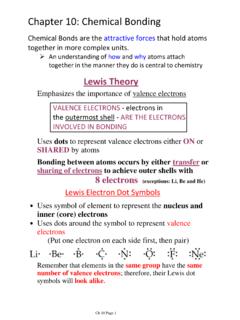
webs.anokaramsey.eduChapter 10: Chemical Bonding Ch 10 Page 1 . Noble gases are considered stable because they do not react with other elements. This stability is attributed to their FULL VALENCE SHELLS -they have a complete OCTET of ELECTRONS (exception: helium) He: 1s2 Ne: 1 s22s22p6

Basic Concepts of Chemical Bonding - Lamar University
www.lamar.eduBasic Concepts of Chemical Bonding Cover 8.1 to 8.7 EXCEPT 1. Omit Energetics of Ionic Bond Formation Omit Born-Haber Cycle 2. Omit Dipole Moments

Chapter 1 Structure and Bonding - Chemistry
www2.chemistry.msu.eduOrganic chemistry is study of carbon compounds. Why is it so special? 90% of more than 30 million chemical compounds contain carbon. Examination of carbon in periodic chart answers some of these questions. Carbon is group 4A element, it can share 4 valence electrons and form 4 covalent bonds. Origins of Organic Chemistry Review ideas from general chemistry: atoms, …
from Organic Chemistry
chemistry.ucr.educhemical bonding in those molecules. It concludes with a brief survey of the various topics It concludes with a brief survey of the various topics in organic chemistry and a description of the way that we present them in this text.

CHAPTER 19 – CHEMICAL HANDLING AND STORAGE
www.sifacilities.si.edu8. Initially assign each chemical to broad hazard classes, for example: flammable, corrosive (acids and bases), reactive oxidizer, or reducer, special hazard (air/water reactive, peroxide forming chemical, store at reduced temperature or under an inert atmosphere, highly toxic). 9.

The Free High School Science Texts: A Textbook for High ...
www.nongnu.orgChapter 3 The Atom (Grade 10) †Energy quantization and electron conflguration †The Periodic Table of the Elements: Periodicity of ionization energy to