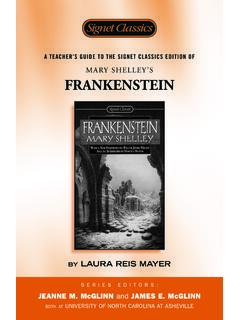
Transcription of A TEACHER’S GUIDE TO THE SIGNET CLASSIC EDITION OF …
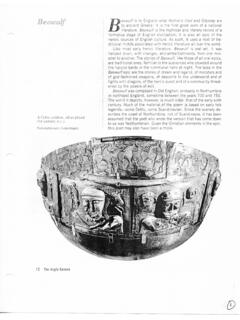
1 SERIES EDITORS:W. GEIGER ELLIS, , UNIVERSITY OF GEORGIA, EMERITUSandARTHEA J. S. REED, , UNIVERSITY OF NORTH CAROLINA, RETIREDA TEACHER S GUIDE TO THE SIGNET CLASSIC EDITION OFBEOWULFBy DANA HUFFINTRODUCTIONB eowulf s origins are mysterious. While we do not know the identity of the author, and we are unsure of its precise dateof composition, most scholars believe it was composed by a single Christian author for a Christian audience in Anglo-Saxon England anywhere from the eighth to eleventh century. beowulf was composed in the oral poetic tradition. Whetherit was originally written or oral is not known. The poem, filled with biblical allusions to the Old Testament, is alsoinfluenced by Germanic oral tradition and Old Norse myth and is well suited for upper-grade high school students of all abilities. Adolescent readers will enjoy its action andadventure.
2 Television shows, such as Xena: Warrior Princess and Hercules, and movies like The 13th Warrior (based onMichael Crichton s Eaters of the Dead), have helped pique student interest in stories of feudal upper-grade high school students previously have been introduced to epic poetry and its related concept of the epichero in such works as The Odyssey. Lower-ability students should be able to read and understand beowulf with the help ofplot summaries and class discussions. All students will benefit from learning about Anglo-Saxon customs and valuesthrough the study of this early poem in a modern European teaching GUIDE is organized in three sections presenting suggestions to be used before beowulf is read, while it is being read,and after the reading is completed. Following these sections are a Bibliography and a Webliography for pursuing further READINGB efore reading beowulf students should review the definitions of epic poetry (a long, narrative poem written in an elevatedstyle which celebrates the deeds of a legendary hero or god) and epic hero (superhuman hero or god of an epic).
3 It maybe helpful to discuss epics that the students have previously read, such as The is noted especially for two literary devices alliteration and kenning. Upper-grade high school students should befamiliar with alliteration, or the repetition of similar sounds, especially the initial consonant sound of a word or of a stressedsyllable, such as Shild s strong son (23, line 19). Alliteration is a literary device that was used frequently by Anglo-Saxons,and Burton Raffel, the translator of the SIGNET CLASSIC EDITION , has preserved as much of the alliteration as should also be introduced to the Germanic and Anglo-Saxon literary device of kenning. Kenning is usually atwo-word metaphorical name for something, such as sea-road for ocean (30, line 239). When neither element of thecompound is a true name of the object, it is a true kenning; when one element is not a true name, it is a also may be helpful for students to be introduced to the Anglo-Saxon tradition of the scop.
4 This will aid students inunderstanding some of the literary devices and other stylistic techniques that appear in beowulf . Scops were bothcomposers and storytellers who traveled from court to court the entertainers of Anglo-Saxon times. Scops were expectedto know a broad repertoire of tales and no doubt be able to compose tales in tribute to the patrons who financed them,a possible explanation for the segment about Offa, a historical king of Mercia from 757-796 (83-84).Students will benefit from learning about the comitatus, or Germanic code of loyalty. Thanes, or warriors, swore loyaltyto their king, for whom they fought and whom they protected. In return the king was expected to be generous with giftsof treasure and land. The king also protected his thanes. Kings were highly praised for their generosity and were expected to be brave, courageous, and loyal.
5 Their reputation for such qualities was very important, asevidenced by beowulf s description of the swimming match with Brecca (40-41).Students should be made aware of the Germanic custom of paying wergild, or man-payment, the practice of paying aslain man s family to atone for the deed and to prevent them from taking revenge against the manslayer. Wergild ismentioned in beowulf . Before the events in the poem, Hrothgar paid a wergild to beowulf s father. Hence, beowulf feelscompelled to help Hrothgar in his time of students may have trouble keeping track of the different warrior groups. Suggest that they refer to the Genealogiesin the SIGNET CLASSIC EDITION (160). It is most important that they remember that beowulf represents the Geats and thatHrothgar represents the Teacher s GUIDE to the SIGNET CLASSIC EDITION of Beowulf2 LIST OF CHARACTERSThe SIGNET CLASSIC EDITION of beowulf includes a Glossary of Names (149-159).
6 Note: the translator of the SIGNET CLASSIC editionhas altered the familiar (to some) Old English forms of the names. For example Heorot is rendered as Herot. A large versionof the Genealogies (160) could be constructed by students and displayed on a bulletin board during the study of TOPICSThe writing activities that follow will encourage students to examine some of beowulf s themes. These activities aresuitable for individual or group assignments. All of them should serve as springboards for class is a hero? Explain your definition and give is courage? How would most people today define courage? qualities do you believe a good leader should possess? Discuss leadership in our society. Name some modern are the characteristics of contemporary leaders? What do we admire about them? does it mean to be loyal? Tell about a time you were loyal or someone was loyal to is a reputation important?
7 What factors influence a person s reputation? is generosity important? What does it mean to be generous? Write about or discuss the most generous person you someone involved in a medieval re-enactment group, such as the Society for Creative Anachronism (SCA).What was life like for a warrior or a king during the Middle Ages? What motivates some to re-enact this time in history?WHILE READINGVOCABULARYT here are a variety of ways to study vocabulary through beowulf . Initially, ask students to identify words that areunfamiliar in the text. Next, they can collaborate in groups or as a class to create definitions of the words based on theirusage in context. Finally, they can check their definitions with a dictionary. Alternatively, ask students to create illustrations or skits demonstrating the definitions of the FOR STUDYNote: Scop and wergild do not actually appear in the text, but students should be familiar with their meanings (see BeforeReading).
8 All other words listed below are found on the pages and line numbers indicated. composers and storytellers of Anglo-Saxon secure a ship (30, line 227) decorative triangular-shaped roofing structures (32, line 307) a fine paid to the relatives of a murdered person to free the offender from further obligations or soft light wood (37, line 438) an alcoholic drink of fermented honey and water (38, line 493) irritated, annoyed (39, line 501) eats greedily (42, line 599) a person or thing that stands watch (44, line 666)10. talons claws (47, line 754)11. sinews tendons (48, line 816)12. hoary gray or white with age (51, line 887)13. pyre a bonfire for burning a dead body (58, line 1107)14. hoard a hidden or carefully guarded supply or accumulation of valuables (61, line 1203)15. scabbard a sheath for a sword (72, line 1562)16. runic consisting or set down in an ancient alphabet used for writing Germanic script, especially in Germanic languages,most often of Scandinavia and Britain from about the third to thirteenth centuries (76, line 1694)A Teacher s GUIDE to the SIGNET CLASSIC EDITION of Beowulf317.
9 Solace to console or cheer (76, line 1708)18. niggardly reluctant to give or spend, stingy (83, line 1929)19. skulked moved stealthily (97, line 2366)20. scruples morals or ethical considerations that restrain one s behavior and inhibits certain actions (119, line 3128)SEGMENT SUMMARIES, QUESTIONS/TOPICS, AND ACTIVITIESPROLOGUE TO part 10 GRENDEL S FIRST ATTACK, beowulf S ARRIVALIn this section, Hrothgar s ancestors are briefly described. Herot is constructed, and Grendel attacks it. beowulf hears ofthe troubles at Herot and decides to help Hrothgar. Once he arrives, he is welcomed and feasted. Unferth challengesBeowulf s reputation. beowulf defends himself and attacks Unferth s reputation. Hrothgar makes note that before now hehas never entrusted his hall to a stranger. beowulf stays awake, waiting for Grendel, as the rest of the hall settles into Grendel s lair.
10 How does it compare to Herot? is the significance of Grendel being descended from Cain? does Grendel attack Herot? had Herot symbolized before the coming of Grendel? After? is Hrothgar s lieutenant concerned about the arrival of beowulf and his men? does the lieutenant recognize beowulf as a hero? does Unferth bring up beowulf s swimming match with Brecca? How does beowulf respond? is Welthow s role in Herot? What does the narrator praise her for?10. What is the significance of Hrothgar s speech in lines 655-661 (44)11. What are beowulf s thoughts as he waits for Grendel s arrival? a model of Herot ( map, floor plan, 3-D model). the scene between beowulf and Unferth through a puppet show or students seem familiar with the concepts of alliteration and kenning, have them identify three examples of eachfrom the text, and/or have them create three examples of their 11 TO part 18 GRENDEL S BATTLE WITH BEOWULFG rendel attacks Herot again, killing a Geat before beowulf engages him in battle.