Transcription of Reporting Verbs - Perfect English Grammar
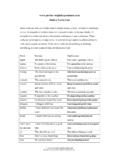
1 2015 May be freely copied for personal or classroom use. Reporting Verbs In the page about reported speech, we talked about how to change direct speech ("I love coffee") into reported speech (Seonaid said that she loved coffee), using the Verbs 'say', 'tell' and 'ask'. However, we can also use many other Verbs to report what someone said, like 'promise', 'warn', 'advise' and 'recommend'. Some of these Verbs look a bit more complicated to use than 'say' and 'tell', but it's just a question of getting to know the verb patterns (or verb structures). (As I'm sure you know, we can often choose if we want to use 'that' or not in English . I've put it in brackets () to show that it's optional. The meaning is exactly the same if you use 'that' or if you don't use 'that'.) 1: SAY Let's look first at the Verbs we've already talked about.
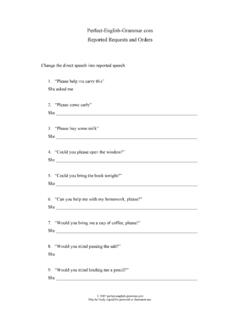
2 The basic verb pattern for using 'say' for reported speech is: say + (that) + clause She said (that) she had already eaten. (The direct speech for this is "I've already eaten".) 2: TELL On the other hand, with 'tell' we need to use an object, a person who we tell the information to. tell + someone + (that) + clause I told John (that) I had seen the new film. (The direct speech for this is "I've seen the new film".) When we are Reporting orders, we can also use another pattern with 'tell': tell + someone + to + infinitive She told the children to go to bed. 2015 May be freely copied for personal or classroom use. 3: ASK We use 'ask' to report questions or requests. For questions we use the pattern: ask + someone + if / question word + clause I asked my boss if I could leave early.
3 She asked them where the station was. For requests we use the pattern: ask + someone + to + infinitive I asked Lucy to pass me the salt. (Remember, my first two examples with 'ask' are no longer real questions, so we use the normal sentence word order. We don't use inversion. We say 'she asked them where the station was', NOT she asked them where was the station .) Other Reporting Verbs follow a variety of patterns. I'm afraid there aren't any rules about which Verbs follow which patterns. You need to learn each one. 4: ADVISE* (= Give someone advice. Notice the different spelling for the verb and the noun.) Advise + someone + to + infinitive She advised him to see a doctor. Advise + (that) + clause The staff advise that you carry water at all times. Advise + against + verb -ing I'd advise against leaving early.
4 5: AGREE Agree + to + infinitive We agreed to meet the following day. Agree + (that) + clause I agreed that the children could do their homework later. 2015 May be freely copied for personal or classroom use. 6: APOLOGISE Apologise + (to + someone) + for + verb -ing They apologised to us for being late. She apologised for forgetting the book. Apologise (+ to + someone) + for + noun She apologised for the delay. 7: DECIDE Decide + to + infinitive They decided to go to the cinema. Decide + (that) + clause They decided that they would go to the cinema. 8: ENCOURAGE Encourage + someone + to + infinitive She encouraged him to take the exam again. The teacher encouraged the students to ask questions. 9: EXPLAIN Explain + (that) + clause The teacher explained that the course was finished.
5 Explain + noun + to + someone She explained the Grammar to the students. (NOT: She explained me the Grammar .) Explain + question word + to + infinitive They explained how to buy a train ticket on the internet. John explained where to find the restaurant. Explain + question word + clause 2015 May be freely copied for personal or classroom use. We explained what the exams would cover. 10: INSIST* Insist + on + verb -ing He insisted on paying. Insist + (that) + clause He insisted that we sit down. 11: PROMISE Promise + to + infinitive He promised to arrive early. Promise + (someone) + (that) + clause I promised him that I wouldn't do it again. 12: RECOMMEND* Recommend + verb -ing I recommend visiting the British Museum while you're in London. Recommend + (that) + clause I recommend that you visit the British Museum 13: REMIND Remind + someone + to + infinitive She reminded him to take his keys.
6 Remind + someone + (that) + clause They reminded me that there is a party tonight. 2015 May be freely copied for personal or classroom use. 14: SUGGEST* Suggest + verb -ing I suggest leaving soon Suggest + (that) + clause I suggest that you come as soon as you can. (NOT: I suggest you to come.) 15: WARN Warn + someone + to + infinitive I warned them not to go in the water. Warn + someone + about + something She warned us about the dangerous roads. Negatives To make the Verbs that we have reported negative, we need to look at the verb pattern: When there's a clause, we make the negative in the usual way: She said that she didn't like ice cream. When there's 'to + infinitive', we generally put 'not' before 'to': He promised not to do it again. When there's ' verb -ing', we generally put 'not' in front of it: I advise not taking the bus.
7 * Advanced Point In formal English , some Verbs that are followed by '(that) + clause' use the infinitive instead of a present tense verb . Some people suggest that this is a kind of subjunctive in English . You only need to worry about this in very formal writing. Mostly, this doesn't make a difference, because the present simple form in English is often the same as the infinitive form. But when the subject is 'he', 'she' or 'it' or when the verb is 'be', we can see it clearly. I advise that he go to bed early. (Normally we'd expect: I advise that he goes to bed early.) I insist that she come now. (Normally we'd expect: I insist that she comes now.) They suggested that the cats be put in the garden for the night. (Normally we'd expect: They suggested that the cats are put in the garden for the night.)
8