Transcription of CPT CODE 99223 - CGS Medicare
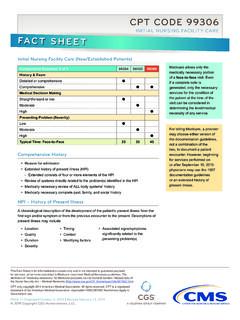
1 CPT code 99223 INPATIENT HOSPITAL CAREFACT SHEETThis Fact Sheet is for informational purposes only and is not intended to guarantee payment for services, all services submitted to Medicare must meet Medical Necessity guidelines. The definition of medically necessary for Medicare purposes can be found in Section 1862(a)(1)(A) of the Social Security Act Medical Necessity ( ).CPT only copyright 2014 American Medical Association. All rights reserved. CPT is a registered trademark of the American Medical Association. Applicable FARS\DFARS Restrictions Apply to Government 1 | Originated October 2, 2013 | Revised February 7, 2019 2019 Copyright, CGS Administrators, allows only the medically necessary portion of a face-to-face visit. Even if a complete note is generated, only the necessary services for the condition of the patient at the time of the visit can be considered in determining the level/medical necessity of any Hospital Care (New/Established Patients)Components Required: 2 of 3992219922299223 History & ExamDetailed Comprehensive Straightforward or low Moderate High Presenting Problem (Severity)Low Moderate High Typical Time: Bedside/Floor/Unit305070 Comprehensive History Includes.
2 Chief complaint/reason for admission Extended history of present illness (HPI) -Extended consists of four or more elements of the HPI Review of systems directly related to the problem(s) identified in the history of present illness Medically necessary review of ALL body systems history Medically necessary complete past, family and social history Four or more elements of the HPI or the status of at least three (3) chronic or inactive conditions, noting that medical necessity is ALWAYS the overarching History of Present IllnessA chronological description of the development of the patient s present illness from the first sign and/or symptom or from the previous encounter to the present. Descriptions of present illness may include: Location Quality Severity Timing Context Modifying factors Associated signs/symptoms significantly related to the presenting problem(s)For billing Medicare , a provider may choose either version of the documentation guidelines, not a combination of the two, to document a patient encounter.
3 However, beginning for services performed on or after September 10, 2013 physicians may use the 1997 documentation guidelines or an extended history of present code 99223 INPATIENT HOSPITAL CAREFACT SHEETThis Fact Sheet is for informational purposes only and is not intended to guarantee payment for services, all services submitted to Medicare must meet Medical Necessity guidelines. The definition of medically necessary for Medicare purposes can be found in Section 1862(a)(1)(A) of the Social Security Act Medical Necessity ( ).PAGE 2 | Originated October 2, 2013 | Revised February 7, 2019 2019 Copyright, CGS Administrators, only copyright 2014 American Medical Association. All rights reserved. CPT is a registered trademark of the American Medical Association. Applicable FARS\DFARS Restrictions Apply to Government ComplaintThe Chief Complaint is a concise statement from the patient describing: The symptom Problem Condition Diagnosis Physician recommended return, or other factor that is the reason for the encounterReview of SystemsAn inventory of body systems obtained through a series of questions seeking to identify signs and/or symptoms which the patient may be experiencing or has purpose of Review of Systems the following systems are recognized: Constitutional ( , fever, weight loss) Eyes Ears, Nose, Mouth Throat Cardiovascular Respiratory Gastrointestinal Genitourinary Musculoskeletal Integumentary (skin and/or breast) Neurologic Psychiatric Endocrine Hematologic/Lymphatic Allergic/ImmunologicPast, Family, And/or Social History (PFSH)Consists of a review of the following.
4 Past history (patient s past experiences with illnesses, operations, injuries, and treatments Family History (a review of medical events in the patient s family, including diseases which may be hereditary or place the patient at risk) Social History (an age appropriate review of past and current activitiesComprehensive Physical Exam Includes: General, multisystem exam OR complete exam of a single organ system Body areas recognized: -Head/including face -Neck -Chest/including breasts and axilla -Abdomen -Genitalia/groin and buttocks -Back -Each extremity Organ systems recognized -Eyes, ears, nose, mouth, throat -Cardiovascular -Respiratory -Gastrointestinal -Musculoskeletal -Skin -Neurologic -Psychiatric -Hematologic/Lymphatic/ImmunologicHigh Complexity Medical Decision MakingDocumentation must meet or exceed two of the following three: Extensive management options for diagnosis or treatment Extensive amount of data to be reviewed consisting of: -Lab results -Diagnostic and imaging results -Other practitioner s notes/charts ( PT, OT, Consultants) -Documentation of labs or diagnostics still needed High risk of complications and/or morbidity or mortality -Comorbidities associate with the presenting problem -Risk(s) of diagnostic procedure(s) performed -Risk(s) associated with possible management optionsCPT code 99223 INPATIENT HOSPITAL CAREFACT SHEETThis Fact Sheet is for informational purposes only and is not intended to guarantee payment for services, all services submitted to Medicare must meet Medical Necessity guidelines.))
5 The definition of medically necessary for Medicare purposes can be found in Section 1862(a)(1)(A) of the Social Security Act Medical Necessity ( ).PAGE 3 | Originated October 2, 2013 | Revised February 7, 2019 2019 Copyright, CGS Administrators, only copyright 2014 American Medical Association. All rights reserved. CPT is a registered trademark of the American Medical Association. Applicable FARS\DFARS Restrictions Apply to Government Information: If patient is admitted to the hospital during an encounter in another setting ( physician office, nursing home, emergency room) and on the same date of service as the admission all E/M services provided by that physician in conjunction with the admission are considered part of the initial hospital care. Comorbidities and other underlying diseases in and of themselves are not considered when selecting the E/M codes UNLESS their presence significantly increases the complexity of the medical decision making. Practitioner s choosing to use time as the determining factor: -MUST document time in the patient s medical record -Documentation MUST support in sufficient detail the nature of the counseling - code selection based on total time of the face-to-face encounter (floor time), the medical record MUST be documented in sufficient detail to justify the code selection Face-to-face time refers to the time with the physician ONLY.
6 The time spent by other staff is NOT considered in selecting the appropriate level of service Please note that ALL services ordered or rendered to Medicare beneficiaries MUST be signed. Signatures may be handwritten or electronically signed; exceptions for stamped signatures are described in MLN Matters article MM8219. ( ) You should NOT add late signatures to a medical record but instead make use of the signature authentication process outlined in MLN Matters article MM6698. ( ) A sample attestation statement is available on the CGS website. ( ) Guidelines regarding signature requirements are located in CMS Publication 100-08, Chapter 3, section ( ).References: CMS Publication 100-04, Chapter 12, sec ; Evaluation and Management Service Codes Medicare Learning Network; Documentation Guidelines for Evaluation and Management (E/M) Services American Medical Association CPT (current procedural terminology) Codebook