Transcription of Quick-Start Guide to Q65 - Princeton University
1 Quick-Start Guide to Q65 Joe Taylor, K1JT; Bill Somerville, G4 WJS; Steve Franke, K9AN; and Nico Palermo, IV3 NWV April 3, 2021 WSJT-X introduces Q65, a digital protocol designed for minimal two-way QSOs over especially difficult propagation paths. On paths with Doppler spread more than a few Hz, the weak-signal performance of Q65 is the best among all WSJT-X modes. Q65 is particularly effective for troposphericscatter, rain scatter, ionospheric scatter, TEP, and EME on VHF and higher bands, as well as other typesof fast-fading uses 65-tone frequency-shift keying and builds on the demonstrated weak-signal strengths of QRA64, a mode introduced to WSJT-X in 2016.
2 Q65 differs from QRA64 in the following important ways: A new low-rate Q-ary Repeat Accumulate code for forward error correction User messages and sequencing identical to those in FST4, FT4, FT8, and MSK144 A unique tone for time and frequency synchronization. As with JT65, this sync tone is readilyvisible on the waterfall spectral display. In addition, Q65 provides a sensitive sync curve nearthe bottom of the waterfall window. Unlike JT65, synchronization and decoding are effective even when meteor pings or other short signal enhancements are present. Optional submodes with T/R sequence lengths 15, 30, 60, 120, and 300 s and different tone spacings.
3 A new, highly reliable list-decoding technique for messages that contain previously copied message fragments. No use is made of a callsign database. Highly effective message averaging for situations where single transmissions are too weak or signal enhancements too sparse for a signal to be decoded. A multi-decode option that attempts to decode all Q65 signals in the received parameters of Q65 for each of the five T/R sequence lengths and their minimum tone spacings ( A submodes) are summarized in the table below. Threshold sensitivities (SNR in 2500 Hz bandwidth yielding 50% probability of decode) were measured for each submode using simulations over the additive white Gaussian noise (AWGN) channel.
4 As with other recently developed modes in WSJT-X, a feature called a priori (AP) decoding improves sensitivity by several additional dB as information is accumulated during a standard minimal QSO. T/R Period (s)Symbol Length (s) A Tone Spacing (Hz) A Occupied Bandwidth (Hz)TransmissionDuration (s)SNR (dB)Max APSNR (dB) error correction (FEC) in Q65 uses a specially designed (65,15) block code with six-bit symbols. Two symbols are punctured from the code, yielding an effective (63,13) code with a payload of k = 13 information symbols conveyed by n = 63 channel symbols. The punctured symbols consist of a 12-bit CRC computed from the 13 information symbols.
5 The CRC is used to reduce the false-decode rate to a very low value. A 22-symbol pseudo-random sequence spread throughout a transmission is sent as tone 0 and used for synchronization. The total number of channel symbols in a Q65 transmission is thus 63 + 22 = each T/R sequence length, submodes A - E have tone spacings and occupied bandwidths 1, 2, 4, 8, and 16 times those specified in the above table. Full submode designations include a number for sequence length and a letter for tone spacing, as in Q65-15A, Q65-120C, etc. Tone spacings and occupied bandwidths for the wider submodes are summarized in the table below.
6 Additional submodes 120F, 300F, and 300G might be implemented in future if there is a perceived Period (s)ASpacing Width(Hz)BSpacing Width(Hz)CSpacing Width(Hz)DSpacing Width(Hz)ESpacing Width(Hz) 1733N/ 217 1733 108 217 49 195 19 75 150 301On-the-air experience during the first six months of testing has shown that Q65 is more sensitive than any other WSJT-X mode when path Doppler spread is more than a few Hz.
7 An excellent example of targeted uses of Q65 is ionospheric scatter on the 6 m band. Extensive tests on the 1150 km path between K1JT and K9AN have shown that with 300 W power output, nearly every Q65-30A transmission is copied correctly by the other station. Q65 will enable stations with a modest Yagi and 100 W or more and to work one another on 6 m at distances up to ~2000 km on most days of the year, in dead band conditions. Ionospheric scatter is best near mid-day and in summer months, but is presentat all tests of Q65 on EME, troposcatter, rain scatter, optical scatter, and other potentially interesting paths have been conducted over the past six months.
8 We find that suitable Q65 submodes perform wellin a wide variety of conditions. Decoding is effective for signals with Doppler spread up to ten times the tone spacing, and even beyond. Recommended submodes known to be effective for specific applications include the following. Obviously, you should feel free to experiment with other combinations. Please report your results on a suitable forum! Trans-Equatorial Propagation (TEP) on 50 MHz: 15C, 30C Ionospheric scatter on 50 MHz: 30A QRP ionospheric scatter on 50 MHz: 120E Ionospheric scatter on 144 MHz: 60C Troposcatter and rainscatter at 10 GHz: 60D Small-dish EME, 10 and 24 GHz: 120E Other EME: 50, 144 MHz 60A; 432 MHz 60B; 1296 MHz: 60C; 10 GHz: 60 DSome representative sensitivity curves from simulation measurements are presented in Figures 1 and 1.
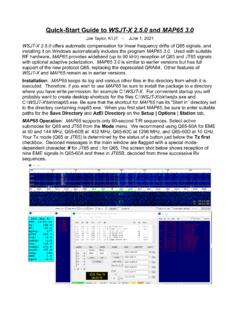
9 Threshold sensitivities for Q65-60D and Q65-120E as a function of frequency 2. Decoding probability of Q65-60A (no AP) as a function of SNR and frequency 0 20 40 60 80 100Q65-60D No APQ65-120E No APQ65-60D Max APQ65-120E Max APSNR for 50% decode probability (dB)Doppler Spread (Hz) 0 20 40 60 80 100-30-28-26-24-22-200510fSpread = 20 HzPercent DecodesSNR2500 (dB)In most ways operating with Q65 is like that for other popular WSJT-X modes, but you should know about some differences. Many of these are introduced in the following short tutorial, which I recommend following before you proceed to make QSOs with a collection of Q65 sample files from and unzip it into a convenient directory such as C:\WSJT-X\ WSJT-X , select Q65 mode, and configure other parameters as shown in the screen shot below.
10 On the File Settings General tab, be sure to check Enable VHF and submode features and Decode after EME delay, and uncheck Single decode. On the Decode menu select Fast, Enable averaging, and Auto Clear Avg after to File Open, navigate to where you saved the sample files, and open the file ..\Q65_Samples\60A_EME_6m\ You should see something like this screen shot, which shows decodes of four 6-meter EME signals received at W7GJ on January 6,2021. Note that decoding takes place first at the selected Rx Freq, then at other that Q65 Sync has been selected at the bottom of the Wide Graph window.