Transcription of Different Types of Lighting - Distribution Group - …
1 The quality and quantity of Lighting affects the ambience, security and function of your facility as well as the performance of your employees. Lighting costs vary from about $ for schools to over $ for some restaurants. Overall, Lighting typically accounts for about one-third of the annual commercial business electric bill. The chart on page two will give you an idea of how much it costs to light Different kinds of commercial Advances in Lighting technology can make significant reductions in the amount of money you spend to light your space or building.
2 Different Types of Lighting While fluorescent Lighting is the most common type of general purpose Lighting found in commercial settings, a wide range of options are available. Incandescent Incandescent lamps have relatively short lives (typically 1000 to 2000 hours of use) and are the least efficient of common light sources. In fact, only about 15 percent of the energy they use comes out as light the rest becomes heat. However, they produce a pleasant color that is similar to natural sunlight. Incandescent lamps are the Fluorescent Ballasts least expensive to buy but the most Fluorescent ballasts are devices that control the starting and operation of expensive to operate.
3 Reduced-wattage fluorescent lamps. The lamps and ballast form a system and their overall incandescents produce about the same performance is a function of the lamp /ballast combination. (Note: HID. light output but consume less energy lamps also require a ballast for operation). Common Types of fluorescent than standard bulbs. ballasts include: Tungsten-halogen Halogen lamps are Standard electromagnetic The standard ballast for many years a type of incandescent lamp that has accounting for the majority of currently installed ballasts. As of 1992, standard efficiency ballasts for four-foot and eight-foot lamps are no become increasingly popular in recent longer available due to federal minimum efficiency standards.
4 Years. They produce a whiter, more intense light than standard Energy-saving electromagnetic Energy-savings electromagnetic ballasts for four-foot and eight-foot lamps that are about 10 percent more incandescents and are typically used for efficient than the old standard electromagnetic ballasts. Electromagnetic decorative, display or accent Lighting . ballasts must now meet federal minimum efficiency standards. Halogen spotlights also have good focusing ability in small areas. They are Fixed-output electronic Fixed output electronic ballasts with standard lamps are about 20 percent more efficient than energy-saving about twice as efficient as regular electromagnetic ballasts, and electronic ballasts with new T8 lamps are incandescent lamps and last two to four about 30 percent more efficient.
5 Early problems with electronic ballasts times longer than most incandescent have been corrected and they are now the industry standard in most lamps. applications. Compact Fluorescent Lamps Multi-level output electronic Multi-level electronic ballasts are able to Compact fluorescent lamps (CFLs) are be switched between Different set levels of full light output such as off, similar in operation to standard 50 percent or 100 percent of full light output. fluorescent lamps but are manufactured Adjustable output dimming electronic These ballasts allow to produce colors similar to continuous adjustment over a range of about 10 percent to 100 percent of incandescent lamps.
6 They are available light output. 1. APS study of energy use in 14 Different Types of commercial buildings in the Phoenix area. 1. in a range of Types and sizes to meet most applications including Annual Lighting Electricity Costs downlighting, ambience, task and general space Lighting . CFLs are about four times as efficient as incandescents and last up to 10 Building Type Annual Cost times longer. lamp ballast combinations that replace incandescents Per Square Foot in standard fixtures are substantially more expensive than their Large Office $ incandescent counterparts.
7 Small Office $ Tubular fluorescent fixtures Tubular fluorescent lamps are one Large Retail $ Small Retail $ of the most common sources of commercial Lighting and also are Sit-down Restaurant $ among the most efficient. The new generation of small diameter Quick-Service Restaurant $ lamps (T-8 and T-10) is particularly efficient. It is important to Large Grocery $ understand that lamps and ballasts work as a system and the overall Small Grocery $ efficiency of a Lighting fixture is dependent on the lamp /ballast In-patient Healthcare $ combination. Traditional magnetic ballasts are less efficient than Out-patient Healthcare $ modern electronic ballasts.
8 All ballasts are now required by the Primary School $ government to meet minimum efficiency standards. Fluorescent Secondary School $ lamps last up to 20,000 hours of use. College/University $ High-intensity discharge (HID) This category of high output Hotel/Resort $ light sources that includes mercury vapor, metal halide, high- pressure sodium and low-pressure sodium Lighting . As with fluorescent lights, HID lights require a ballast for proper lamp operation. The efficiency of HID sources varies widely from mercury vapor with an efficiency almost as low as incandescent to low-pressure sodium which is among the most efficient light sources.
9 Color rendering varies widely from the bluish cast of mercury vapor lamps to the distinctly yellow light of low-pressure sodium. Characteristics and Efficiency of Different Light Sources The performance and features of a light source needs to be matched to the Lighting task being performed. In order to select the right light source for the job, you should consider important performance variables such as light output (Lumens), efficiency (Lumens/Watt technically referred to as efficacy ), lamp life, and color rendering properties measured in terms of the Color Rendering Index (CRI).
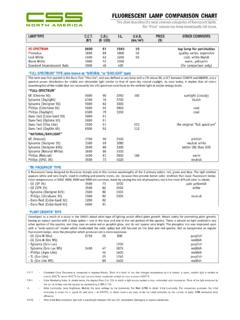
10 The CRI is a measure of the degree to which a light source renders colors that are close to true color. For practical purposes it is a number from 0 to 100; the higher the number, the closer to true color. The efficiencies of each type of light source can vary dramatically, so the choice of light source can have a dramatic impact on Lighting energy costs. The performance characteristics and efficiencies of common light sources are shown in the table and chart below. Characteristics of Common Light Sources2. Light Source Efficiency Average lamp Color (Lumens/Watt) Life (Hours) Rendering Index Standard Incandescent 5-20 750-1000 100.



![WELCOME [www.maxlite.com]](/cache/preview/4/e/1/b/d/f/0/1/thumb-4e1bdf01942499ed99a302b529376e1f.jpg)