Transcription of Chem and physics of soap bubbles part 2 - …
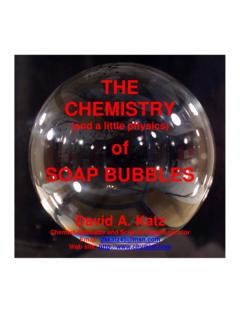
1 THE. CHEMISTRY. (and a little physics ). of SOAP bubbles . David A. Katz Chemist, Educator and Science Communicator Email: Web site: 14. The Chemistry (and a little physics ). of Soap bubbles 2010, 2003, 2001, 1999, 1998, 1994, 1989, 1988, 1986, 1983, 1982 by David A. Katz All rights reserved. No reproduction permitted by any means, manual, electronic, or photographic, without the express written permission of the author. David A. Katz Chemist, Educator, Science Communicator, and Consultant 133 N. Desert Stream Dr. Tucson, AZ 85745-2207, USA. Voice/Fax/Message: 520-624-2207. Email: 15. The Behavior of Soap bubbles One reason a bubble breaks is that it hits something dry. The other reason is a result of the water in the walls of the bubble draining to the bottom of the bubble. The water, in the bottom of the bubble produces a small bump on the bottom and will drip from the bubble.
2 (see Figure 13). One can observe water dripping from the bottom of a large bubble. (See Experiment 6) When the top of the bubble becomes too thin to support the total mass of the bubble, it breaks. The addition of glycerin, or other viscous material like Karo syrup, adds strength to a bubble since this material does not drain out of the soap film readily making the upper part of the soap bubble stronger. Figure 13. Schematic diagram of a soap bubble The swirling colors observed in a soap bubble are a result of thin film interference and the changing thickness of the film due to the draining liquid. (See Figure 14) The color is not affected by the addition of coloring agents, such as food colors, when used in normal concentrations. Although a bubble is transparent, like glass, some light is reflected off the outside surface of the soap film.
3 Some light is also reflected off the inside surface of the film. When the two reflected light waves meet, they may be in phase (the waves aligned peak to peak and trough to trough) or out of phase (not aligned). In phase light waves produce the same color as the incoming light ( , white light) making the color appear brighter. This is called constructive interference. Out of phase light waves produce interference effects which we see as 16. color. If the light waves are out of phase so that the peak of one wave is aligned with the trough of the reflected wave, then the light cancels itself out and no color is seen. This is called destructive interference. As the thickness of the soap film changes, the distance the light travels changes, and the different interference effects give different colors.
4 When just about all the water is drained out of the upper part of the soap bubble, the wall becomes so thin that the light reflected from the top surface cancels itself out (when light is reflected, all peaks become troughs) and dark spots appear in the soap film. The swirling effects are a result of the uneven thickness in the soap film as the water drains out. (See Experiment 7). Figure 14. Interference between light waves reflected from the outside and inside surfaces of a soap film. 17. Experiment 6. Observing the Water Draining From a Soap Bubble Materials needed Large bubble loop 15 to 20 cm (6 to 8 inches) in diameter Soap bubble solution Pan or tray to hold the soap solution Procedure Obtain a large bubble loop, approximately 15 to 20 cm (6 to 8 inches) in diameter. Dip it in soap solution and make a large bubble.
5 Observe the shape of the bubble as it falls through the air. Does water drip from the bottom of the bubble? 18. Experiment 7. Observing Colors in a Soap Bubble Materials needed Soda straws Soap bubble solution Container to hold the soap solution Plastic sheet or tablecloth Procedure Spread some soap solution on a clean waterproof surface, such as a Formica tabletop or a table covered with a plastic tablecloth, to wet an area about 20 to 30 cm (about 8 to 12. inches) in diameter. Dip a soda straw into the soap solution, touch it to the wet surface, and gently blow a hemispherical (or dome shaped) bubble. Watch the soap bubble as the water drains toward the bottom of the bubble. How do the colors change? Do the colors stabilize? Watch the top of the bubble. When the top of the soap film is close to its minimum thickness, it will be some multiple of half the wavelength of the reflected light.
6 The light from the two surfaces, the inside and the outside, will cancel (destructive interference). making parts of the bubble film look black. (See photo below.). 19. 20. Soap Bubble Activities There are many activities that can be performed with soap bubbles . The simplest is making bubbles with a loop, wand, or home-made frame. You can buy a bubble trumpet, or use a household funnel. A soda straw, or an empty cardboard tube from toilet tissue, paper towels, aluminum foil, or plastic wrap can be used to blow bubbles , although the cardboard tubes tend to disintegrate after they become wet. You can even blow bubbles from your hand by making a circle from your thumb and forefinger. See what household items you can use to blow bubbles . Catch a Bubble You can catch a bubble or put your finger, hand, or even an arm through a soap film without breaking it by first spreading the soap solution over the skin surface.
7 As longs as a surface or your skin is wet, even with water, soap bubbles generally will not break when they contact that surface. (See Experiment 8.). Bouncing bubbles You can bounce a bubble off your shirt sleeve once the shirt has been washed in detergent. There will be small amounts of detergent that remain in your clothing that will prevent the bubble from breaking. (See Experiments 9 and 10.). Bubble Basketball Play bubble basketball with a tabletop basketball game. (See Experiment 11.). Experiment 8. Catching soap bubbles Materials needed Small bubble loop Soap bubble solution Procedure Dip one hand into some soap bubble solution. Let the excess solution drip off your hand. Blow some bubbles using the bubble loop. Gently catch some bubbles . Will this work if your hand is wet with plain water?
8 21. Experiment 9. Demonstrating that soap or detergent is in your clothes Materials needed Ultraviolet lamp, long wave Container of detergent Procedure In a darkened room, place an ultraviolet lamp near your clothes (light colors or whites work best). Note how your clothes fluoresce ( , glow with a blue color). The fluorescence is due to optical brighteners from the laundry detergent. Do you recall the TV commercials stating that detergents make your clothes whiter and brighter ? What you are seeing is the brighter aspect of the detergent. Although detergents clean your clothes, they leave a residue behind that may give the clothes a yellow or gray color. Before the use of optical brighteners, people used a material called laundry bluing. Laundry bluing was a solution of Prussian Blue, a blue dye that covered up the yellow or gray from the detergent residue.
9 The problem was that laundry bluing had to be added to the rinse cycle and one had to watch the washing machine for that cycle to start. Also, if spilled, laundry bluing would leave permanent stains. Optical brighteners were a welcome improvement to the detergents. In sunlight or under fluorescent lights, both sources of ultraviolet light, the brightener in the clothes is glowing. You do not see it consciously, but are aware of it subconsciously and your clothes appear to be brighter. Thus, if there is optical brightener in your clothes, there is also some detergent residue. Place the ultraviolet lamp near the detergent. It also fluoresces. Place the ultraviolet lamp next to the label of the detergent container. Does the label, or parts of it fluoresce? What you are seeing is some subliminal advertising.
10 That is, the label glows to your subconscious under the fluorescent lights in the market making you notice that detergent and, hopefully, to the manufacturer, you will pick up that container and purchase the detergent. Experiment 10. Bounce a bubble off your shirt sleeve Materials needed Small bubble loop Soap bubble solution Procedure Blow some bubbles using the bubble loop. Gently bring your arm up to the bubbles and give them a gentle push. If your shirt has been washed in detergent, the bubbles should bounce off your shirt sleeve. 22. Experiment 11. Bubble basketball Materials needed Small bubble loop Soap bubble solution Cloth gloves, prewashed in detergent or wet with bubble solution and allowed to dry. Small basketball hoop. Look for wastepaper basket basketball sets these fit over the top of a door or on the side of a wastebasket.