Transcription of THE TRIANGLE OF CARE - static.carers.org
1 8/6/10 14:39 Page 1. THE TRIANGLE OF CARE. CARERS INCLUDED: A GUIDE TO BEST. PRACTICE IN ACUTE MENTAL HEALTH CARE. 8/6/10 14:39 Page 2. THE TRIANGLE OF CARE CARERS INCLUDED: A GUIDE TO BEST PRACTICE IN ACUTE MENTAL HEALTH CARE. 8/6/10 14:39 Page 1. Contents Foreword 2. Executive Summary 3. Introduction 4. The rationale behind the key elements 10. Appendix 1: TRIANGLE of Care Self-Assessment Tool 22. References 26. Glossary of acronyms 29. Acknowledgements The creation of TRIANGLE of Care has taken many years and involved many people. It celebrates a developing awareness of carers' needs and demonstrates that in different parts of the country those people who work with and on behalf of carers are creating excellent resources and better outcomes.
2 The original impetus to identify ways of improving engagement between professionals and carers'. grew from a training programme created by carers in Devon. Similar initiatives grew in other places. The work of Lu Duhig in Avon & Wiltshire influenced this resource in many ways. We acknowledge the thought and effort which has gone into creating the Best Practice Examples'. and are grateful for the generosity of carer champions in responding to requests to make them widely available. Delivering a TRIANGLE of Care must be work in progress. Services will need to review their practice from time to time and many other services not listed may have Best Practice to share. We ask those working with carers and carer groups to use the web site to share emerging ideas and their best practice.
3 Finally thanks to Yvonne Stoddart and Malcolm Rae who as always provided invaluable encouragement and suggestions and to Bridget Lawless who helped with editing the many drafts. Authors Alan Worthington, Carer Advisor, National Acute Care Programme Paul Rooney, Lead, National Acute Care Programme 1. 8/6/10 14:39 Page 2. Foreword Carers are vital partners in the provision of mental health and social care services. million people care for someone with a mental illness in the UK. That is one in every forty people, or one in four of the UK's six million carers. Carers are increasingly being recognised for their expertise and knowledge, and the fact that they can be essential partners in the treatment and recovery processes. Indeed, caring rarely stops when the person cared for enters acute care services.
4 Carers are often integral to a service user's support system, and their input and support can substantially improve that person's chances of recovery. This makes it even more important that carers are meaningfully involved in care and support planning, and offered the information and support they need to care safely and effectively. None of us should be forced into the position of offering more care than we would wish, or can safely provide. This is why it is vital for the carer(s) to be identified and agreement reached for continuing involvement. To this end, the TRIANGLE of Care offers key principles and resources to influence services and other people working with carers to be more effective in involving them within acute care. This will benefit staff, service users and carers themselves.
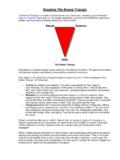
5 As the largest independent provider of carers support services, the Princess Royal Trust for Carers continues to work tirelessly through our affiliated network, to ensure carers are recognised and offered appropriate support. The Princess Royal Trust for Carers welcomes the production of this essential guide. We look forward to working with the National Mental Health Development Unit and partners to ensure its recommendations form the bedrock of effective carer support and involvement within acute care and related mental health services. Carole Cochrane, Chief Executive Officer, The Princes Royal Trust for Carers THE TRIANGLE OF CARE CARERS INCLUDED: A GUIDE TO BEST PRACTICE IN ACUTE MENTAL HEALTH CARE. 2. 8/6/10 14:39 Page 3. Executive Summary The TRIANGLE of Care' is a therapeutic alliance between service user, staff member and carer that promotes safety, supports recovery and sustains well being.
6 The key elements to Who is this document for? achieving a TRIANGLE of Care This document is primarily addressed to acute services, inpatient and crisis resolution home The essence of this document is to clearly treatment (CRHT) staff and their managers, and identify the six key elements required to achieve also to inform carers, service users and carer better collaboration and partnership with carers groups. Success in achieving change depends in the service user and carer's journey through a upon staff becoming willing champions' for typical acute episode. For each element we better partnership working and being able to suggest good practice examples and resources challenge practice that excludes carers. A more that may be helpful. inclusive attitude for carers and families should The six key elements state that: be promoted, where they are listened to and really heard and consulted more closely.
7 1) Carers and the essential role they play are identified at first contact or as soon Better recognition that carers are key partners in as possible thereafter. the planning and provision of acute care also 2) Staff are carer aware' and trained in makes sound economic sense. Both commissioners carer engagement strategies. and providers of acute care services need to recognise that supporting carers through initiatives 3) Policy and practice protocols re such as the TRIANGLE of Care is a sound investment confidentiality and sharing information in safety, quality and continuity of care at relatively are in place. little financial cost. This said, supporting carers 4) Defined post(s) responsible for carers should not be used as a means, intentionally or are in place.
8 Otherwise, to substitute necessary statutory support and responsibilities. Carers support should not be 5) A carer introduction to the service seen as a means to reduce support to service users, and staff is available, with a relevant or to legitimise inappropriate assumptions from range of information across the acute services about how much carers can take on. care pathway. 6) A range of carer support services is available. Documents and Best Practice examples cited in this booklet In addition to the above, there also needs to be regular assessing and auditing to ensure these All the documents cited in this booklet are listed six key elements of carer engagement exist and in the References section and can be located by remain in place. A self-assessment audit tool for name on the Acute Care Programme website.
9 Carer engagement can be found in Appendix 1. You can also search using the tag TRIANGLE of care. You will find the tag cloud under the Our Work section on the website. Alternatively, copy the link in this booklet's reference section into your browser. 3. 8/6/10 14:39 Page 4. Introduction In July 2009 a number of key national organisations including the National Mental Health Development Unit (NMHDU), The NHS Confederation Mental Health Network, other professional organisations and service user and carer representatives, came together to raise the profile of acute care mental health at a national Acute Care summit. From this summit an Acute Care Declaration (2009) was developed with a commitment from those involved to work together to champion the development of high quality acute care services.
10 The Acute Care Declaration includes an WHAT IF? A Carer's important commitment from key stakeholders: journey through acute to work together to encourage the care services (With apologies to Rudyard Kipling.). commissioning and provision of high quality care by developing a service which shows respect for people who use What would help carers acute mental health services and their and service users? families and carers, and to include them as When asking for help, what if . partners in care and provide support to other informal care givers when needed. both my relative and I had a phone number to call if an acute situation were to develop Acute Care Declaration 2009. as a carer I could call the staff, tell them the need was urgent and I would get a quick response The TRIANGLE of Care approach is aimed at when assessing my relative, the worker(s).