Transcription of 1.0 Safety Management System
1 Safety Management Systemi of iiTHIS IS AN UNCONTROLLED DOCUMENT WHEN DOWNLOADED, COPIED, OR Update 6/11/08 10 Safety Management System1 Scope and Purpose .. Scope .. Authority and Responsibility .. 12 References13 Terms and Definitions24 General Requirements .. Safety Policy .. Quality Policy .. Safety Planning .. Organizational Structure and Responsibilities.. Compliance with Legal and Other Requirements .. Procedures and Controls .. Emergency Preparedness and Response .. Documentation and Records Management .. Figure 1: Safety Management System Summary .. 65 Safety Risk System Analysis.. Identify Hazards.. Analyze Safety Risks.
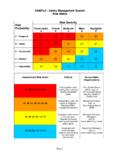
2 Assess Safety Risks .. Control of Safety Risks .. Figure 2: Risk Assessment Matrix.. Figure 3: Safety Risk Management Process .. 12 Safety Management Systemii of iiTHIS IS AN UNCONTROLLED DOCUMENT WHEN DOWNLOADED, COPIED, OR Update 6/11/08 10:366 Safety Assurance and Internal Evaluation General Requirements .. System Description .. Information Acquisition.. Analysis of Data .. System Assessment .. Preventive/Corrective Action Process .. Management Reviews .. Continual Improvement .. Figure 4: Hazard Identification, Safety Assurance, and Internal Evaluation .. 177 Safety Safety Culture .. Communication and Awareness.
3 Personnel Requirements (Competence).. Training .. Safety Lessons Learned .. 188 Integrated Safety Round Organizational Structure and Responsibility .. Meeting Components.. Action Log .. Current Membership .. 21 Safety Management System1 of 21 THIS IS AN UNCONTROLLED DOCUMENT WHEN DOWNLOADED, COPIED, OR Update 6/11/08 10 Safety Management System1 Scope and primary role of the Aviation Safety Department is to promote programs that support operational excellence, prevent accidents and incidents, and manage corporate risk. The Airline Safety Management System (SMS) is proactive, predictive, and data-driven in nature. SMS components include the collection, analysis, and dissemination of Safety information.
4 The purpose of the SMS is to raise Safety awareness throughout the The scope of the Safety Management System is established by the Chief Executive Officer (CEO) for the Airline. It is described, documented, and communicated to employees through the Safety , Policies and Procedures Manual (SPPM 1 [9]). The Aviation Safety Department serves as the primary liaison for implementation of the SMS at the Airline. This document applies to all Aviation Safety personnel and includes all activities, processes, and procedures within the Aviation Safety and ResponsibilityThe Director Aviation Safety has the authority to establish and modify this document. The General Manager Flight Safety has responsibility for the quality of the References[1] federal Aviation Administration (2006).
5 Introduction to Safety Management systems for air operators. Advisory Circular 120-92.[2] Airline. (2007). Aviation Safety Quality Management System .[3] Airline. (2007). Aviation Safety Terms and Definitions. [4] Airline. (2007). Aviation Safety Document Control Process.[5] Airline. (2007). Aviation Safety Control of Records.[6] Airline. (2007). Aviation Safety Reports.[7] Airline. (2007). Aviation Safety Investigations.[8] Airline. (2007). Aviation Safety Data[9] Airline. (2007). 1 Safety Policies and Procedures Management System2 of 21 THIS IS AN UNCONTROLLED DOCUMENT WHEN DOWNLOADED, COPIED, OR Update 6/11/08 10:363 Terms and DefinitionsAll terms and definitions for Aviation Safety are detailed and documented in ASOP [3].
6 4 Safety Management System processes are documented in this section and monitored according to the Aviation Safety Department roles and responsibilities, as detailed in the Aviation Safety Manuals (ASMs). These processes are also measured ASM [6] and analyzed ASM [8]. All SMS outputs are recorded, controlled, and documented according to ASOP [5]. Departmental outputs are recorded according to the Aviation Safety Department scope, documented in the respective ASMs, and retained for specific traceability and The organization promotes a positive Safety culture as detailed in sections and The scope of the Safety Management System is established by the CEO for the Airline.
7 It is described, documented, and communicated to employees through the Safety Policies and Procedures Mission Statement: Aviation Safety supports the Safety -oriented culture of the Airline by identifying threats to the operation, assisting operational divisions in the proactive Management of human error, and conducting Safety PolicyThe Airline is committed to providing our customers with the highest level of product and service quality results derived from a quality System whose foundation lies in a culture of Safety , customer satisfaction, and continuous Providing a safe and secure operation is the first and most fundamental obligation to our customers and employees, as well as to the communities we Consistently meeting customer expectations is both our collective duty and the foundation of our The Airline maintains the highest standard of business conduct and operates in full compliance with all applicable laws and Management System3 of 21 THIS IS AN UNCONTROLLED DOCUMENT WHEN DOWNLOADED, COPIED, OR Update 6/11/08 10 Every Airline leader and employee has an inherent responsibility for an ongoing commitment to quality and to the promotion of a quality Continuous improvement of the quality Management System , including an annual review of quality objectives.
8 Is a required focus of our business As directed by the CEO through the Vice President Corporate Safety , Security, and Compliance (VP CSSC), the Aviation Safety Department coordinates the implementation of the SMS at the Airline. Each participating division has appointed an SMS project leader who represents his or her respective division in facilitating the implementation of the SMS. Aviation Safety has appointed liaisons to coordinate these efforts within each Each participating division will establish an organizational structure that supports the guidance of AC 120-92 [1]. The structure and procedures for the divisional SMS will be documented in the SMS manual for that division.
9 Any deviations or changes to the divisional SMS will be coordinated with the Aviation Safety Department through the divisional SMS project Structure and Senior Leadership Responsibility: The Chief Executive Officer (CEO) is ultimately responsible for the Safety Management System and provides the necessary resources to implement and maintain the program. The CEO has designated the Director of Safety (VP CSSC) to be the member of Management who:A. Ensures that processes needed for the SMS are established, implemented, and Reports to top Management on the performance of the SMS and specific areas in need of Promotes awareness of the SMS throughout the The VP CSSC has designated the Director Aviation Safety as the person responsible for managing the development and implementation of the Safety Management System at the Aviation Safety -related Positions: All aviation Safety -related positions within the Aviation Safety Department are defined, documented, and communicated to employees through the Aviation Safety Quality Manual (ASM [2]).
10 With Legal and Other RequirementsThe Director Aviation Safety ensures that all components of the SMS comply with all Safety -related legal and regulatory requirements. These include, but are not limited to: Safety Management System4 of 21 THIS IS AN UNCONTROLLED DOCUMENT WHEN DOWNLOADED, COPIED, OR Update 6/11/08 10 federal Aviation Regulations and Advisory Circulars [1]. ICAO Regulations (Annex 13). NTSB Regulations (14 CFR 49 Part 830-831). Airline Operations Airline corporate policies and and ControlsThe Aviation Safety Department maintains procedures to accomplish the objectives of the Safety Policy. This document addresses details on the planning and implementation process to support the Safety Management policies and the Aviation Safety Department objectives.