Transcription of 1. Digital capabilities: the 6 elements defined - Jisc Building …
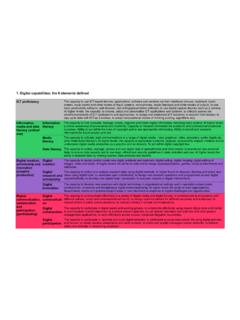
1 1. Digital capabilities : the 6 elements defined ICT proficiency The capacity to use ICT-based devices, applications, software and services via their interfaces (mouse, keyboard, touch screen, voice control etc); to use basic productivity software, web browser, and writing/presentation software; to use Digital capture devices. Ability to identify and use Digital tools to carry out tasks effectively, efficiently, productively, and with attention to quality. At higher levels, the capacity: to choose, adapt and personalise ICT applications and systems; to critically assess the benefits/constraints of ICT applications and approaches; to design and implement ICT solutions; to recover from failures; to stay up to date with ICT as it evolves; to adopt computational modes of thinking. Information, Information The capacity to find, evaluate, manage, curate, organise and share Digital information, including open content. At higher levels media and data literacy a critical awareness of provenance and credibility.
2 Capacity to interpret information for academic and professional/vocational literacy (critical purposes. Ability to apply the rules of copyright and open alternatives creative commons. Ability to reference appropriately use) in different contexts. Ability to record and preserve information for future access and use. Media The capacity to critically read communications in a range of Digital media text, graphical, video, animation, audio, haptic etc. literacy At higher levels, the capacity to appreciate audience, purpose, accessibility, impact, modality and to understand Digital media production as a practice and an industry. Ability to collate and repurpose media giving due recognition to originators. Data literacy The capacity to collate, manage, access and use Digital data in spreadsheets and other media; to record and use personal data; to ensure data security and to use legal, ethical and security guidelines in data collection and use. At higher levels the ability to interpret data by running queries, data analyses and reports, and to share data openly.
3 Digital creation, Digital The capacity to design and/or create new Digital artefacts and materials; Digital writing; Digital imaging; Digital audio and video scholarship and creation production; the Digital editing of images, video and audio. At higher levels the ability to code and to design apps/applications, innovation games, virtual environments and interfaces. (creative Digital The capacity to collect and analyse research data using Digital methods. At higher levels to discover, develop and share new production) research and ideas using Digital tools; to undertake open scholarship; to design new research questions and programmes around Digital scholarship issues/methods; to develop new Digital tools / processes; to evaluate impacts of Digital interventions. Digital The capacity to develop new practices with Digital technology in organisational settings and in specialist subject areas innovation (professional, vocational and disciplinary); Digital entrepreneurship. At higher levels the ability to lead organisations, departments, teams and practice/subject areas in new directions in response to Digital challenges and opportunities.
4 Digital Digital The capacity to communicate effectively in a variety of Digital media and Digital forums; to communicate in accordance with communication, communicati different cultural, social and communicational norms; to design communications for different purposes and audiences; to collaboration on respect others in public communications; to maintain privacy in private communications. and Digital The capacity to participate in Digital teams and working groups; to collaborate effectively using shared Digital tools and media;. participation collaboration to work towards shared objectives; to produce shared materials; to use shared calendars and task lists and other project (participating) management applications; to work effectively across cultural, social and linguistic boundaries. Digital The capacity to participate in, facilitate and build Digital networks; to participate in social and cultural life using Digital services and forums; to create positive connections and build contacts; to share and amplify messages across networks; to behave participation safely and ethically in networked environments.
5 Digital learning and The capacity to identify and participate in Digital learning opportunities; to use Digital learning resources; to participate in personal/professional learning/teaching relationships via Digital media; to use Digital tools (personal or organisational) for learning; to use Digital tools development (learning) to organise, plan and reflect on learning; to record learning events/data and use them for self-analysis, reflection and showcasing of achievement; to undertake self-assessment and participate in other forms of Digital assessment; to manage own time and tasks, attention and motivation to learn in Digital settings (self-regulation). Digital identity Digital The capacity to develop and project a positive Digital identity or identities and to manage Digital reputation (personal or and wellbeing identity organisational) across a range of platforms; to build and maintain Digital profiles; to develop a personal style and values for (self- management Digital participation; to collate and curate personal materials across Digital networks.)
6 Actualising) Digital The capacity to look after personal health, safety, relationships and work-life balance in Digital settings; to use personal Digital wellbeing data for positive wellbeing benefits; to use Digital media to foster community actions and wellbeing; to act safely and responsibly in Digital environments; to manage Digital stress, workload and distraction; to act with concern for the human and natural environment when using Digital tools; to balance Digital with real-world interactions appropriately. Rationale The Jisc '7 elements of Digital literacy' model is well used and recognised (93% recognition from survey April 2015). Most other frameworks and definitions can be fitted comfortably into one or more of the elements as originally defined . However, since it was first devised, two issues have emerged as critical in living, learning and working effectively with technology: data literacy in an age of proliferating personal data, big/deep data and data hacking, and various aspects of 'well-being' (health, safety, work-life balance, relationships, personal safety and privacy) in an increasingly hybridised (real/virtual) environment.
7 Some of the original elements also look a bit dated as Digital practice has moved on and as discourse about Digital literacy has become more nuanced and widely shared. The most significant change is to combine 'information' with 'media' literacies, as feedback suggests that users have difficulty distinguishing between the two. This version has been adapted considerably from an earlier version in response to detailed feedback from 16 stakeholders (over 40 were consulted over the initial version) and broad brush feedback from consultation events, which are ongoing. There was consensus over the need for shared language and an appetite for a shared framework, but one that was mapped carefully to other frameworks such as the SCONUL 7 pillars, CILIP, ANCIL, UK PSF, Vitae Digital lens etc showing how and where these representations add detail to the broader picture. The framework was seen as most useful to: bridge staff and student Digital capabilities ( supporting discussion about and planning for both in departments and services).
8 Plan for embedding Digital capabilities into specific subject areas (for which the 7 elements are already well used). map Digital expertise across different staff roles, by HR in role description or in individual staff review structure professional development Respondents said: '[A] mechanism for having discussions about Digital capabilities within a common framework would add some consistency whilst allowing for flexibility when identifying capabilities or fluency goals for particular roles / disciplines.'. 'It's a useful background document with the potential to expand narrow conceptions! That the majority of the framework is not about technical skills is great as such it could be useful as an enlightenment document :)'. '1. To frame research into existing provision at institutional and national level (primarily of interest to educational technology providers and professionals) 2. To structure professional development and capacity Building at individual/departmental/institutional level (primarily of interest to practitioners and those responsible for staff and organisational development at both strategic and operational level).
9 '. 'Perhaps HR in particular could use this as part of the review process for different performance related elements but also to reconsider what job specifications might be necessary in a Digital age. Some of the other frameworks do a similar job but are perhaps more complex and harder to take in.'. Several experienced respondents suggested that a smaller number of elements would aid recognition and local contextualisation. Separate versions for staff and students were seen as desirable, though with a common underlying structure and elements . There was also interest in whether different levels would need to be applied to the different elements for them to be instituted in a diagnostic or developmental way. The different elements are dealt with in more detail below as there was considerable feedback on each. The six elements There is some confusion about 'ICT proficiency' (fluency, capability, skills, techno-literacy etc) being included as a separate element with the same status as others.
10 ICT proficiency is widely seen as a pre-requisite for or backbone of all the other capabilities and has been removed from some local examples of the 7 elements for this reason. The Beetham and Sharpe development pyramid widely referenced by people surveyed for this project . has 'functional skills' with ICT as the foundation of more complex abilities and practices. This element has been retained but visually it is placed in the centre, overlapping with all the other elements , to indicate its foundational status. After feedback particularly from the library community, and bearing in mind international efforts to combine them ( UNESCO's Media and Information Literacy framework) 'information literacy' and 'media literacy' have been brought into alignment. There remain at least two distinct discourses at play here, one focused on information and/or management (affiliated with librarianship and computer science) and the other on making meaning with/from Digital media (affiliated with communications and media studies).